

The best transactional email API is not the one that appears first in a Google search, and it’s not the one with the most features on a comparison grid. It’s the one whose architecture, operational model, and scaling characteristics match what your team actually needs — today and at the next order of magnitude.
Most “best of” articles rank providers from 1–10 based on criteria the author chose to make their preferred provider win. This guide does something different: it gives you a structured evaluation framework, applies it honestly to nine providers, and explains the trade-offs so your team can make the decision — because the right provider depends on constraints only your team knows.
Engineering Snapshot: Choosing a transactional email API is an infrastructure decision, not a software purchase. The provider you select becomes a dependency in every authentication flow, every billing notification, every security alert your product sends. Evaluate it with the same rigor you’d apply to choosing a database or a cloud provider — because replacing it later carries the same kind of migration cost.
We’ll use the Infrastructure Fit Score throughout this guide: a framework that evaluates providers across eight dimensions — reliability, deliverability, API design, observability, pricing, operational complexity, developer experience, and migration difficulty — weighted differently depending on your team’s stage and constraints. No provider scores highest on all eight. That’s the point.
Table of Contents
- What Makes a Great Transactional Email API?
- Evaluation Criteria Explained
- Quick Comparison Table
- Detailed Provider Reviews
- Feature Comparison Matrix
- Which Provider Fits Your Team?
- Common Mistakes When Choosing
- Migration Checklist
- Frequently Asked Questions
- Final Recommendation
What Makes a Great Transactional Email API?
A great transactional email API is invisible when it’s working and diagnostic when it isn’t. Password resets arrive in seconds. OTPs land in primary inbox, not spam. Billing notifications deliver reliably at month-end volume spikes. And when something goes wrong — a deliverability dip, a provider-side degradation, a sudden bounce rate increase — the system gives you enough signal to diagnose and fix the problem without opening a support ticket.

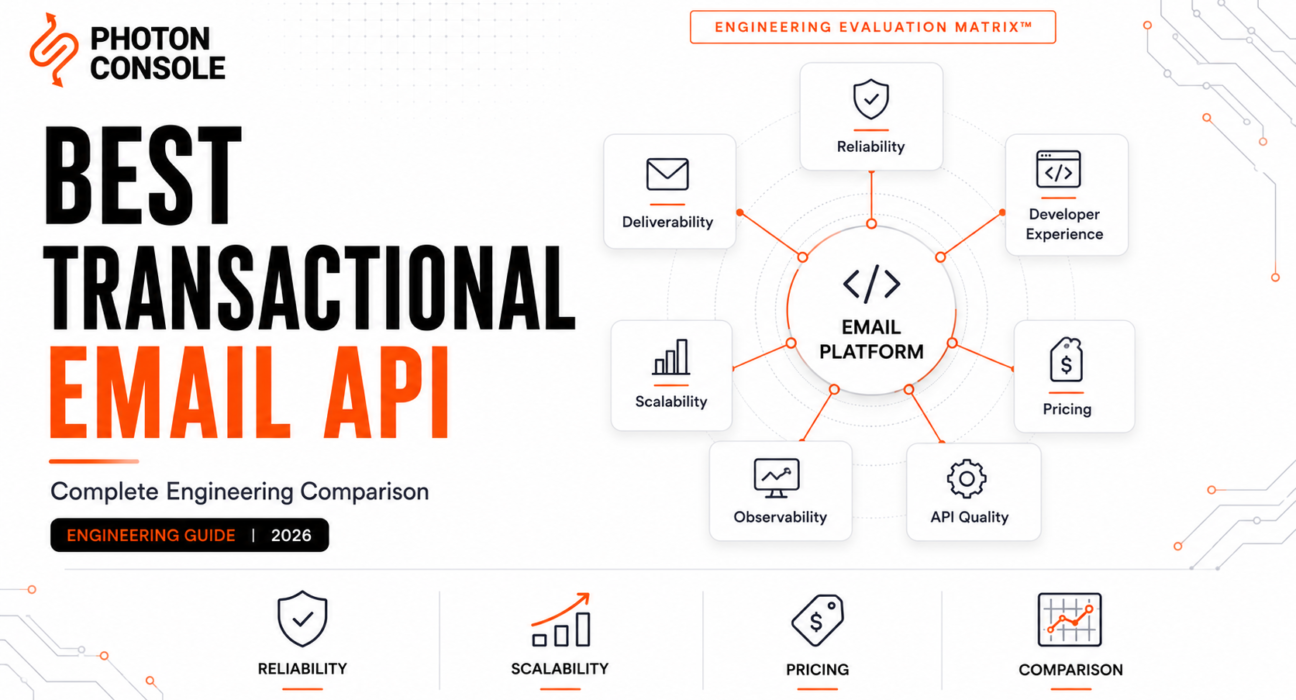
That description rules out most providers for most teams, because no provider excels equally at every dimension. The real question is which dimensions matter most for your specific use case, volume, and operational capacity. The Engineering Evaluation Matrix breaks this into eight dimensions, each evaluated independently:
Table 1: Engineering Evaluation Matrix
| Dimension | What It Measures | Why It Matters |
|---|---|---|
| Reliability | Uptime, incident frequency, queue durability | Email is in the critical path of auth and payments |
| Deliverability | Inbox placement, reputation management, traffic segmentation | Sent ≠ delivered; the gap determines user experience |
| API design | REST quality, error messages, idempotency, rate limit transparency | Determines long-term maintenance cost |
| Observability | Webhooks, delivery diagnostics, SMTP response codes, reputation signals | Can you debug a deliverability incident without opening a ticket? |
| Pricing | Cost model, hidden fees, scaling economics | Total cost ≠ send fee (see our TCO analysis) |
| Operational complexity | How much infrastructure you build around the provider | Determines ongoing engineering investment |
| Developer experience | Docs, SDKs, sandbox, time-to-first-send | Affects integration speed and debugging velocity |
| Migration difficulty | How hard it is to switch away | Lock-in risk; proxy for provider confidence |
Evaluation Criteria Explained
Reliability
Reliability is not the number on the SLA page. It’s the incident history, the transparency of the status page, and what happens to your messages during a partial outage — are they queued durably and delivered after recovery, or can they be lost? Ask for incident history, not SLA percentages.
Deliverability
Deliverability is the gap between “sent” and “reached the inbox.” It’s determined by IP reputation, domain reputation, authentication alignment (SPF, DKIM, DMARC), and whether the provider segments transactional from marketing traffic to protect your sending reputation. The best transactional email API for deliverability is the one that protects your reputation by default, not the one that requires you to manage it manually.
API Design
A well-designed API returns actionable error messages, supports idempotent requests, documents rate limits clearly, and doesn’t require provider-specific knowledge to debug. A poorly designed API returns cryptic errors that send you to the documentation, which sends you to support.
Webhooks and Observability
Webhooks are your only source of truth for what happened after the API accepted a message. Evaluate: which events are supported, are payloads signed, how do retries work, and is there enough diagnostic data to debug a production delivery failure without a support ticket? See our email observability guide for the full framework.
Dedicated IP
Relevant above ~50,000–100,000 emails/month where your volume can sustain an independent sending reputation. Below that, a well-managed shared pool typically outperforms a self-managed dedicated IP. Evaluate whether the provider offers dedicated IPs, at what tier, and whether they assist with IP warming.
Pricing
The send fee is the visible cost. The real cost includes dedicated IP fees, overage rates, team seats, retention add-ons, and the engineering time to operate the provider. Our guide to sending at volume without overpaying covers the economics in depth.
Security and Compliance
At minimum: API key authentication over TLS, signed webhook payloads. For regulated industries: SOC 2, HIPAA/BAA availability, data residency controls, and audit logging. These features typically live on enterprise tiers.
Documentation and Support
Documentation quality predicts long-term maintenance cost. Good docs cover edge cases, not just happy paths. Good support means you can resolve a deliverability incident without waiting 48 hours for a reply.
Quick Comparison: Best Transactional Email API Providers in 2026
Table 2: Provider Quick Comparison
| Provider | Primary Strength | Primary Trade-off | Best For |
|---|---|---|---|
| PhotonConsole | Pay-per-use simplicity, SMTP relay focus | Smaller ecosystem vs established players | Growing SaaS, cost-conscious teams |
| Amazon SES | Lowest per-message cost at any volume | Requires significant self-managed infrastructure | Engineering-heavy teams on AWS |
| Postmark | Transactional-only focus, top deliverability | Premium pricing, no marketing email | Teams where inbox placement is critical |
| SendGrid | Ecosystem breadth, Twilio integration | Complexity, variable support quality | Teams needing marketing + transactional |
| Mailgun | Flexible API, strong developer tools | Deliverability variability post-acquisition | Developer-focused teams |
| SMTP2GO | Straightforward setup, good support | Fewer advanced infrastructure controls | Small teams wanting simplicity |
| Resend | Modern DX, React Email integration | Younger platform, limited infrastructure features | Frontend-heavy teams, early-stage |
| Brevo | All-in-one marketing + transactional | Transactional is not primary focus | Teams wanting one platform for everything |
| SparkPost | High-volume analytics, predictive tools | Enterprise-oriented pricing | High-volume enterprise senders |
Table 3: Pricing Overview
| Provider | Pricing Model | Starting Price | Free Tier | Dedicated IP |
|---|---|---|---|---|
| PhotonConsole | Pay-per-email | Pay-as-you-go | Yes (limited) | Available |
| Amazon SES | Pay-per-email | $0.10/1,000 | 3,000/mo (12 months) | $24.95/mo per IP |
| Postmark | Base + overage | $15/mo (10k) | 100/mo | $50/mo (Pro+) |
| SendGrid | Tiered subscription | $19.95/mo (50k) | 60-day trial | Included on Pro ($89.95/mo) |
| Mailgun | Tiered subscription | ~$35/mo (50k) | Limited trial | Scale tier (~$90/mo) |
| SMTP2GO | Tiered subscription | $10/mo (10k) | 1,000/mo | Higher tiers |
| Resend | Tiered subscription | $20/mo (50k) | 3,000/mo | Not available |
| Brevo | Daily send limits | ~$9–25/mo | 300/day | Add-on (~$12/mo) |
| SparkPost | Enterprise | Contact sales | Limited test | Managed pools |
All pricing is approximate and based on publicly available information as of mid-2026. Verify directly with each provider. Sources: SendGrid, Postmark, Amazon SES, Mailgun, SMTP2GO, Resend, Brevo.
Detailed Provider Reviews
PhotonConsole
Overview: A cloud-based SMTP relay and email delivery service with pay-per-use pricing and no monthly minimums. Positioned for developers and growing SaaS teams who want managed transactional email without subscription-tier friction.
Strengths: Pay-as-you-go model avoids wasted spend at variable volumes. Supports both HTTP API and SMTP relay. Signed webhooks, delivery logs, and straightforward SMTP configuration.
Limitations: Smaller ecosystem and brand recognition compared to SendGrid or Amazon SES. Teams needing deep third-party integrations or enterprise-grade subaccount management may find the feature surface thinner than larger providers.
Best for: Growing SaaS teams, cost-conscious startups, and teams migrating from unreliable SMTP setups who want a managed relay without committing to subscription tiers.
Migration difficulty: Low — standard SMTP/API interface, no proprietary lock-in.
Amazon SES
Overview: AWS’s email sending service. Lowest per-message cost in the market ($0.10/1,000), but requires significant engineering investment to operate in production — bounce handling, webhook assembly (via SNS), suppression management, and reputation monitoring are all your team’s responsibility.
Strengths: Unmatched cost at high volume. Native AWS ecosystem integration. Managed dedicated IPs with automated warm-up available.
Limitations: No built-in deliverability dashboard. Webhook events require assembling an SNS → SQS → processing pipeline. Sandbox restrictions on new accounts can delay launch. Support quality depends on your AWS support tier. See our SES alternatives comparison for a deeper analysis.
Best for: Engineering-heavy teams already on AWS who have (or will build) the operational capacity to manage email infrastructure as a distinct system.
Migration difficulty: Medium — standard SMTP/API, but the self-managed infrastructure around SES (queues, webhook processing, monitoring) doesn’t transfer.
Postmark
Overview: Transactional-only email service with an explicit focus on deliverability and speed. No marketing email allowed — a deliberate constraint that protects transactional sending reputation.
Strengths: Industry-leading deliverability for transactional mail. Clean API, well-documented webhooks, message stream separation for traffic segmentation. Sub-2-second delivery to major providers. See our Postmark alternatives guide for detailed comparison.
Limitations: No marketing email — teams that need both need a second provider. Premium pricing, especially at higher volumes with overages. Limited free tier (100 emails/month).
Best for: Teams where transactional email speed and inbox placement are critical (OTP, password reset, security alerts) and who are willing to pay a premium for deliverability assurance.
Migration difficulty: Low — clean API, no proprietary dependencies.
SendGrid
Overview: Market incumbent owned by Twilio. Broadest ecosystem of integrations, supports both transactional and marketing email, extensive documentation.
Strengths: Ecosystem breadth. Twilio integration for multi-channel. Subuser and IP pool management for traffic segmentation. Dedicated IP included on Pro tier. See our SendGrid alternatives guide and SendGrid vs Mailgun comparison.
Limitations: Complex tier structure. Support quality at non-enterprise tiers has drawn consistent criticism. Free tier replaced by 60-day trial. Mixing marketing and transactional on the same plan requires careful segmentation.
Best for: Teams needing a single platform for both marketing and transactional email, or already in the Twilio ecosystem.
Migration difficulty: Low-Medium — standard APIs, but SendGrid-specific template systems and subuser configurations require rebuild.
Mailgun
Overview: Developer-focused email API owned by Sinch. Strong API documentation, flexible routing rules, and email validation tooling.
Strengths: API quality and flexibility. Routing rules for complex email workflows. HMAC-signed webhooks. Email validation as a built-in feature. See our Mailgun alternatives guide.
Limitations: Deliverability reputation has been variable during ownership transitions. Support quality inconsistent in user reports. Higher entry price than some competitors ($35/mo for Foundation tier).
Best for: Developer teams that value API flexibility and routing control, and are comfortable monitoring deliverability independently.
Migration difficulty: Low — standard REST/SMTP interface.
SMTP2GO
Overview: Straightforward SMTP relay service with a reputation for good support and simple setup. See our SMTP2GO alternatives comparison.
Strengths: Fast setup, transparent pricing ($10/mo entry), 24/7 support, permanent free tier. Good fit for teams that want reliability without complexity.
Limitations: Fewer advanced infrastructure controls (limited traffic segmentation, basic analytics). Feature surface thinner than SendGrid or SparkPost at enterprise scale.
Best for: Small teams, agencies, and applications that need reliable email delivery without building complex infrastructure around it.
Migration difficulty: Low.
Resend
Overview: Modern developer-experience-first email API with React Email integration and TypeScript-first SDK.
Strengths: Cleanest developer experience in the comparison. React Email for template development. Generous free tier (3,000/mo). Svix-based signed webhooks.
Limitations: Younger platform with less production track record at enterprise scale. No dedicated IPs. No SMTP relay (API only). Limited traffic segmentation.
Best for: Early-stage products, frontend-heavy engineering teams, and developers who prioritize DX over infrastructure feature depth.
Migration difficulty: Low — standard REST API.
Brevo
Overview: All-in-one marketing platform (formerly Sendinblue) that includes transactional email alongside CRM, SMS, and automation.
Strengths: Single platform for marketing + transactional. Generous free tier (300 emails/day). SMS integration. Competitive pricing.
Limitations: Transactional email is not Brevo’s primary focus — teams with demanding deliverability or observability requirements may find the transactional side thinner than dedicated providers. Daily send limits (not monthly) can be restrictive for spiky traffic. Shared infrastructure between marketing and transactional traffic can affect deliverability.
Best for: Teams wanting marketing + transactional in one platform where transactional delivery speed is not time-critical.
Migration difficulty: Low-Medium.
SparkPost
Overview: Enterprise-oriented email delivery platform (now part of Bird) with sophisticated analytics and predictive deliverability tools. See our SparkPost alternatives comparison.
Strengths: Deep analytics and reporting. Predictive deliverability tools. Managed IP pools with sophisticated rotation. Extensive webhook event taxonomy. Built for high-volume senders.
Limitations: Enterprise-oriented pricing and onboarding. Less suited for small-scale senders. Feature depth can feel over-scoped for teams sending under 100k/month.
Best for: High-volume enterprise senders who need sophisticated analytics, deliverability optimization, and managed IP infrastructure.
Migration difficulty: Medium — some SparkPost-specific features (signals, engagement tracking) don’t transfer directly.
Feature Comparison Matrix
Table 4: API and Infrastructure Features
| Feature | PhotonConsole | SES | Postmark | SendGrid | Mailgun | SMTP2GO | Resend | Brevo | SparkPost |
|---|---|---|---|---|---|---|---|---|---|
| REST API | Yes | Yes | Yes | Yes | Yes | Yes | Yes | Yes | Yes |
| SMTP relay | Yes | Yes | Yes | Yes | Yes | Yes | No | Yes | Yes |
| Signed webhooks | Yes | SNS sig | Yes | Yes | HMAC | Yes | Svix | Limited | Yes |
| Dedicated IP | Yes | Yes | Pro+ | Pro+ | Scale | Higher tiers | No | Add-on | Yes |
| Traffic segmentation | Account | Config sets | Streams | Subuser/pool | Domain | Limited | Limited | Limited | Subaccount |
| Inbound email | No | Yes | Yes | Yes | Yes | No | No | No | Yes |
| Templates | Basic | SES templates | Yes | Yes | Yes | Yes | React Email | Yes | Yes |
Table 5: Developer Experience Comparison
| Dimension | PhotonConsole | SES | Postmark | SendGrid | Mailgun | SMTP2GO | Resend | Brevo | SparkPost |
|---|---|---|---|---|---|---|---|---|---|
| Time to first send | Minutes | Hours (sandbox) | Minutes | Minutes | Minutes | Minutes | Minutes | Minutes | Hours |
| Error message quality | Good | AWS-standard | Excellent | Good | Good | Good | Good | Adequate | Good |
| Documentation depth | Good | Extensive | Excellent | Extensive | Good | Good | Good | Adequate | Good |
| Sandbox/test mode | Yes | Sandbox by default | Yes | Yes | Yes | Yes | Yes | Yes | Yes |
Table 6: Operational Complexity Scale
| Provider | Integration Effort | Ongoing Ops Overhead | Self-Build Required | Complexity Rating |
|---|---|---|---|---|
| PhotonConsole | Low | Low | Minimal | Low |
| Amazon SES | Medium-High | High | Substantial (bounce handling, webhooks, monitoring) | High |
| Postmark | Low | Low | Minimal | Low |
| SendGrid | Low-Medium | Medium | Some (tier management, subuser config) | Medium |
| Mailgun | Low | Medium | Some (deliverability monitoring) | Medium |
| SMTP2GO | Low | Low | Minimal | Low |
| Resend | Low | Low | Minimal | Low |
| Brevo | Low | Low-Medium | Some (traffic isolation if needed) | Low-Medium |
| SparkPost | Medium | Medium | Some (analytics integration) | Medium |
Table 7: Migration Difficulty Index
| Provider | API Portability | DNS Changes Required | IP Warm-Up Needed | Migration Difficulty |
|---|---|---|---|---|
| PhotonConsole | Standard SMTP/API | SPF/DKIM/DMARC update | If moving to dedicated IP | Low |
| Amazon SES | Standard + AWS-specific config | Yes | Yes (managed option available) | Medium |
| Postmark | Standard REST | Yes | Auto-managed | Low |
| SendGrid | Standard + subuser rebuild | Yes | If changing IP | Low-Medium |
| Mailgun | Standard REST/SMTP | Yes | If changing IP | Low |
| SMTP2GO | Standard SMTP | Yes | If changing IP | Low |
| Resend | Standard REST (no SMTP) | Yes | Shared pools | Low |
| Brevo | Standard SMTP/API | Yes | If changing IP | Low-Medium |
| SparkPost | Standard + SparkPost-specific features | Yes | Yes | Medium |
Which Provider Fits Your Team?
The best transactional email API for your team depends on constraints only you know: volume, budget, engineering capacity, compliance requirements, and how much operational overhead you’re willing to absorb. This table maps common team profiles to provider archetypes.
Table 8: Provider Fit by Team Profile
| Team Profile | Primary Constraint | Providers Worth Evaluating |
|---|---|---|
| Early-stage startup (<2 engineers) | Integration speed, minimal ops | PhotonConsole, Resend, Postmark |
| Growing SaaS (5–20 engineers) | Scaling without friction, cost predictability | PhotonConsole, SendGrid, Mailgun, SMTP2GO |
| Enterprise / regulated industry | Compliance, audit trails, dedicated infrastructure | SendGrid, SparkPost, Amazon SES |
| High-volume sender (1M+ emails/mo) | Cost at scale, infrastructure control | Amazon SES, SparkPost |
| Marketing + transactional combined | Single platform | Brevo, SendGrid |
| Developer tools / API-first product | Developer experience, modern DX | Resend, Postmark, Mailgun |
Table 9: Best Provider by Use Case
| Use Case | Top Priority | Best Fit Providers |
|---|---|---|
| Password reset / OTP | Speed, inbox placement | Postmark, PhotonConsole |
| E-commerce order updates | Reliability, traffic segmentation | SendGrid, Postmark, SMTP2GO |
| Fintech / banking alerts | Compliance, dedicated IP, audit | SendGrid, SparkPost, Amazon SES |
| Healthcare reminders | HIPAA/BAA, reliability | SendGrid (enterprise), SparkPost |
| Marketplace notifications | Volume, segmentation | SendGrid, SparkPost, Amazon SES |
| AI SaaS / developer tool | Modern DX, quick integration | Resend, Postmark, PhotonConsole |
| Internal SaaS / enterprise | Security, dedicated infrastructure | Amazon SES, SendGrid |
Common Mistakes When Choosing a Transactional Email API
- Choosing on price alone. Amazon SES is cheapest by send fee. It’s often the most expensive by total cost when engineering time is included. See our SES alternatives analysis for the full breakdown.
- Ignoring webhook quality during evaluation. Most proof-of-concept integrations test sending. The observability path — webhook events, diagnostic data, delivery confirmation — is what you live with daily in production.
- Assuming all transactional deliverability is equal. Providers that mix transactional and marketing traffic without strict segmentation expose your password resets to reputation risk from promotional campaigns.
- Evaluating DX on documentation alone. The real test is debugging a failure that only appears in production.
- Not testing the migration path before committing. Try the off-boarding experience before the on-boarding experience. A provider that makes leaving painful is betting on lock-in.
- Skipping the pre-launch infrastructure checklist. Authentication, DNS, monitoring, and SMTP monitoring tooling need to be in place before production volume, not after.
Migration Checklist
Table 10: Migration Checklist
| Step | Action | Why It Matters |
|---|---|---|
| 1 | Build an internal email service abstraction | Decouples application code from any specific provider |
| 2 | Audit and clean recipient lists before migration | Stale addresses cause bounce spikes on a new IP |
| 3 | Configure SPF, DKIM, DMARC on the new provider | Authentication must be validated before any volume moves |
| 4 | Plan and execute an IP warm-up schedule | A cold IP will get throttled or filtered |
| 5 | Run old and new providers in parallel during transition | Validates the new path without risking full traffic |
| 6 | Instrument monitoring and alerting before cutover | Catch issues during migration, not after |
| 7 | Migrate webhook endpoints and normalize event schemas | Delivery event data must continue flowing uninterrupted |
| 8 | Document a rollback plan | If the new provider underperforms, you need a path back |
Frequently Asked Questions
What is the best transactional email API for startups?
For early-stage teams prioritizing speed and simplicity: Resend, Postmark, or PhotonConsole. Resend has the most modern developer experience. Postmark has the strongest deliverability for transactional-only sending. PhotonConsole offers pay-per-use flexibility without subscription tiers.
Is Amazon SES the cheapest option?
By per-message send fee, yes ($0.10/1,000). By total cost of ownership, often no — SES requires building and maintaining bounce handling, webhook processing, and monitoring infrastructure that managed providers include. See our TCO analysis.
Should I use the same provider for marketing and transactional email?
Generally no. Transactional and marketing email have different engagement profiles, and mixing them on the same infrastructure without strict segmentation risks degrading deliverability for your transactional messages. If you must use one provider for both, ensure it offers traffic segmentation (separate IPs, message streams, or subaccounts).
How do I evaluate deliverability before committing?
Ask how the provider segments transactional from marketing traffic, how shared IP pools are monitored for abuse, and what diagnostic data is available when messages land in spam. A sandbox test doesn’t reveal deliverability quality — use free tiers and trial periods with real sending at real volume.
Can I switch email API providers later?
Yes, but it carries deliverability risk. IP-level reputation resets entirely on a new provider. Domain-level reputation transfers partially if the sending domain stays constant. Plan for a warm-up period and run providers in parallel during transition.
What’s the most important criterion most teams overlook?
Webhook quality and observability depth. Most teams evaluate the sending path thoroughly and barely test the feedback path — which is the one they rely on daily for monitoring, debugging, and suppression.
Final Recommendation
There is no single best transactional email API for every team. There is the right provider for your specific architecture, volume, operational maturity, and growth trajectory. The Infrastructure Fit Score framework in this guide gives you the dimensions to evaluate; Tables 8 and 9 give you the mapping from constraints to providers; and the detailed reviews give you the trade-offs for each.
If you’re choosing for the first time: start with the provider that fits your current stage (Table 8), build an internal email service abstraction from day one (so migration is always possible), and instrument email observability and monitoring before you need them, not after a deliverability incident forces you to.
If you’re switching: follow the migration checklist (Table 10), plan for a warm-up period, and never hard-cutover under deadline pressure. The best time to migrate is when you don’t have to — not during the outage that proved you should have.
Related Reading
- Email API Integration
- Email Observability Explained
- Email IP Warming Explained
- Dedicated IP vs Shared IP
- Queue Architecture Explained
- SMTP Retry Logic
- Transactional Email Latency
- Reducing Email Bounce Rate
- Sending 100K Emails Without Overpaying
- Transactional Email Service
- 8 Critical Criteria for Choosing an SMTP Relay