

Every engineering team eventually hits the same Slack thread: someone read that dedicated IPs are “more professional,” someone else read that shared IPs are “safer for low volume,” and nobody has enough information to make the call with confidence. The thread usually ends with a decision made on vibes, not evidence.
The vibes-based decision is the problem. IP allocation is an infrastructure choice with real operational consequences, and most of the content written about it treats it as a feature comparison instead of a systems question.
This guide treats it as a systems question.
Engineering Snapshot: A cold dedicated IP with zero sending history is, from an ISP’s perspective, functionally worse than an established shared IP pool. Reputation is accumulated, not assigned. A brand-new /32 has no track record — which is a liability, not a feature — until it earns one, typically over 4 to 8 weeks of disciplined warm-up.
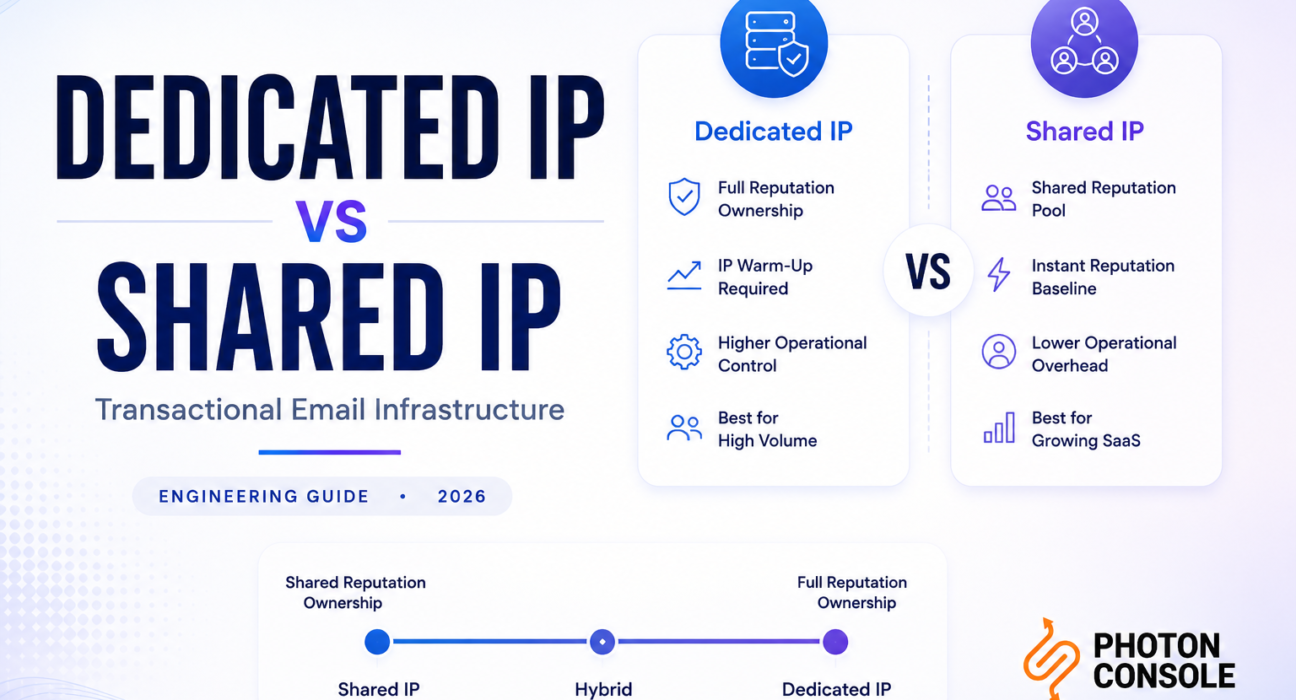
The question engineering teams actually need answered is not “dedicated or shared.” It is: who is best positioned to own and defend sender reputation for this specific sending pattern, at this specific volume, with this specific team’s operational bandwidth? That’s the frame this article uses throughout. We’ll call it the Reputation Ownership Curve — the idea that IP strategy is really a decision about who carries the operational burden of reputation, and that the correct owner changes as a product scales. We’ll return to it repeatedly.

What Is a Shared IP?
A shared IP is a sending address used by multiple customers of an SMTP relay service simultaneously. Your transactional mail — password resets, OTPs, receipts — leaves the same IP address as mail from dozens or hundreds of other senders on the same provider.
This sounds risky to engineers who haven’t worked in deliverability before. It usually isn’t. Reputable providers actively manage shared pools: they monitor complaint rates, isolate abusive senders, and maintain aggregate sending quality across the pool. You inherit the pool’s reputation, for better or worse, but a well-run pool’s reputation is typically better than what a brand-new sender could build alone in month one.
Shared IPs are the default allocation model for almost every SMTP relay provider’s entry and mid tiers, including most SMTP relay services evaluated for early-stage products.
What Is a Dedicated IP?
A dedicated IP is an address allocated exclusively to one sender. No pooling, no shared history, no exposure to another customer’s mistakes. Your sending behavior — and only your sending behavior — determines the reputation attached to that address.
This is the appeal: full control, no noisy neighbors, and a reputation that’s entirely a function of your own practices. It’s also the risk: full control, no noisy neighbors, and a reputation that’s entirely a function of your own practices. Dedicated IPs remove variance in both directions.
A dedicated IP with poor list hygiene and inconsistent volume is not automatically better than a well-managed shared pool. It’s just a different risk profile — one that requires more from the team operating it.
How Sender Reputation Actually Works
Most explanations of sender reputation stop at “send good email and don’t get marked as spam.” That’s true but useless operationally. Reputation is built from a small number of measurable signals that ISPs track continuously:
- Complaint rate — the percentage of recipients hitting “report spam.” Anything consistently above 0.1% is a warning sign to major mailbox providers.
- Bounce rate, particularly hard bounces, which signal poor list hygiene or invalid addressing.
- Spam trap hits — sending to addresses specifically planted to catch senders with stale or purchased lists.
- Engagement signals — opens, clicks, and for transactional mail specifically, whether recipients expect and act on the message (an OTP that’s opened within 60 seconds is a strong positive signal; a password reset ignored for three weeks is neutral-to-negative).
- Volume consistency — sudden spikes without a warm-up history are treated as suspicious by default, because that’s the exact signature of a compromised sending account.
- Authentication alignment — whether SPF, DKIM, and DMARC are correctly configured and aligned with the sending domain.
None of these signals care whether the IP is shared or dedicated. They care about behavior. IP strategy only matters because it determines whose behavior is being measured, and how quickly bad behavior from one source can be isolated from good behavior from another.
How ISPs Evaluate Reputation
Gmail, Outlook/Microsoft 365, and Yahoo each run their own reputation models, but the mechanics converge on a similar pattern: domain reputation and IP reputation are evaluated together, with domain reputation increasingly weighted more heavily as authentication (DKIM/DMARC alignment) has become standard. Google’s guidance for bulk senders is explicit about authentication and complaint-rate thresholds, and Yahoo’s sender requirements follow a similar structure. This matters for the dedicated-vs-shared decision because domain reputation partially decouples the outcome from IP choice. A sender with excellent domain-level signals (consistent DMARC alignment, low complaint rates, engaged recipients) can survive IP-level noise that would sink a sender with weak domain hygiene, regardless of whether that IP is shared or dedicated.
This is why emails landing in spam at Gmail specifically is so often a domain-authentication problem being misdiagnosed as an IP problem.
Table 1: Reputation Signal Weighting by Mailbox Provider (Directional)
| Signal | Gmail | Outlook/Microsoft 365 | Yahoo |
|---|---|---|---|
| Domain (DMARC) alignment | High | High | High |
| IP reputation (shared pool) | Medium | Medium-High | Medium |
| IP reputation (dedicated) | Medium-High | High | Medium-High |
| Complaint rate threshold sensitivity | Very High | High | High |
| Engagement-based filtering | Very High | Medium | Medium |
Outlook has historically weighted IP-level reputation more heavily than Gmail, which is part of why dedicated IP migrations sometimes produce visibly different results across providers in the same send.
Why Shared IPs Are Often Better for Small SaaS Products
This is the section most vendor content skips, because shared IPs don’t sell upgrades. But the engineering case is straightforward.
A new product sending 5,000–50,000 transactional emails a month does not have enough volume to build a statistically meaningful reputation of its own in a reasonable timeframe. Reputation models need consistent signal over weeks. Low, irregular volume on a dedicated IP looks — to an ISP — indistinguishable from a low-and-slow spam operation testing the waters. A shared pool with established, high-volume history gives that same sender instant access to a reputation baseline it could not build alone for months.
There’s also an operational cost most teams underestimate: a dedicated IP is not “set and forget.” It requires monitoring, warm-up discipline, and someone accountable for noticing degradation before it becomes a delivery incident. For a two-person engineering team also shipping product, that’s a real cost, not a nice-to-have.
Engineering Snapshot: Providers generally don’t recommend dedicated IPs below roughly 50,000–100,000 emails a month sustained, specifically because there isn’t enough volume to keep a reputation model confidently calibrated. Below that threshold, a shared pool almost always outperforms a self-managed dedicated IP.
When Dedicated IPs Become Essential
The calculus flips at scale, and for a specific set of reasons — not simply “you got bigger.”
- Sustained high volume where your sending pattern is large enough to constitute its own reliable statistical signal (typically hundreds of thousands to millions of emails per month).
- Compliance or enterprise requirements — some enterprise customers or regulated industries require sending isolation for audit and control reasons that have nothing to do with deliverability performance.
- Reputation isolation — when transactional and any bulk/marketing traffic need to be strictly separated so one traffic type’s mistakes cannot affect the other. This is less “dedicated vs shared” and more traffic segmentation, which we cover below.
- Predictable, high-frequency sending where the operational maturity exists to actually monitor and defend the IP’s reputation continuously.
Notice what’s absent from this list: “it looks more professional.” That’s marketing language, not an engineering justification, and it’s the single most common bad reason teams migrate prematurely.
The Hidden Cost of Dedicated IPs
The advertised cost of a dedicated IP is a line item. The real cost is operational:
- Warm-up time — typically 4–8 weeks of deliberately ramped volume before the IP can be trusted with full production traffic.
- Monitoring overhead — someone needs to watch SMTP response codes, bounce patterns, and complaint feedback loops continuously, not occasionally.
- Single point of failure risk — one bad campaign, one compromised API key sending unexpected volume, or one poorly deduplicated list can damage a reputation that took two months to build, with no pool to absorb the impact.
- No inherited baseline — every migration or new dedicated IP starts back at zero, regardless of how good your domain reputation was on the previous setup.
This is the trade a team is actually making: they’re trading the shared pool’s statistical insulation for full control, and full control requires full accountability. Teams that adopt dedicated IPs without accepting the monitoring cost tend to end up worse off than they were on a shared pool — a pattern deliverability consultants see constantly and vendor marketing rarely mentions.
IP Warming Explained
IP warming is the deliberate, gradual increase of sending volume on a new IP to build reputation without triggering spam-filtering heuristics tuned to detect sudden volume spikes. There is no universal schedule, but the shape is consistent: start small, increase gradually, and prioritize your most engaged recipients first.
We call the shape of this process the Warm-Up Confidence Curve — reputation systems don’t grant trust linearly with volume; trust compounds slowly at first, accelerates once a consistent pattern is established, and then plateaus once the IP has enough history to be treated as a known quantity rather than a new unknown.
Table 2: Illustrative Warm-Up Timeline
| Week | Daily Volume Target | Priority Recipients | Monitoring Focus |
|---|---|---|---|
| 1 | 50–500 | Most engaged / recently active users | Bounce rate, spam trap hits |
| 2 | 500–2,000 | Engaged users, expand slightly | Complaint rate trend |
| 3–4 | 2,000–10,000 | Broader active base | Inbox placement sampling |
| 5–6 | 10,000–50,000 | Full active base | Provider-specific feedback loops |
| 7–8 | Full production volume | All recipients | Steady-state reputation confirmation |
Skipping stages — a common failure mode when teams are under launch pressure — is the single most reliable way to sabotage a dedicated IP before it has a chance to prove itself.
Common Deliverability Mistakes
- Mixing transactional and marketing traffic on the same IP or domain, letting one traffic type’s engagement problems drag down the other.
- Migrating to a dedicated IP without a warm-up plan because a launch deadline made “just switch it” feel faster.
- Treating delivery failures as a code problem first and a reputation problem never, which delays root-cause diagnosis.
- Ignoring retry logic that silently retries against a degraded IP instead of alerting a human.
- Not separating reputation monitoring from uptime monitoring — an IP can be “up” and still deliverability-dead.
Shared IP Failure Scenarios
Scenario: Noisy neighbor abuse. Another sender on the same shared pool starts sending to a purchased list and hits several spam traps within days. If the provider’s pool isolation is weak, complaint rates for the whole pool tick upward, and your OTP delivery times to Outlook quietly increase from seconds to minutes — with nothing in your own configuration having changed.
Root cause and lesson: pool quality is a vendor-management problem, not something you can engineer around from your side. This is why evaluating an SMTP relay provider’s abuse-handling practices matters as much as evaluating price.
Scenario: Sudden traffic spike mistaken for the pool’s baseline. A billing run sends 40,000 invoice emails in an hour instead of the usual trickle. On a well-managed shared pool this is usually absorbed without incident, because the pool’s aggregate volume dwarfs the spike. On a smaller or lower-quality pool, it can trip volume-anomaly heuristics anyway.
Dedicated IP Failure Scenarios
Scenario: Cold dedicated IP deployment under launch pressure. A team provisions a dedicated IP the week of a big product launch and sends full onboarding volume from day one, no warm-up. Gmail and Outlook both throttle heavily; some mail is deferred for hours; some silently lands in spam. The team spends the launch week firefighting instead of watching signups.
Root cause and lesson: the IP had no history to justify the volume. This is the single most common dedicated-IP failure, and it is entirely avoidable with a warm-up plan started weeks before launch, not the week of.
Scenario: Poor list hygiene on a low-volume dedicated IP. A team migrates from shared to dedicated at moderate volume without cleaning bounced or invalid addresses first. Hard bounce rate creeps above 5%. With no pool to dilute the signal, the dedicated IP’s reputation degrades measurably within two weeks, and bounce rate becomes the whole story of that quarter’s deliverability.
Production Scenarios: Root Causes and Operational Lessons
Abstract deliverability advice is easy to nod along to and hard to apply. These are the patterns that actually show up in production, mapped to the IP strategy decisions behind them.
OTP delivery under 60-second SLA. A fintech product needs one-time-passcodes delivered in under a minute for login to feel usable. On a shared pool, this is achievable as long as the pool’s queue isn’t backed up by another sender’s bulk campaign. On a dedicated IP, it’s achievable as long as the IP is warm and the sending domain’s authentication is clean — but a cold or under-warmed dedicated IP will get deferred or rate-limited by Outlook specifically, turning a 60-second SLA into a 10-minute one during exactly the launch week the team can least afford it. Lesson: OTP traffic is the least forgiving traffic type for warm-up shortcuts, because latency itself is the product experience, not just a deliverability metric.
Invoice and billing notifications at monthly cadence. Weekly or monthly billing runs create a sawtooth volume pattern — near zero most days, a spike on billing day. This pattern alone can look anomalous to reputation systems that expect steady volume, regardless of IP model. Teams on shared pools benefit from the pool smoothing this out. Teams on dedicated IPs need to either spread billing sends across a longer window or explicitly account for the spike in their warm-up and monitoring plan. Lesson: predictable-but-spiky traffic needs deliberate volume-shaping, not just a good IP.
High-volume SaaS onboarding after a marketing push. A product gets featured somewhere and signups triple overnight. Onboarding emails (welcome, verification, first-run guidance) triple with them. On a shared pool with high aggregate baseline volume, this is usually invisible. On a dedicated IP mid-warm-up, this is the single most common way teams accidentally blow through their own warm-up schedule and trigger throttling at exactly the moment they need deliverability most. Lesson: warm-up plans need a contingency branch for unplanned growth, not just the happy-path ramp in Table 2.
Marketing traffic accidentally mixed with transactional. A growth team adds a “product update” campaign to the same sending domain and IP used for password resets, reasoning that it’s “just one email.” Complaint rates on the campaign are unremarkable by marketing standards (0.08%) but represent a meaningful reputation hit when blended with transactional traffic’s normally near-zero complaint rate. Lesson: the mixing itself is the failure, independent of the campaign’s individual quality — this is the strongest practical argument for the segmentation strategies covered next.
Shared IP abuse by another sender. Covered above as a shared-pool failure scenario, but worth restating as a production pattern: the symptom (rising deferral rates, slower OTP delivery) is often diagnosed internally as “our code broke” before anyone checks whether the shared pool’s aggregate reputation moved. Lesson: deliverability monitoring needs to be pool-aware, not just endpoint-aware — a healthy-looking API response doesn’t mean the message reached the inbox.
Poorly warmed cold dedicated IP. Already covered above, and worth the repetition: this is, by a wide margin, the most common dedicated-IP failure mode teams report, and it is entirely self-inflicted. Every other failure scenario in this article has some external component. This one doesn’t.
Multi-IP Strategies
The dedicated-vs-shared framing implies a binary choice. Mature sending infrastructure is rarely binary. Common patterns at scale:
- Traffic-type segmentation — dedicated IP for transactional mail, separate pool or dedicated IP for marketing, so engagement differences between the two don’t cross-contaminate reputation.
- Tiered dedicated IPs — separate IPs for high-priority transactional mail (password resets, security alerts) versus lower-priority notifications, isolating blast radius if one category has a bad week.
- Hybrid shared-then-dedicated — new products launch on shared pools and graduate specific traffic categories to dedicated IPs only once volume and operational maturity justify it.
This is where the Infrastructure Ownership Spectrum becomes a useful mental model: IP strategy isn’t a single decision made once, it’s a position on a spectrum from “fully outsourced reputation” (shared pool) to “fully owned reputation” (dedicated, self-monitored), and most mature systems sit at different points on that spectrum for different traffic types simultaneously.
How Large SaaS Companies Handle Email Reputation
At scale, the pattern converges: transactional and marketing traffic are strictly separated onto different sending domains and IP strategies, dedicated IPs are used where volume and monitoring capacity justify them, and reputation health is treated as a continuously monitored production metric with the same seriousness as latency or error rate — not a one-time setup task.
This is also where queue architecture and IP strategy intersect: large-scale senders design their sending queues to be reputation-aware, throttling or rerouting traffic away from a degrading IP automatically rather than relying on someone to notice a dashboard.
Table 3: Operational Complexity by Sending Strategy
| Strategy | Setup Complexity | Ongoing Monitoring Load | Failure Blast Radius |
|---|---|---|---|
| Shared pool (single provider) | Low | Low | Shared across pool |
| Single dedicated IP | Medium | Medium-High | Fully isolated to sender |
| Segmented dedicated IPs | High | High | Isolated per traffic type |
| Hybrid (shared + dedicated) | Medium-High | Medium-High | Partially isolated |
Table 4: Ideal Team Size / Maturity vs Strategy
| Team Stage | Recommended Strategy | Rationale |
|---|---|---|
| Pre-seed / early MVP | Shared pool | No volume to justify dedicated reputation-building |
| Seed / early growth (<100k emails/mo) | Shared pool, monitor closely | Reputation baseline more valuable than control |
| Growth stage (100k–1M emails/mo) | Evaluate dedicated for transactional | Volume can now sustain a reputation model |
| Scale (1M+ emails/mo, dedicated ops capacity) | Dedicated + segmentation | Operational maturity justifies full ownership |
One more framework worth naming before the checklist: the Reputation Transfer Matrix. Teams often assume reputation “carries over” when they migrate providers or IP models. It doesn’t, fully. Domain-level signals (DMARC history, engagement patterns tied to the sending domain) transfer partially. IP-level signals do not transfer at all — a new IP starts at zero regardless of how good the old one was. Knowing which signals transfer and which reset is what separates a migration that dips briefly and recovers from one that causes a multi-week deliverability incident.
Migration Checklist
- Confirm sustained volume genuinely justifies dedicated IP reputation-building (see Table 4).
- Audit list hygiene and remove stale or unverified addresses before migrating — never after.
- Confirm SMTP configuration and authentication (SPF, DKIM, DMARC) are correctly aligned on the new sending domain or IP before any volume moves.
- Build an explicit warm-up schedule (see Table 2) and assign an owner accountable for it.
- Run shared and dedicated in parallel during warm-up rather than a hard cutover.
- Instrument bounce, complaint, and delivery monitoring before, not after, the migration begins.
- Document a rollback plan in case reputation signals degrade mid-warm-up.
Decision Framework
We’ll call this the Deliverability Risk Ladder: as monthly volume and operational maturity increase, the risk of self-managing a dedicated IP decreases, and the risk of remaining on a shared pool without traffic segmentation increases. The decision point is where those two curves cross for your specific product.
Table 5: Decision Framework Summary
| Factor | Favors Shared | Favors Dedicated |
|---|---|---|
| Monthly volume | Under ~50–100k | Sustained 100k+ |
| Monitoring capacity | Limited / no dedicated owner | Dedicated deliverability owner exists |
| Traffic type | Transactional only, consistent pattern | Mixed transactional + marketing needing isolation |
| Compliance requirements | None specific | Enterprise/regulatory isolation required |
| Tolerance for warm-up period risk | Low (can’t absorb a rocky 6–8 weeks) | Acceptable given launch timeline |
Table 6: Provider Support Comparison (What to Actually Ask a Vendor)
| Question | Why It Matters |
|---|---|
| How is your shared pool segmented and abuse-monitored? | Determines noisy-neighbor exposure |
| What warm-up support or automation do you provide for dedicated IPs? | Manual warm-up is error-prone under deadline pressure |
| Can transactional and marketing traffic be isolated at the account level? | Prevents cross-contamination without a full migration |
| What reputation monitoring and alerting is built in? | Determines how much you must build yourself |
| What’s the minimum volume you recommend before going dedicated? | A vendor recommending dedicated IPs at low volume is optimizing for revenue, not your deliverability |
Providers that evaluate this honestly — including SMTP relay platforms like PhotonConsole — will tell a low-volume sender to stay on a shared pool rather than upsell a dedicated IP prematurely. If a vendor pushes dedicated IPs regardless of your volume, treat that as a sales incentive, not deliverability advice.
Visual Asset Specifications
The following visuals are specified for design production and are not embedded in this article body.
- Dedicated vs Shared IP Architecture. Purpose: show mail flow from multiple senders through a shared pool vs a single sender through a dedicated IP. Layout: two side-by-side diagrams. Labels: sender nodes, IP node, ISP node. Designer notes: use neutral gray for shared senders, brand accent for the reader’s own traffic.
- Sender Reputation Flow. Purpose: illustrate signals (complaints, bounces, engagement) feeding into a reputation score. Layout: funnel diagram. Labels: signal inputs on left, ISP decision on right. Designer notes: keep to 5 input signals max for clarity.
- IP Warm-Up Curve. Purpose: visualize Table 2’s volume ramp. Layout: line chart, week on x-axis, volume on y-axis, log scale. Designer notes: annotate weeks 1 and 7 as key inflection points.
- Email Reputation Lifecycle. Purpose: show reputation as continuous, not a one-time setup. Layout: circular/cyclical diagram (build, monitor, defend, recover). Designer notes: avoid implying a “finished” end state.
- Decision Tree. Purpose: walk a reader through Table 5’s factors to a recommendation. Layout: top-down branching tree, 4 decision nodes max. Designer notes: end nodes should read as plain-language recommendations, not just “shared/dedicated.”
- Reputation Ownership Spectrum. Purpose: visualize the Infrastructure Ownership Spectrum concept. Layout: horizontal gradient bar, “fully outsourced” to “fully owned.” Designer notes: place shared pool, hybrid, and dedicated-segmented as markers along the bar.
- Deliverability Risk Matrix. Purpose: plot volume vs monitoring capacity to show risk zones. Layout: 2×2 quadrant matrix. Designer notes: label quadrants plainly (e.g., “stay shared,” “consider dedicated,” “high risk — under-resourced dedicated”).
- Traffic Segmentation Diagram. Purpose: show transactional vs marketing traffic isolated onto separate IPs/domains. Layout: two parallel pipelines converging only at the sender application layer. Designer notes: emphasize the isolation point, not the shared origin.
Frequently Asked Questions
Is a dedicated IP always better for deliverability?
No. Below roughly 50,000–100,000 emails a month, a well-managed shared pool typically outperforms a self-managed dedicated IP, because it starts with an established reputation baseline instead of none.
How long does IP warming take?
Typically 4–8 weeks of gradually increasing volume, prioritizing engaged recipients first, before an IP can be trusted with full production traffic.
Can I switch from shared to dedicated without hurting deliverability?
Yes, if you run both in parallel during warm-up, audit list hygiene first, and don’t hard-cutover under deadline pressure. Migrating without a warm-up plan is the most common cause of dedicated IP failures.
Should transactional and marketing email share an IP?
Generally no. Marketing traffic typically has lower and more variable engagement, which can drag down reputation for transactional mail sharing the same IP or domain.
Does domain reputation matter more than IP reputation?
Increasingly, yes, particularly at Gmail. Strong DMARC alignment and low complaint rates at the domain level can partially offset IP-level noise, though the two are evaluated together, not independently.
Does reputation carry over when I switch SMTP providers?
Partially. Domain-level authentication history carries some weight if the sending domain stays the same, but IP-level reputation resets entirely on a new provider or new dedicated IP. Treat any provider migration as a fresh warm-up event, not a like-for-like swap.
What’s the single biggest mistake teams make with dedicated IPs?
Skipping or compressing the warm-up period under launch pressure. It is responsible for more dedicated-IP deliverability incidents than any other single cause covered in this guide.
Final Recommendations
Start on a shared pool unless you have a specific, named reason not to. Move to a dedicated IP when volume, monitoring capacity, and traffic segmentation needs actually justify it — not when it “feels” like the more serious infrastructure choice. Whichever path you choose, the underlying rule doesn’t change: reputation is built by consistent, well-authenticated, well-hygiened sending behavior, and IP strategy only determines who is accountable for defending it.
Most teams don’t have a dedicated-IP problem or a shared-IP problem. They have a monitoring problem, an authentication problem, or a list hygiene problem wearing an IP-strategy costume. Solve those first, on whichever IP model matches your actual operational maturity.
Related Reading
- Improving Email Deliverability
- Emails Sent But Not Delivered
- Diagnosing Delayed Emails
- Transactional Email Latency Explained
- Email Infrastructure Checklist Before Launch
- Debugging Transactional Email Failures in Production
- Sending 100,000 Transactional Emails a Month Without Overpaying
- SendGrid vs Mailgun
- Amazon SES Alternatives: An Infrastructure-Level Comparison
- Postmark Alternatives for Engineering Teams
External references: Google’s email sender guidelines, Yahoo sender best practices, RFC 5321, RFC 5322, M3AAWG, and AWS SES dedicated IP documentation.