

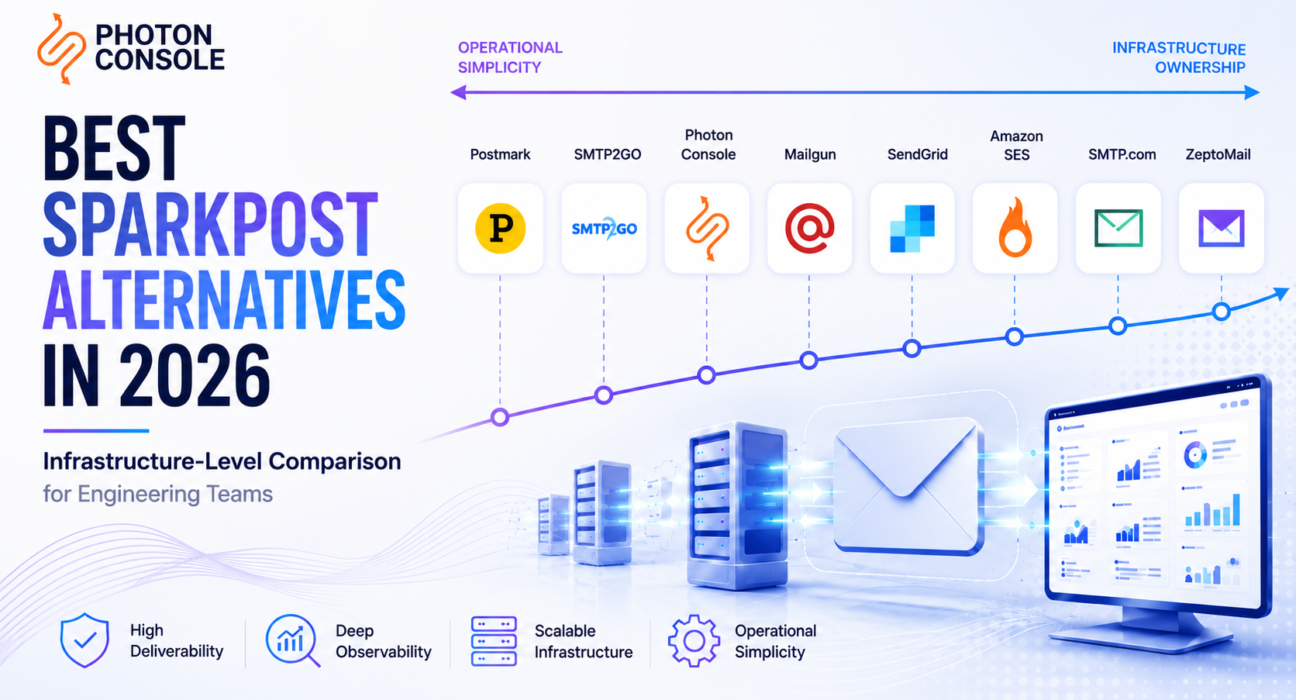
Most engineering teams searching for SparkPost alternatives are not leaving because SparkPost cannot deliver email. They are leaving because email infrastructure requirements changed — and SparkPost changed with them, in a direction those teams did not want to follow.
When MessageBird acquired SparkPost for $600 million in 2021 and rebranded the platform as Bird Email in 2023, the product’s center of gravity shifted toward large enterprise omnichannel conglomerates. The teams who built transactional infrastructure on SparkPost’s Momentum MTA — for its predictive deliverability signals, real-time diagnostics, and automated IP warming — found themselves looking at a product built for a different buyer. Pricing became opaque. Support degraded. Accounts processing strictly transactional traffic — password resets, invoices, OTPs — faced unexplained suspensions with no recovery path.
Simultaneously, Google and Yahoo enforced strict new sender mandates from 2024 onward that rewrote the rules of inbox placement. DMARC alignment, one-click unsubscribe, spam complaint rate thresholds below 0.10 percent — deliverability engineering became a regulated discipline, not a configuration task.
This article is not a feature checklist. It is an infrastructure-level evaluation of the most relevant SparkPost alternatives for engineering teams in 2026. We cover architectural tradeoffs, hidden operational costs, production failure patterns, and the exact conditions under which each provider earns its place in a production email stack.

SparkPost Alternative Selection Matrix
For teams needing a fast orientation before the deep analysis: this table maps every alternative by the single dimension that matters most — what kind of engineering team it is designed for.
| Provider | Best For | Complexity | Deliverability Control | Observability | Recommended Team |
|---|---|---|---|---|---|
| Amazon SES | High-volume bulk with AWS-native depth | Very High | Maximum | DIY (SNS/SQS/Lambda) | Infrastructure engineer + DevOps |
| Postmark | Mission-critical transactional | Very Low | Low (provider-managed) | Strong (45-day history) | Any developer |
| Mailgun | Inbound parsing, list validation, complex routing | Medium | High | Moderate | Backend developer with email experience |
| SendGrid | Agencies, multi-client isolation at scale | Medium | High (subuser architecture) | Moderate | Backend developer + admin oversight |
| SMTP2GO | MSPs and agencies, multi-domain relay | Low | Moderate | Moderate | IT admin or full-stack developer |
| ZeptoMail | Transactional-only, guaranteed inbox placement | Very Low | Low (provider-managed) | Moderate | Any developer |
| SMTP.com | Dedicated IPs, ISP relationship depth | Medium | High | Moderate (Reputation Defender) | Deliverability specialist |
| PhotonConsole | Startups, SaaS teams, developer-first relay | Low | Moderate (provider-managed) | Moderate (real-time logs) | Any developer |
The rest of this article explains why.
Why Engineering Teams Originally Chose SparkPost
SparkPost earned its position by processing an estimated four to five trillion emails annually — roughly 40 percent of all commercial email worldwide. The core capability was the Momentum Mail Transfer Agent, a proprietary MTA designed for enterprise throughput, queue management, and concurrent session control at scale.
What distinguished Momentum was operational visibility. The platform exposed real-time diagnostics that let infrastructure engineers query delivery state during active incidents. OutboundConcurrency tracked established outbound sessions — a primary signal for ISP throttling. DelayedQueueSize tracked messages delayed by transient 4xx failures, informing retry calculations. DNSATimeouts flagged resolver degradation before it cascaded into bounce storms. Enterprise teams at Adobe, the New York Times, and Zillow built operational runbooks around this telemetry.
SparkPost also pioneered predictive deliverability through its Signals product — inbox placement testing, seed list monitoring, preemptive reputation scoring — and automated IP warming schedules that protected newly provisioned addresses from ISP blacklisting. That combination made SparkPost the defensible choice for teams treating email as a first-class infrastructure concern.
Why Teams Are Looking For SparkPost Alternatives in 2026
The $600 million acquisition introduced friction that compounded over time. Transparent public pricing tiers shifted to opaque enterprise contracts. Organizations sending fewer than one million emails per month were effectively priced out of self-serve access.
Documented reports from Reddit, Hacker News, and G2 describe accounts sending exclusively transactional traffic being suspended without warning, explanation, or adequate support paths. For SaaS products where password resets and authentication codes are core to the user experience, a sudden email blackout is not an inconvenience. It is an outage.
The developer experience stagnated. SparkPost’s template architecture lacks inheritance — updating a logo requires editing hundreds of individual templates. The rebranding to Bird Email compounded this: brand confusion, documentation split across two domains, support channel consolidation that degraded response quality. The platform that once served developer-centric teams now reads as an omnichannel suite with email as one channel among many.
Most Teams Are Solving The Wrong Email Problem
Providers rarely cause email failures. Architecture does.
Here is what we observe repeatedly: a team decides to leave SparkPost, spends two weeks evaluating providers, picks one, migrates, and within six months experiences the same deliverability issues. The reason: they replaced the provider without replacing the architecture.
The actual problems in failing email infrastructure follow a consistent pattern regardless of provider. DNS authentication is incomplete — SPF and DKIM configured, but DMARC set to p=none, signaling no enforcement commitment. Suppression logic is absent — the application re-sends to hard-bounced addresses because nothing removes them from the active list. Observability is nonexistent — the team cannot determine whether a missing OTP was dropped by the MTA, rejected by the ISP, or lost during webhook transmission. Traffic streams are merged — marketing and authentication codes share the same IP pool and reputation.
Switching providers does not fix any of these problems. It moves them to a new address. The teams that succeed use the migration as an architecture audit: separate traffic streams, enforce DMARC, implement suppression, build webhook consumption, establish observability baselines — all before the first production send on new infrastructure.
The provider swap is the easy part. The architecture correction is the work that changes outcomes.
For a complete audit framework, see our email infrastructure checklist for SaaS products and our guide on SPF, DKIM, and DMARC explained simply.
What Changed After Google and Yahoo’s 2024 Sender Requirements
The inbox is the only SLA users actually experience. Starting in 2024, Google and Yahoo made that SLA enforceable with hard algorithmic thresholds that eliminated the margin for error in email infrastructure.
The requirements mandate SPF and DKIM authentication, strict DMARC alignment, valid Forward-Confirmed reverse DNS, TLS encryption, and compliance with RFC 5322 and RFC 5321. Bulk senders (5,000+ messages per day to Gmail or Yahoo) must additionally enforce DMARC alignment and support one-click unsubscribe per RFC 8058. Refer to the Google Email Sender Guidelines and Yahoo Sender Best Practices for official specifications.
Three changes matter most operationally:
Reputation became mathematical, not relational. Senders must maintain spam complaint rates below 0.10 percent, with a hard ceiling at 0.30 percent. Breaching that triggers automated throttling or rejection. Once classified as a bulk sender, the classification is permanent — it does not expire even if volume drops below threshold.
Suppression handling became mandatory, not optional. Prior to these requirements, failing to suppress hard bounces degraded deliverability gradually. Now, sustained delivery attempts to invalid addresses trigger behavioral flags consistent with directory harvest attacks — accelerating reputation damage and ISP enforcement.
Observability became critical, not aspirational. Without feedback loop processing, teams have no mechanism to detect complaint rate spikes before they breach the 0.30 percent ceiling. Most deliverability incidents begin as observability failures. By the time user complaints arrive, the IP reputation has been degrading for days or weeks.
The dedicated IP assumption also changed. Algorithmic scoring penalizes inconsistent sending volumes. For senders below 300,000 consistent messages per month, well-vetted shared IP pools routinely outperform dedicated IPs because the pool’s accumulated reputation does the warming work a single sender would need months to replicate. Providers with aggressive sender vetting (Postmark, ZeptoMail) produce better shared pool outcomes than equivalent dedicated infrastructure.
BIMI (Brand Indicators for Message Identification) has moved from experimental to strategic. Verified brand logos in the inbox require strict DMARC enforcement (p=quarantine or p=reject) and a Verified Mark Certificate ($1,000-$1,500/year per logo from an accredited authority). The recent rollout of Common Mark Certificates is lowering this barrier. See the BIMI Group for current implementation guidance.
For authentication configuration, see our guide on how to improve email deliverability.
Infrastructure Ownership vs Operational Simplicity: The Spectrum
Every email provider sits somewhere on the Infrastructure Ownership Spectrum — a framework mapping the inverse relationship between a platform’s transmission control and the external engineering effort required to keep it functional. Cheap transmission often becomes expensive operations.
| Infrastructure Tier | Representative Providers | Engineering Burden | Deliverability Control | Auxiliary Systems Required |
|---|---|---|---|---|
| Bare-Metal Transmitter | Amazon SES | Very High | Maximum | SNS, SQS, Lambda, DynamoDB suppression lists |
| Platform Orchestrator | SendGrid, Mailgun, SMTP.com | Medium | High | Subuser/account isolation, IP pool management, active monitoring |
| Managed Relay | SMTP2GO, PhotonConsole | Low | Medium-High | Minimal — authentication and routing handled by provider |
| Fully Managed Engine | Postmark, ZeptoMail | Very Low | Medium (strict policies) | None — provider enforces stream isolation and IP vetting |
The Infrastructure Ownership Burden — engineering hours consumed by bounce handling, suppression management, IP warming, and incident response — is the hidden variable that makes low-cost providers expensive at scale. See our full analysis in the pay-per-use vs subscription total cost of ownership analysis.
The Email Infrastructure Maturity Model
Most teams do not outgrow providers. They outgrow assumptions. Provider selection is a function of organizational maturity, not aspiration. The most common migration failure is selecting a provider that maps to a maturity level the team has not reached.
| Maturity Level | Description | Typical Architecture | Appropriate Provider Tier |
|---|---|---|---|
| Level 1: Ad Hoc | Email via app server, shared hosting SMTP, or platform defaults. No authentication. No monitoring. | PHP mail(), WordPress default, cPanel relay | Managed Relay (PhotonConsole, SMTP2GO) |
| Level 2: Configured | Dedicated provider. SPF/DKIM configured. Basic logging. No suppression. No isolation. | Single provider, DNS partially configured | Managed Relay or Fully Managed Engine |
| Level 3: Managed | DMARC enforced. Bounce handling automated. Streams separated. Webhooks operational. | Two-provider or isolated-stream architecture | Platform Orchestrator or Fully Managed Engine |
| Level 4: Instrumented | Full observability pipeline. DLQ retention. Suppression synced to application database. | Multi-provider, custom alerting, centralized monitoring | Platform Orchestrator or Bare-Metal Transmitter |
| Level 5: Autonomous | Predictive reputation. Automated warming. BIMI/VMC compliance. Self-healing feedback loops. | Custom orchestration across multiple MTAs | Bare-Metal Transmitter with auxiliary stack |
Teams at Level 1-2 who migrate to Amazon SES (a Level 4-5 provider) consistently underestimate the investment. The result: cheapest possible transmission, no bounce handling, no suppression, no observability — the exact conditions that produce a Silent Failure Cascade.
Deliverability Health Scorecard
Before selecting a provider, assess your current infrastructure. This scorecard identifies whether you are solving a provider problem or an architecture problem.
| Criterion | Score |
|---|---|
| SPF record configured and valid | 1 point |
| DKIM signing active with key rotation | 1 point |
| DMARC enforced at p=quarantine or p=reject | 1 point |
| Hard bounce suppression automated | 1 point |
| Webhook/feedback loop consumption operational | 1 point |
| Transactional and marketing traffic isolated | 1 point |
| IP warming process documented and followed | 1 point |
| Score Range | Assessment | Action Required |
|---|---|---|
| 0-2 | High Risk | Fix architecture before migrating providers. A new provider will not solve these problems. |
| 3-4 | Vulnerable | Address gaps during migration. Prioritize suppression and DMARC enforcement. |
| 5-6 | Operationally Healthy | Provider selection can proceed based on feature and cost requirements. |
| 7 | Infrastructure Mature | Full spectrum of providers available. Select based on architectural preference. |
If your score is below 5, the provider is not the problem. See our email infrastructure checklist.
The Best SparkPost Alternatives in 2026
Amazon SES
Amazon SES is the lowest-cost raw transmission infrastructure — approximately $0.10 per thousand emails — operating at genuine hyperscale. For teams embedded in AWS, it offers the tightest cloud architecture integration.
The tradeoff is absolute: SES provides transmission. Everything else is your problem. When a hard bounce occurs, SES routes a notification through SNS — if configured. Your team must provision SNS topics, SQS dead-letter queues, Lambda functions to parse variable bounce payloads, and DynamoDB suppression lists. The Virtual Deliverability Manager (VDM) adds dashboard insights, but core remediation remains the customer’s responsibility. Failure to build this stack does not produce an error — it produces a Silent Failure Cascade.
Best for: High-volume bulk traffic routed through teams with AWS engineering depth. Maturity Level 4+.
Do not use if: Your team lacks dedicated infrastructure capacity or your Deliverability Health Score is below 5.
See our Amazon SES alternatives comparison.
Postmark
Postmark has the most defensible transactional infrastructure philosophy in the market: strict separation of transactional and broadcast traffic at the IP pool level, with aggressive sender vetting before pool access.
Message Streams enforce separation structurally — distinct pools, not configurable options. Marketing complaints cannot contaminate transactional IP reputation. Observability: up to 45 days of searchable history. Tradeoffs: marketing is a secondary capability, pricing is premium per-message, templates use Postmark’s Mustachio syntax (meaningful migration overhead from SparkPost).
Best for: Applications where transactional reliability is non-negotiable — authentication, billing, system alerts — and the team will pay to eliminate operational complexity.
See our Postmark alternatives guide.
Mailgun
Mailgun occupies a distinct niche: native inbound email parsing and built-in list validation — capabilities no other provider here offers at comparable depth. Inbound parsing receives email on behalf of domains and routes structured event data to webhooks, enabling reply-tracking and support flows without a custom SMTP server. List validation scrubs addresses pre-transmission with a documented 21 percent bounce rate reduction.
Complexity tradeoff: routing multiple domains without explicit isolation creates shared-reputation risk. Shared pools exhibit more variability than Postmark’s due to less restrictive vetting.
Best for: Applications requiring inbound parsing, pre-send validation, or complex routing. Teams who want flexibility over simplicity.
See also: Best Mailgun alternatives and SendGrid vs Mailgun.
SendGrid
SendGrid (Twilio SendGrid) is the largest-scale Platform Orchestrator. Its subuser architecture provisions isolated sending environments — separate API keys, statistics, and suppression lists per account. For agencies managing dozens of domains, this matters.
The challenge: default configuration does not enforce isolation. Teams routing all traffic through a single account will experience reputation blending. Deliverability problems manifest gradually, not acutely, making root cause analysis difficult. Webhook schemas differ significantly from SparkPost and have changed across SendGrid API versions.
Best for: Agencies and larger organizations with the maturity to configure subuser isolation and manage IP pool health at scale.
See our SendGrid alternatives comparison.
SMTP2GO
SMTP2GO’s differentiator is sub-account isolation designed for MSPs and agencies. Each sub-account operates independently, preventing cross-client reputation damage. SPF/DKIM automated during setup. Geographically redundant infrastructure with automated failover.
Limitation: less granular control over IP pool assignment, retry logic, and suppression than SES or Mailgun. Opinionated in ways that limit intervention for teams wanting fine-grained tuning.
Best for: Agencies and MSPs managing multi-domain environments needing isolation without enterprise administration overhead.
See our SMTP2GO alternatives analysis.
ZeptoMail
ZeptoMail (Zoho) enforces the most opinionated position: bulk email is explicitly forbidden. No promotions, no newsletters. This is a deliverability guarantee mechanism — shared pools are never exposed to marketing complaint spikes. REST API and SMTP relay on ports 465/587, with built-in authentication and Zoho’s data residency options.
Tradeoff: categorical restriction. Requires pairing with separate bulk infrastructure — administrative overhead in exchange for guaranteed transactional deliverability.
Best for: Applications requiring absolute inbox placement for OTPs and system-critical receipts.
SMTP.com
Two decades of ISP relationship management and dedicated IP infrastructure with Reputation Defender monitoring. Automated blocklist monitoring, deliverability scoring, and guided remediation workflows. Supports high-volume dedicated instance deployments for organizations that have outgrown shared infrastructure.
Best for: Established platforms needing dedicated, actively monitored IP environments with ISP relationship depth.
PhotonConsole
PhotonConsole is an SMTP relay service built for SaaS products, startups, and development teams that need managed delivery infrastructure without tier lock-ins or opaque pricing.
The platform manages routing, authentication, and logging at the infrastructure layer. SPF, DKIM, and DMARC handled during onboarding. Bounce handling and delivery logging managed at platform level. Integrates with Node.js, PHP, and WordPress stacks via standard SMTP credentials without application-level changes. Real-time delivery logs provide the observability baseline that bare-metal providers require custom tooling to achieve. Pay-as-you-use pricing scales proportionally with volume.
The tradeoffs: PhotonConsole operates as a managed relay. It does not provide inbound parsing (Mailgun), subuser isolation (SendGrid), strict transactional-only pool enforcement (Postmark, ZeptoMail), or dedicated IP warming schedules. Teams requiring fine-grained IP control or advanced multi-tenant architecture will find those levers are not exposed. The platform does not currently publish latency SLAs for transactional delivery, which teams benchmarking against Postmark or ZeptoMail’s documented sub-second dispatch should evaluate independently.
Best for: Startups and SaaS teams at Maturity Level 1-3 who need reliable relay with authentication handled and pricing that matches actual volume.
Limitations: Not suited for dedicated IP management, deep subuser architectures, inbound parsing, or high-volume bulk marketing. Less appropriate for teams needing bare-metal control.
See current pricing and our guide on 8 critical criteria developers must evaluate when choosing an SMTP relay.
Engineering Complexity Comparison
Ratings use a 1-5 scale (1 = minimal, 5 = significant).
| Provider | Setup | Operations | Deliverability Control | Observability | Maintenance | Min. Team |
|---|---|---|---|---|---|---|
| Amazon SES | 5 | 5 | 5 | 2/3 (VDM) | 5 | Infra eng + DevOps |
| Postmark | 1 | 1 | 2 | 4 | 1 | Any developer |
| Mailgun | 3 | 3 | 4 | 3 | 3 | Backend dev (email exp.) |
| SendGrid | 3 | 3 | 4 | 3 | 3 | Backend dev + admin |
| SMTP2GO | 2 | 2 | 3 | 3 | 2 | IT admin / full-stack |
| ZeptoMail | 1 | 1 | 2 | 3 | 1 | Any developer |
| SMTP.com | 3 | 3 | 4 | 3 | 3 | Deliverability specialist |
| PhotonConsole | 1 | 1 | 3 | 3 | 1 | Any developer |
Deliverability Control reflects how directly the team can influence outcomes — IP selection, suppression logic, retry config. Lower scores mean the provider manages those decisions. Whether that is desirable depends on maturity level.
Migration Difficulty Matrix: SparkPost to Each Alternative
Migration effort is the variable most consistently underestimated.
| Target | Template Migration | Webhook Rebuild | DNS Reconfig | Infrastructure Rebuild | Overall Difficulty |
|---|---|---|---|---|---|
| Amazon SES | Medium | High (SNS/SQS/Lambda) | Medium | Very High | Very High |
| Postmark | High (Mustachio rewrite) | Low | Low | Very Low | Medium |
| Mailgun | Medium | Medium | Medium | Low | Medium |
| SendGrid | Medium | Medium-High | Medium | Medium | Medium-High |
| SMTP2GO | Low | Low | Low | Very Low | Low |
| ZeptoMail | Medium | Low | Low | Very Low | Low-Medium |
| SMTP.com | Medium | Medium | Medium | Medium | Medium |
| PhotonConsole | Low (app-side templates) | Low | Low | Very Low | Low |
Highest friction: providers requiring both template rewrites and infrastructure rebuild (SES). Lowest: relay providers where the application retains template ownership (SMTP2GO, PhotonConsole). See our SMTP relay service overview.
Production Failure Patterns Every Team Should Understand
The Silent Failure Cascade
The application injects messages to invalid addresses. Servers return 5xx bounces. The application — without configured feedback loops — continues injecting. The ISP observes sustained invalid traffic, silently degrades IP reputation, routes legitimate traffic to spam. The team discovers the failure weeks later through user complaints. The defining characteristic: no immediate alerts. Delivery appears normal from the application’s perspective.
See our guides on emails sent but not delivered and reducing bounce rate for SaaS applications.
The Bounce Storm
Temporary misconfiguration (expired certificate, DNS outage) generates mass 4xx failures. The MTA’s delayed queue expands exponentially if retry logic is aggressive, consuming resources and delaying valid messages. OTPs queued during a bounce storm can expire before delivery. Well-implemented retry uses exponential backoff with jitter. See SMTP retry logic for transactional systems.
Shared IP Degradation
On mixed-traffic shared pools, a single sender’s marketing campaign exceeding complaint thresholds penalizes every co-tenant. Unrelated organizations’ OTPs fail. The architectural fix: strict stream isolation — provider-enforced (Postmark, ZeptoMail) or two-provider architecture.
Webhook Backpressure Failure
Large event batches must be accepted, queued, and acknowledged with 200 OK within 10 seconds. Synchronous processing before response causes timeouts, triggering retry loops. Best practice: accept immediately, persist to queue (Redis, SQS, RabbitMQ), process asynchronously. DLQ retention of 30+ days prevents the Observability Gap. See our SMTP monitoring tools guide.
Patterns We See Across Email Infrastructure Failures
These patterns recur regardless of provider, scale, or industry. They are architecture problems, not vendor problems.
Missing suppression lists during migration. The old provider suppressed thousands of addresses. The new provider receives the full list on day one. Bounce rate spikes before any reputation is established.
DMARC at p=none. SPF and DKIM configured, but DMARC not enforced. The domain signals it has no authentication commitment. Mailbox providers treat it accordingly.
Merged traffic streams. Marketing and transactional on the same IP. One promotional campaign with a 1.5 percent complaint rate poisons OTP delivery for nine days.
No webhook monitoring. Team discovers missing delivery data weeks after the webhook endpoint started timing out. No DLQ preserved the payloads. The gap is permanent.
Skipped IP warming. Full volume on day one to a new IP triggers ISP defenses identical to newly provisioned spam infrastructure. The M3AAWG Sender Best Practices document the warming requirements in detail.
See our SMTP testing methods guide for pre-send validation.
Production Case Studies
SaaS Authentication Platform Migrates to SES
Problem: A B2B SaaS sending 800K transactional emails/month migrated from SparkPost to SES for a projected 70 percent cost reduction.
What happened: No SNS/SQS bounce processing configured. Within three weeks: 12,000 hard bounces to invalid addresses. Gmail flagged the domain. OTP delivery rates dropped to 74 percent. Support tickets for “login not working” increased 340 percent. Engineering pulled from roadmap for two weeks to build the feedback loop retroactively.
Root cause: Bare-Metal Transmitter selected at Maturity Level 2.
Outcome: 11-week migration instead of 2. Total cost exceeded what a managed provider would have cost for the year.
E-Commerce Platform: Shared IP Degradation
Problem: Order confirmations landing in spam across multiple customer reports.
What happened: Promotional re-engagement campaign (inactive 6+ months) generated 1.8 percent complaint rate. Shared IP reputation penalty affected all traffic — orders, shipping, password resets in spam for 9 days.
Root cause: No stream isolation. Same IP, same domain, same reputation for all traffic.
Outcome: Two-provider architecture implemented. Transactional deliverability returned to 99+ percent within 3 weeks.
Webhook Backpressure During Black Friday
Problem: Internal analytics showed zero delivery confirmations for four hours despite 180,000 successful dispatches.
What happened: Synchronous PostgreSQL updates per webhook event exceeded 10-second timeout. Provider retries saturated endpoint. After 72 hours, endpoint disabled entirely.
Root cause: Synchronous webhook processing, no intermediate queue, no DLQ.
Outcome: Rebuilt with async architecture (Redis queue, background workers). Black Friday analytics never fully recovered.
How We Would Architect Email Infrastructure Today
Startup (Pre-PMF, <50K emails/month)
Single managed relay (PhotonConsole, SMTP2GO). Templates in application code. Authentication handled during onboarding. No marketing infrastructure yet. Total email engineering: half a day. Level 1-2.
Growing SaaS (50K-500K emails/month)
Separate transactional and marketing traffic. Transactional through managed relay or fully managed engine. Marketing through platform orchestrator. DMARC enforced at p=quarantine or p=reject. Webhook consumption operational. Level 2-3.
Multi-Product SaaS (500K-2M emails/month)
Per-product sending domains for reputation isolation. Dedicated transactional provider (Postmark, ZeptoMail) for auth-critical flows. Separate relay for system notifications. Bulk through SES or SendGrid with subuser isolation. Centralized observability across providers. DLQ retention on all webhook consumers. Level 3-4.
Agency (10-100 Client Domains)
Sub-account isolation non-negotiable (SMTP2GO, SendGrid subusers). Independent SPF/DKIM per client domain. Centralized billing, per-client reporting. Premium transactional provider for clients requiring guaranteed delivery. Level 3.
Enterprise (2M+ emails/month)
Hybrid: SES bulk (with full auxiliary stack), premium transactional provider, SMTP.com or dedicated SendGrid for notification streams. BIMI/VMC implementation. Centralized observability with custom alerting. DLQ retention with automated replay. Level 4-5.
See how to send 100K emails/month without overpaying and our transactional email queue architecture guide.
Email Infrastructure Decision Scorecard
Use this scorecard to map your operational profile to the correct provider tier. Score each factor based on your current state.
| Factor | Managed Relay | Fully Managed Engine | Platform Orchestrator | Bare-Metal Transmitter |
|---|---|---|---|---|
| Monthly Volume | <200K | <500K | 200K-2M | 1M+ |
| Engineering Team | 1-3 developers | 1-5 developers | 3-10 with email experience | Dedicated infra/DevOps function |
| Deliverability Risk Tolerance | Low (need it to just work) | Very Low (mission-critical) | Moderate (can debug) | Managed (full control needed) |
| Compliance Requirements | Standard authentication | Strict (BIMI, data residency) | Moderate (subuser isolation) | Full (VPC, dedicated IPs, audit trails) |
| Operational Capacity | Zero email ops bandwidth | Minimal oversight | Regular monitoring | Active management, custom tooling |
Match the column that best describes your organization across all five factors. That column indicates your appropriate starting tier. You can always migrate up the spectrum as maturity increases. Migrating down after an incident is more expensive.
Deliverability Risk Comparison
| Provider | Shared IP Risk | Stream Isolation | Auto Suppression | Bounce Handling | Recovery Complexity |
|---|---|---|---|---|---|
| Amazon SES | N/A (dedicated at scale) | Customer-built | No (SNS/Lambda) | Customer-built | Very High |
| Postmark | Very Low | Enforced (Message Streams) | Yes | Platform-managed | Low |
| Mailgun | Moderate | Customer configures | Yes | Platform-managed | Medium |
| SendGrid | Moderate (default blends) | Optional (subusers) | Yes | Platform-managed | Medium |
| SMTP2GO | Low | Account-level | Yes | Platform-managed | Low |
| ZeptoMail | Very Low | Enforced (bulk banned) | Yes | Platform-managed | Very Low |
| SMTP.com | Low (dedicated available) | Partial | Yes | Reputation Defender | Medium |
| PhotonConsole | Low | Single-stream relay | Yes | Platform-managed | Low |
Before Migrating: Pre-Migration Checklist
Rushing a SparkPost migration creates exactly the problems teams are trying to escape.
- Audit traffic composition. Transactional vs marketing ratio determines whether you need one provider or two.
- Export and import the suppression list. Every suppressed address must transfer before the first send.
- Map webhook architecture. Rebuild for the new provider’s JSON schema. Field names are not portable.
- Update DNS records 72 hours before cutover. Validate with MXToolbox.
- Gradual volume ramp. 10 percent week one, increasing weekly based on bounce/complaint monitoring.
- Validate observability before first send. Webhook endpoints, log retention, alerting thresholds. See SMTP testing methods.
- Rebuild templates. Postmark = Mustachio. Others = Handlebars, API-driven, or custom. Allocate time.
- Establish baseline metrics. Delivery rates, bounce rates, complaint rates, latency from SparkPost.
- Run parallel providers during transition. Maintain SparkPost as fallback for critical flows.
Full framework: email infrastructure checklist. Queue architecture: transactional email queue architecture.
Key Definitions
Silent Failure Cascade: An architectural vulnerability where an application continues injecting messages to invalid addresses because the feedback loop is broken or unconfigured. ISPs silently degrade the sender’s IP reputation. No alert fires. Damage accumulates over days or weeks before becoming visible.
Deliverability Debt: The cumulative consequence of deferring infrastructure decisions — no DMARC enforcement, no suppression, merged traffic streams. Accrues silently until a threshold event forces emergency remediation at a cost exceeding proper initial configuration.
Infrastructure Ownership Burden: The inverse relationship between transmission cost and engineering hours required. High-burden platforms (SES) provide cheap sending but expensive operations. Low-burden platforms (Postmark, PhotonConsole) charge more per message but eliminate auxiliary architecture costs.
Observability Gap: The blind spot created when logging retention is insufficient or webhook delivery fails without DLQ routing. Prevents the team from determining whether a missing notification was dropped by the MTA, rejected by the ISP, or lost during webhook transmission.
Operational Complexity Tax: The total cost of using the wrong infrastructure tier — lost revenue from abandoned sessions, engineering hours diverted to deliverability debugging, consulting fees for reputation recovery.
Stream Isolation: Routing transactional and marketing email through separate IP pools, sending domains, or providers to prevent reputation contamination between traffic types.
Frequently Asked Questions
Is SparkPost the same as Bird Email?
Yes. MessageBird acquired SparkPost in 2021 and rebranded it as Bird Email in 2023. The Momentum MTA remains, but the product focus shifted toward enterprise omnichannel deployments.
Is SparkPost still a good provider in 2026?
SparkPost (now Bird Email) remains technically capable. The Momentum MTA still handles enterprise-scale throughput. The concern is strategic fit: opaque pricing, reduced SMB focus, documented account enforcement unpredictability, and aging developer experience. Teams under 1M emails/month should evaluate alternatives. Enterprise teams embedded in the Bird omnichannel ecosystem may find the platform still appropriate.
SparkPost vs Amazon SES?
SparkPost provided managed deliverability intelligence — predictive scoring, automated IP warming, built-in observability. SES provides raw transmission at lower cost with zero managed deliverability. Migrating from SparkPost to SES without building the SNS/SQS/Lambda feedback loop is the single most common migration failure pattern we observe. SES is appropriate only for teams at Maturity Level 4+.
SparkPost vs Postmark?
SparkPost handled both marketing and transactional at scale. Postmark is architecturally constrained to transactional-first with broadcast as a secondary capability. Postmark’s strict Message Streams enforce IP pool isolation that SparkPost did not. For teams whose primary concern is transactional reliability, Postmark eliminates the operational complexity SparkPost required. For teams needing unified marketing and transactional, Postmark alone is insufficient.
Can I migrate from SparkPost without changing templates?
Only if you migrate to a relay-based provider (SMTP2GO, PhotonConsole) where templates remain in your application code. Migrating to Postmark requires rewriting in Mustachio. Migrating to SendGrid or Mailgun requires adapting to their Handlebars-based or proprietary template engines. SES supports custom templates but requires separate infrastructure setup.
How long should IP warming take?
For a new IP with no sending history, a minimum of four weeks with a gradual ramp: 10 percent of target volume in week one, increasing by 15-20 percent weekly based on bounce and complaint rate monitoring. Rushing warming triggers ISP scrutiny indistinguishable from newly provisioned spam infrastructure. On shared IP pools (managed providers), warming is handled by the pool’s accumulated reputation — no customer-side warming required.
Do I need a dedicated IP?
Not necessarily. For senders below 300,000 consistent messages per month, well-vetted shared pools routinely outperform dedicated IPs. Algorithmic reputation scoring penalizes inconsistent volume, which makes dedicated IPs counterproductive for senders with variable traffic patterns. Dedicated IPs make sense above 300K consistent monthly volume or when compliance requirements mandate IP isolation.
What are the Google and Yahoo sender requirements?
All senders: SPF or DKIM, valid PTR records, TLS, RFC 5321/5322 compliance. Bulk senders (5,000+ messages/day): DMARC alignment, one-click unsubscribe (RFC 8058). Spam complaint ceiling: 0.10 percent target, 0.30 percent hard limit. See Google Email Sender Guidelines and Yahoo Sender Best Practices.
Related Reading
- Transactional email service — what it is and how to choose one
- Transactional vs marketing email — the infrastructure difference
- Transactional email latency explained for SaaS
- Email API integration guide
- SMTP configuration reference
- SMTP relay for transactional emails
- Why emails go to spam in Gmail
- Emails delayed — causes and resolution
- Email infrastructure failures — what causes them
- Free SMTP servers — what to know
- SMTP response codes explained
Further Reading and Technical References
- Google Email Sender Guidelines
- Yahoo Sender Best Practices
- Amazon SES Developer Guide
- RFC 5321 — Simple Mail Transfer Protocol
- RFC 5322 — Internet Message Format
- RFC 8058 — One-Click Unsubscribe
- BIMI Group — Brand Indicators for Message Identification
- M3AAWG Sender Best Practices and Published Documents
- MXToolbox — DNS and Deliverability Diagnostics
Final Verdict
The migration away from SparkPost is not a vendor selection problem. It is a systems architecture decision forced by a market that moved toward stricter deliverability enforcement and greater infrastructure specialization simultaneously.
The providers who serve engineering teams best in 2026 are the ones whose architectural model matches the team’s actual operational capacity. Amazon SES for teams with AWS depth. Postmark and ZeptoMail for teams eliminating transactional risk. SMTP2GO and PhotonConsole for teams needing professional relay without enterprise overhead. SendGrid and Mailgun for teams requiring marketing integration, complex routing, or inbound capabilities. SMTP.com for enterprise senders needing dedicated IP management with ISP trust.
What is not correct — for any team — is choosing a provider based on pricing alone, migrating without a gradual volume ramp, or routing transactional and marketing traffic through shared infrastructure without explicit architectural controls.
The defining principle of email infrastructure in 2026 is not which provider you use. It is whether the architecture you build on top of that provider closes the Observability Gap, prevents the Silent Failure Cascade, eliminates Deliverability Debt, and enforces stream isolation. The provider is replaceable. The architecture determines outcomes.
Start with the Deliverability Health Scorecard. Assess your maturity level. Select the provider that matches where your team is today. Build toward where you need to be.
If you need a managed SMTP relay that handles authentication, routing, and logging without requiring a parallel infrastructure project, PhotonConsole is built for that use case. See current pricing to evaluate fit.