

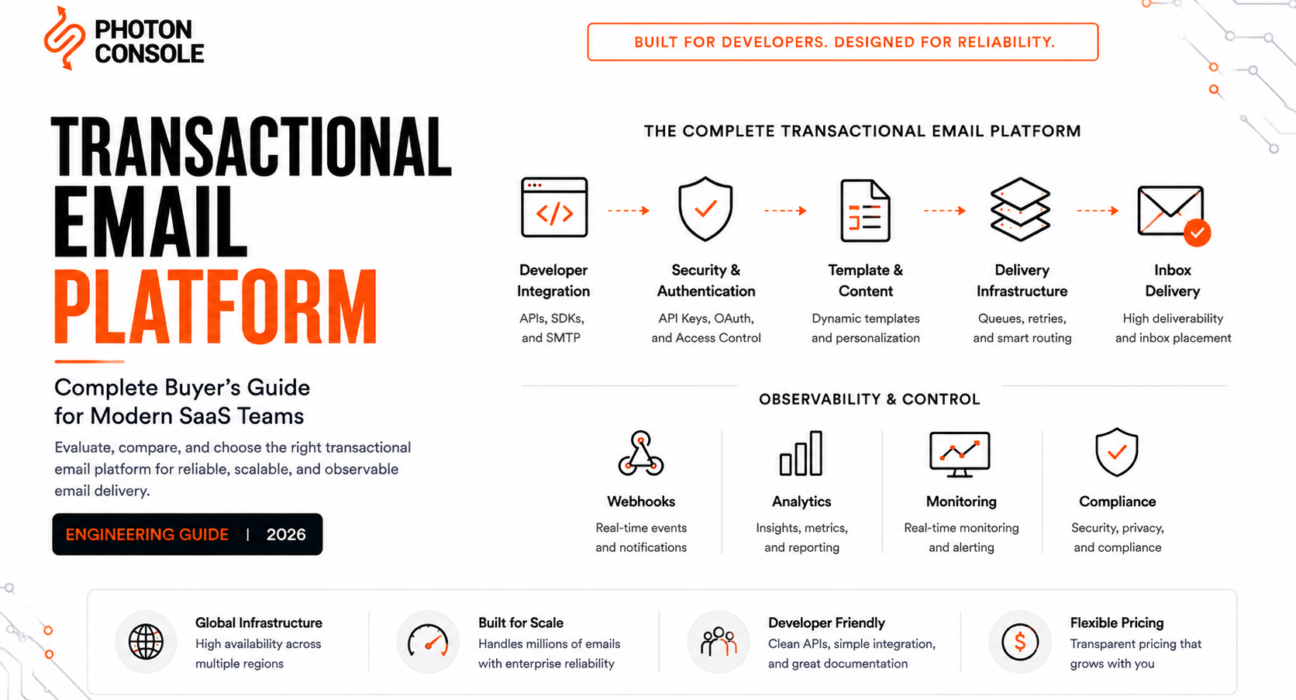
A transactional email platform is not a product you evaluate the way you evaluate a library. It is a piece of infrastructure your application depends on for password resets, order confirmations, and security alerts — the messages where failure is a support ticket at best and a compliance incident at worst. The buying decision therefore looks less like picking a tool and more like picking a database vendor: you are committing to an operational surface, a compliance posture, and a migration cost you will carry for years.
This guide is scoped to that buying decision. It covers what separates a platform from a bare API or relay, the nine platforms most SaaS teams shortlist, and the evaluation criteria — compliance, security, scalability ceilings, lifecycle risk, migration cost — that rarely appear on a pricing page but determine whether the choice holds up at scale.
Table of Contents
- Executive Summary
- What Is a Transactional Email Platform?
- Platform Architecture
- Essential Platform Features
- Compare Leading Platforms
- Engineering Comparison Matrix
- Best Platform by Business Type
- Real-World Scenarios
- Common Buying Mistakes
- Migration Checklist
- Frequently Asked Questions
- Final Recommendation
Executive Summary
Quick answer: A transactional email platform is a managed system that combines delivery infrastructure, REST and SMTP interfaces, authentication, queueing, retry logic, deliverability management, webhooks, analytics, monitoring, security controls, and compliance tooling into a single operational surface. A platform differs from an email API in the same way a managed database differs from a driver: the API is the entry point, the platform is everything behind it that you would otherwise have to build and staff yourself.
The practical buying criteria, ranked by how often they cause regret post-purchase:

- Observability depth — teams underweight this at purchase and discover the gap during their first deliverability incident.
- Migration cost, both in and out — heavy SDK and template lock-in turns a vendor problem into a quarter-long project.
- Compliance posture — a platform that cannot sign a BAA or meet regional data-residency requirements is disqualified regardless of price.
- Pricing model fit — tiered subscriptions penalize variable volume; pay-per-use penalizes nothing but offers fewer bundled extras.
- Scalability ceiling — the volume at which you must renegotiate, warm dedicated IPs, or move to enterprise onboarding.
Buyer’s shortcut: If a platform cannot tell you, in its documentation, (a) how it classifies and retries soft bounces, (b) what its published rate limits are, and (c) what compliance certifications it holds — treat those as answers, not omissions. Vague documentation at evaluation time predicts vague support during an incident.
What Is a Transactional Email Platform?
The category names in this space are used interchangeably in marketing copy and mean quite different things in practice. The distinction matters at purchase because you can accidentally buy a relay when you needed a platform, and discover the gap only when you need suppression lists or an audit trail.
| Category | What It Is | What It Does Not Include | Typical Buyer |
|---|---|---|---|
| SMTP Server | Software you run (Postfix, Exim) that speaks SMTP | IP reputation management, deliverability tooling, analytics, support | Teams with dedicated mail ops staff |
| SMTP Relay | Hosted service that accepts SMTP and forwards to recipients | Often lacks deep analytics, templating, suppression management | Teams replacing a failing self-hosted server |
| Email API | HTTP endpoint that accepts a message payload | Interface only — surrounding tooling varies wildly | Developers integrating a new send path |
| Transactional Email API | Email API tuned for one-to-one triggered messages | May exclude bulk/marketing capability by design | Product engineering teams |
| Email Delivery API | Emphasizes the delivery/deliverability layer specifically | Naming convention more than a distinct category | Teams with existing deliverability problems |
| Transactional Email Platform | All of the above plus monitoring, compliance, security controls, suppression, analytics, support SLAs | — | CTOs and platform teams making a multi-year infrastructure commitment |
If you are still deciding between a hosted relay and a full platform, our guide to the SMTP relay service covers the relay end of that spectrum, and the transactional email service overview covers the service-level fundamentals this guide assumes as background.
Platform Lifecycle Model™
Most teams pass through four stages, and the mistake is buying for the stage you are in rather than the one you will reach within eighteen months.
| Stage | Typical Volume | What Breaks | What to Buy |
|---|---|---|---|
| 1. Ad hoc | < 5,000/month | Self-hosted SMTP or framework mail() silently drops messages | Any hosted relay or free-tier platform |
| 2. Product-critical | 5,000 – 100,000/month | No bounce visibility; spam complaints go unnoticed | Platform with real webhook and suppression tooling |
| 3. Scale | 100,000 – 5M/month | Shared IP reputation becomes a liability; costs become material | Dedicated IP options, pricing that scales linearly |
| 4. Regulated / enterprise | Any volume, high stakes | Audit requests, data residency, BAAs, procurement review | Platform with formal compliance certifications and contractual SLAs |
Platform Architecture
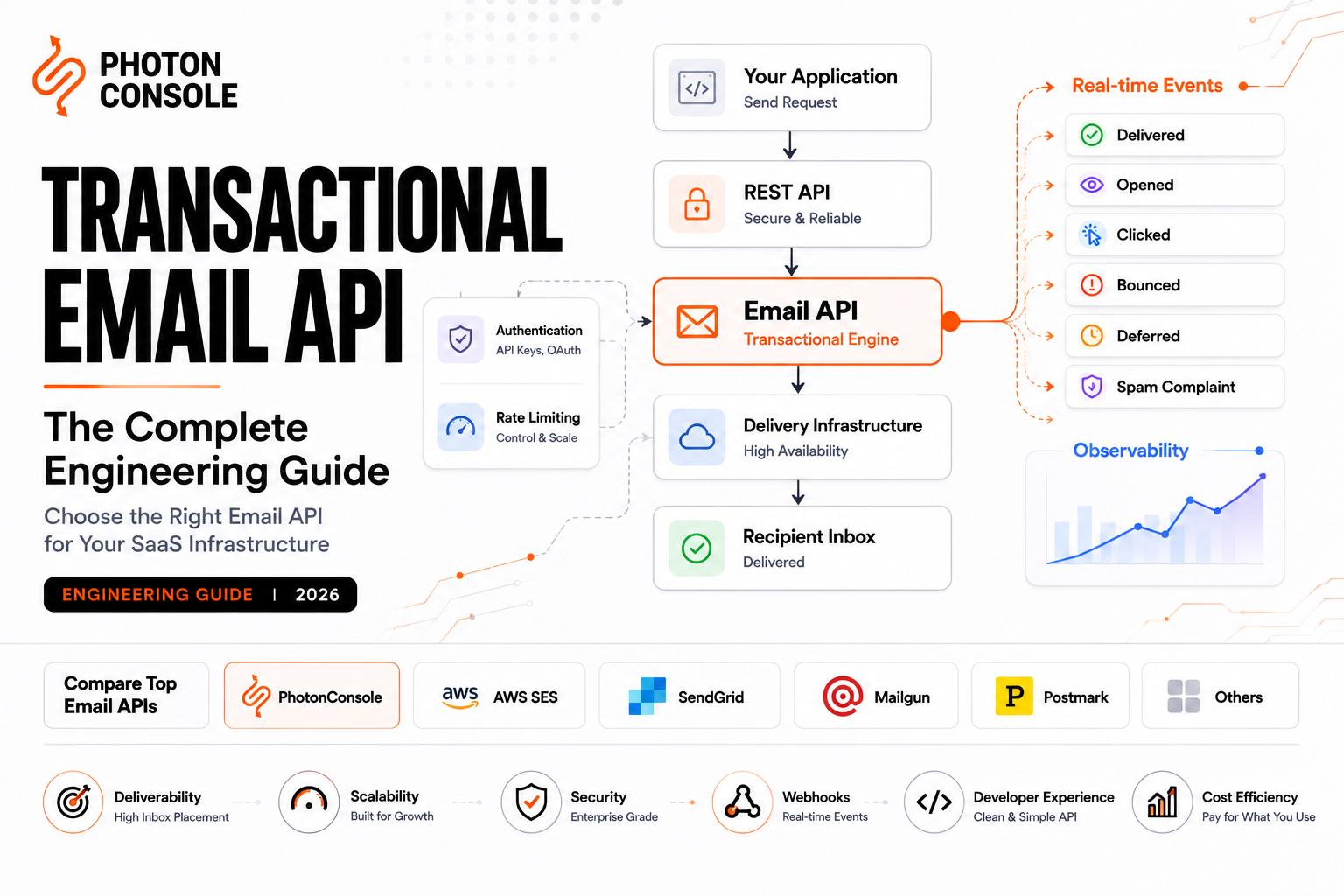
Every transactional email platform implements roughly the same twelve-layer architecture. What differs between vendors is how much engineering investment sits in each layer — and which layers they expose to you versus keep opaque.
Diagram 1 — Platform Architecture (full stack)
Purpose: give buyers a shared vocabulary for what “platform” actually includes, so feature lists can be mapped to layers.
Layout: vertical stack, 12 layers, grouped into four labeled bands.
Application
   ↓
API Gateway            ─┐
   ↓                     │ INGRESS
Authentication         ─┘
   ↓
Template Engine        ─┐
   ↓                     │
Queue                    │ PROCESSING
   ↓                     │
Retry Engine           ─┘
   ↓
Smart Routing          ─┐
   ↓                     │ DELIVERY
Delivery Infrastructure  │
   ↓                     │
Inbox                  ─┘
   ↓
Webhooks               ─┐
   ↓                     │ FEEDBACK
Monitoring               │
   ↓                     │
Analytics              ─┘
Designer notes: four color bands (ingress / processing / delivery / feedback). The feedback band should visually loop back to the application to reinforce that observability is a closed circuit, not a terminal step.
A brief note on each layer, since vendor documentation rarely explains what it is actually responsible for:
| Layer | Responsibility | What to Ask the Vendor |
|---|---|---|
| API Gateway | Accepts requests, enforces rate limits | Are rate limits published and returned in response headers? |
| Authentication | Validates API keys, enforces scopes | Can keys be scoped per-service and per-domain? |
| Template Engine | Renders dynamic content server-side | Are templates versioned? Can they be managed via API? |
| Queue | Buffers accepted messages for processing | What is the queue depth policy under load — buffer or reject? |
| Retry Engine | Reattempts on soft bounces and downstream throttling | Is backoff exponential and response-code-aware? |
| Smart Routing | Selects IP pool and outbound path per message | Are transactional and bulk sends routed separately? |
| Delivery Infrastructure | Outbound MTAs, IP reputation management | How is shared-pool reputation actively managed? |
| Webhooks | Emits delivery events back to your application | Are events retried on your endpoint failure? For how long? |
| Monitoring | Platform-side health and alerting | Is there a public status page with incident history? |
| Analytics | Aggregate delivery, bounce, engagement reporting | How long is event data retained, and is it exportable? |
Diagram 2 — Scalability Pyramid™
Purpose: show which capabilities become load-bearing as volume grows, so buyers evaluate for their future stage.
Layout: five-tier pyramid, widest at base.
                 ▲
          Compliance & Audit         (regulated scale)
      ─────────────────────────
        Dedicated IP & Warming        (high volume)
    ─────────────────────────────
       Observability & Analytics      (product-critical)
  ─────────────────────────────────
        Retry & Bounce Handling       (early production)
─────────────────────────────────────
         Basic Send Capability        (day one)
Designer notes: label the right edge of each tier with the lifecycle stage that first requires it. Base tier in neutral gray, escalating saturation toward the apex.
Essential Platform Features
| Feature | Why It Matters at Purchase | Verification Method |
|---|---|---|
| REST API | Primary integration path for new services | Review error-code reference, not just endpoint list |
| SMTP compatibility | Lets legacy code paths migrate on your timeline | Confirm SMTP and REST hit the same pipeline and share observability |
| SDKs | Reduces integration cost; also a lock-in vector | Check language coverage and recent maintenance activity |
| Template management | Decouples copy changes from deploys | Confirm versioning and API-based template management |
| Webhooks | The only reliable source of post-acceptance truth | Confirm retry policy on your endpoint failures |
| Retry logic | Determines resilience under ISP throttling | See our retry logic guide for what good looks like |
| Bounce handling | Prevents reputation damage from repeat sends | Confirm hard/soft classification is exposed to you |
| Suppression lists | Compliance and reputation requirement | Confirm automatic suppression and API access to the list |
| Dedicated IP | Reputation isolation at volume | Ask the volume threshold and warming support offered |
| Shared IP | Lower cost, pooled reputation risk | Ask how the pool is monitored and bad senders removed |
| Monitoring & observability | Time-to-detection during incidents | Public status page, alerting integrations — see our monitoring guide |
| Analytics | Trend detection before incidents | Data retention window and export capability |
| Compliance | Hard gate in regulated industries | Request the certification list and BAA availability in writing |
| Security | Blast radius control | Scoped API keys, SSO, audit logs, IP allowlisting |
| Rate limiting | Predictability under burst load | Published limits, not “contact sales” |
| Inbound processing | Needed for reply-handling workflows | Confirm inbound parse support if your product needs it |
Diagram 3 — Infrastructure Maturity Framework™
Purpose: let a buyer score any platform on a consistent 4-axis maturity model rather than a marketing feature checklist.
Layout: radar/spider chart, four axes, 0–5 scale each.
        Observability
              |
              |
Security ─────┼───── Deliverability
              |
              |
        Operability

Score each axis 0-5:
  0 = undocumented / unavailable
  3 = documented and functional
  5 = documented, configurable, and instrumented
Designer notes: render as an overlay-capable radar so buyers can plot two or three shortlisted platforms on one chart. Provide a blank template version for download.
Compare Leading Platforms
Nine platforms, evaluated at the buying level: architecture posture, operational burden, scalability ceiling, migration cost, and — importantly — who should not buy them. Pricing and certifications change; verify current terms directly before committing.
PhotonConsole
| Attribute | Details |
|---|---|
| Overview | Cloud transactional email platform with REST and SMTP interfaces against one delivery pipeline |
| Architecture | Unified pipeline for both interfaces, so partial migrations don’t fragment observability |
| Strengths | Pay-per-use pricing removes tier-jump risk; low SDK lock-in makes exit cost low |
| Weaknesses | Smaller integration ecosystem and fewer bundled marketing features than incumbent platforms; enterprise procurement artifacts less extensive than established vendors |
| Developer Experience | Direct request contract, documented response codes and retry behavior |
| Pricing Philosophy | Pay-per-use at $0.50 per 1,000 emails; 5,000 emails/month free tier |
| Operational Complexity | Low |
| Scalability | Suits stages 1–3; verify dedicated IP thresholds before committing at high volume |
| Migration Difficulty | Low, in both directions |
| Best Use Cases | Startups and growing SaaS with variable volume; teams wanting to avoid subscription waste |
| Who Should Avoid It | Enterprises needing an extensive third-party integration marketplace, or teams requiring bundled marketing-campaign tooling |
Amazon SES
| Attribute | Details |
|---|---|
| Overview | AWS-native email infrastructure, priced as a primitive rather than a product |
| Architecture | Composable — full platform behavior requires assembling SES with SNS, CloudWatch, and Lambda |
| Strengths | Lowest per-email cost at scale; deep AWS integration; strong compliance inherited from AWS |
| Weaknesses | You assemble the platform yourself; sandbox mode requires manual production access approval |
| Developer Experience | Powerful but assumes AWS fluency (IAM, SigV4, region config) |
| Pricing Philosophy | Pay-per-use with additional AWS cost surface (data transfer, CloudWatch, SNS) |
| Operational Complexity | High — the lowest sticker price with the highest engineering-time cost |
| Scalability | Effectively unlimited |
| Migration Difficulty | Medium — IAM policies and domain verification add setup; AWS-specific code creates some lock-in |
| Best Use Cases | AWS-native teams at high volume with engineering capacity to assemble the surrounding tooling |
| Who Should Avoid It | Small teams without AWS expertise; anyone who needs platform behavior out of the box |
Postmark
| Attribute | Details |
|---|---|
| Overview | Transactional-only platform that structurally excludes bulk marketing sending |
| Architecture | Separate streams for transactional and broadcast; strict policy enforcement upstream |
| Strengths | Strong deliverability reputation as a direct result of the transactional-only policy; excellent documentation |
| Weaknesses | No marketing email support; premium pricing at scale |
| Developer Experience | Widely regarded as best-in-class for clarity and speed of integration |
| Pricing Philosophy | Tiered by volume, priced at a deliberate premium |
| Operational Complexity | Low |
| Scalability | Good, though cost scales less favorably than pay-per-use at high volume |
| Migration Difficulty | Low |
| Best Use Cases | Teams where transactional deliverability is worth paying a premium to protect |
| Who Should Avoid It | Anyone needing marketing sends on the same platform; extremely cost-sensitive high-volume senders |
Mailgun
| Attribute | Details |
|---|---|
| Overview | Developer-oriented platform with strong routing, validation, and inbound processing |
| Architecture | Programmable routing rules; inbound parse as a first-class capability |
| Strengths | Fine-grained routing control; email validation API alongside sending; solid inbound support |
| Weaknesses | Support responsiveness varies by plan tier; feature access is tier-gated |
| Developer Experience | Strong documentation, good programmatic infrastructure management |
| Pricing Philosophy | Tiered, with a pay-as-you-go option at higher per-email rates |
| Operational Complexity | Low-Medium |
| Scalability | Good across stages 2–4 |
| Migration Difficulty | Low |
| Best Use Cases | Products needing inbound email processing or complex routing logic |
| Who Should Avoid It | Teams needing consistent support quality without paying for a top tier |
SendGrid
| Attribute | Details |
|---|---|
| Overview | Twilio-owned platform spanning transactional and marketing email |
| Architecture | Broad platform surface; mature template engine; extensive integration marketplace |
| Strengths | Largest ecosystem, mature documentation, strong dynamic templating |
| Weaknesses | Tiered pricing penalizes spiky volume; some senders report deliverability inconsistency on shared pools |
| Developer Experience | Mature SDKs across most major languages |
| Pricing Philosophy | Tiered subscription by monthly volume |
| Operational Complexity | Low-Medium |
| Scalability | Strong, with enterprise tiers available |
| Migration Difficulty | Low-Medium; template and SDK usage creates moderate lock-in |
| Best Use Cases | Teams consolidating marketing and transactional email under one vendor |
| Who Should Avoid It | Teams with highly variable monthly volume that would repeatedly cross tier boundaries |
Resend
| Attribute | Details |
|---|---|
| Overview | Modern developer-experience-first platform built around React Email |
| Architecture | REST-first; templating expressed as JSX components |
| Strengths | Exceptional DX for React/Next.js teams; fast time-to-first-send |
| Weaknesses | Younger platform — thinner enterprise compliance and procurement track record; limited SMTP depth |
| Developer Experience | Best-in-class within the JavaScript ecosystem |
| Pricing Philosophy | Tiered, with a generous low-volume free tier |
| Operational Complexity | Low |
| Scalability | Good for stages 1–3; evaluate carefully for regulated or enterprise use |
| Migration Difficulty | Low in, moderate out if templates are deeply coupled to React Email |
| Best Use Cases | React/Next.js-native product teams building new transactional flows |
| Who Should Avoid It | Regulated industries with heavy procurement requirements; non-JavaScript stacks |
SMTP2GO
| Attribute | Details |
|---|---|
| Overview | SMTP-first relay platform with global routing redundancy |
| Architecture | SMTP as the primary interface; REST layered on top |
| Strengths | Multiple global data centers; straightforward setup; reliable core relay function |
| Weaknesses | REST API and templating trail API-first platforms; lighter analytics |
| Developer Experience | Adequate; simplicity is the selling point rather than depth |
| Pricing Philosophy | Tiered by monthly volume |
| Operational Complexity | Low |
| Scalability | Good for stages 1–3 |
| Migration Difficulty | Low — minimal lock-in by design |
| Best Use Cases | Teams whose primary need is dependable SMTP relay with geographic redundancy |
| Who Should Avoid It | API-first teams needing rich templating, deep analytics, or advanced observability |
Brevo
| Attribute | Details |
|---|---|
| Overview | Combined marketing, CRM, and transactional platform (formerly Sendinblue) |
| Architecture | Broad business-suite surface with transactional sending as one component |
| Strengths | Consolidates marketing, CRM, and transactional under one vendor and one bill |
| Weaknesses | Engineering tooling is shallower than developer-first platforms; product priorities favor marketing users |
| Developer Experience | Adequate but not a differentiator |
| Pricing Philosophy | Tiered with bundled marketing/CRM features |
| Operational Complexity | Medium |
| Scalability | Suits stages 1–3 for small combined teams |
| Migration Difficulty | Low-Medium for the email component; higher if CRM data is entangled |
| Best Use Cases | Small teams where one platform serving marketing and engineering is worth the tradeoff |
| Who Should Avoid It | Engineering-led teams that will not use the marketing/CRM surface they’re paying for |
SparkPost
| Attribute | Details |
|---|---|
| Overview | Enterprise-oriented platform with deep deliverability analytics |
| Architecture | Analytics and event granularity as the central differentiator |
| Strengths | Deepest deliverability insight tooling in this comparison; granular webhook events |
| Weaknesses | Onboarding and pricing geared toward large senders; overkill for small teams |
| Developer Experience | Solid, oriented to larger engineering organizations |
| Pricing Philosophy | Tiered, enterprise-focused |
| Operational Complexity | Medium-High |
| Scalability | Strong through stage 4 |
| Migration Difficulty | Medium |
| Best Use Cases | Large engineering orgs where deliverability analytics justify the operational overhead |
| Who Should Avoid It | Early-stage teams; anyone who will not staff someone to act on the analytics |
Platform-specific deep dives: SendGrid alternatives, Amazon SES alternatives, Postmark alternatives, SMTP2GO alternatives, Mailgun alternatives, SendGrid vs Mailgun, and best SMTP relay services.
Engineering Comparison Matrix
| Platform | REST API | SMTP | SDKs | Templates | Webhooks | Inbound |
|---|---|---|---|---|---|---|
| PhotonConsole | Yes | Yes | Core languages | Basic | Yes | Limited |
| Amazon SES | Yes | Yes | AWS SDKs | Basic | Via SNS | Yes |
| Postmark | Yes | Yes | Good coverage | Yes | Yes | Yes |
| Mailgun | Yes | Yes | Extensive | Basic | Yes | Yes |
| SendGrid | Yes | Yes | Extensive | Dynamic | Yes | Yes |
| Resend | Yes | Limited | Modern (JS-first) | Dynamic (React Email) | Yes | Limited |
| SMTP2GO | Limited | Yes | Basic | Basic | Yes | Limited |
| Brevo | Yes | Yes | Good coverage | Dynamic | Yes | Limited |
| SparkPost | Yes | Yes | Good coverage | Dynamic | Yes | Yes |
| Platform | Analytics Depth | Monitoring | Retry Logic | Suppression Management |
|---|---|---|---|---|
| PhotonConsole | Moderate | Standard | Documented backoff | Yes |
| Amazon SES | Assembled via CloudWatch | Via AWS tooling | Configurable | Yes |
| Postmark | Strong | Strong | Documented | Yes |
| Mailgun | Strong | Standard | Documented | Yes |
| SendGrid | Strong | Standard | Documented | Yes |
| Resend | Moderate | Standard | Documented | Yes |
| SMTP2GO | Moderate | Standard | Documented | Yes |
| Brevo | Moderate | Standard | Documented | Yes |
| SparkPost | Deepest in comparison | Strong | Documented | Yes |
| Platform | Scoped API Keys | Audit Logging | Enterprise Procurement Readiness |
|---|---|---|---|
| PhotonConsole | Yes | Standard | Developing |
| Amazon SES | Via IAM (granular) | Via CloudTrail | Strong (inherits AWS) |
| Postmark | Yes | Yes | Strong |
| Mailgun | Yes | Yes | Strong |
| SendGrid | Yes (granular) | Yes | Strong |
| Resend | Yes | Standard | Developing |
| SMTP2GO | Limited | Standard | Moderate |
| Brevo | Yes | Standard | Moderate |
| SparkPost | Yes | Yes | Strong |
Compliance certifications (SOC 2, ISO 27001, HIPAA BAA availability, GDPR data residency) change frequently and vary by plan tier. Treat the table above as directional and request current documentation directly from each vendor during procurement.
| Platform | Setup Burden | Ongoing Ops Burden | Engineering Time Cost |
|---|---|---|---|
| PhotonConsole | Low | Low | Low |
| Amazon SES | High | Medium | High |
| Postmark | Low | Low | Low |
| Mailgun | Low-Medium | Low | Low-Medium |
| SendGrid | Medium | Low | Low-Medium |
| Resend | Low | Low | Low |
| SMTP2GO | Low | Low | Low |
| Brevo | Medium | Medium | Medium |
| SparkPost | Medium-High | Medium | Medium-High |
| Platform | Pricing Model | Cost Predictability at Variable Volume | Migration In | Migration Out (lock-in) |
|---|---|---|---|---|
| PhotonConsole | Pay-per-use ($0.50/1,000) | High | Low | Low |
| Amazon SES | Pay-per-use + AWS surface | Medium | Medium | Medium |
| Postmark | Tiered, premium | Low at scale | Low | Low |
| Mailgun | Tiered + PAYG option | Medium | Low | Low-Medium |
| SendGrid | Tiered subscription | Low | Low-Medium | Medium |
| Resend | Tiered | Medium | Low | Medium (template coupling) |
| SMTP2GO | Tiered | Medium | Low | Low |
| Brevo | Tiered, bundled | Medium | Low-Medium | Medium (CRM entanglement) |
| SparkPost | Tiered, enterprise | Low for small teams | Medium | Medium |
For volume-specific cost modeling, see pay-per-use vs subscription total cost of ownership and sending 100,000 transactional emails a month without overpaying.
Diagram 4 — Engineering Decision Matrix™ (platform selection tree)
Purpose: reduce a nine-way comparison to a small shortlist in under a minute.
Layout: top-down binary decision tree, four decision nodes, leaf nodes name 2–3 platforms each.
              Regulated industry / BAA required?
                    /                    \
                  YES                     NO
                   |                       |
          Enterprise-ready              Already on AWS?
          platforms only                /            \
                                      YES             NO
                                       |               |
                                  Amazon SES     Marketing + transactional
                                                  in one platform?
                                                  /            \
                                                YES             NO
                                                 |               |
                                        SendGrid, Brevo    Volume predictable?
                                                            /          \
                                                          YES           NO
                                                           |             |
                                                    Tiered plans   Pay-per-use
Designer notes: keep decision nodes as diamonds, leaf nodes as rounded rectangles. Add a footnote that leaf nodes are shortlists, not verdicts.
Best Platform by Business Type
| Business Type | Dominant Constraint | What to Prioritize |
|---|---|---|
| Startup (pre-PMF) | Cash and engineering time | Generous free tier, minimal setup, low exit cost |
| Growing SaaS | Unpredictable volume growth | Linear pricing without tier cliffs; observability before you need it |
| Marketplace | Reputation isolation across sender types | Separate streams/domains for transactional vs user-generated notifications |
| Healthcare | Compliance is a hard gate | BAA availability, audit logging, data residency — evaluate these first, features second |
| FinTech | Security and auditability | Scoped keys, SSO, audit trails, dedicated IPs |
| Developer platform | Your users’ language diversity | Broad SDK coverage, reliable webhooks, strong documentation |
| CRM | Event correlation and inbound handling | Rich webhook payloads, inbound parse support |
| AI SaaS | Fast iteration, unpredictable growth curves | Low setup friction, pay-per-use pricing, easy exit |
| Enterprise | Procurement and SLA requirements | Contractual SLAs, certifications, named support |
| Internal business apps | Cost and simplicity | Cheapest reliable option; observability requirements are lower |
Diagram 5 — Platform Maturity Curve
Purpose: show how platform requirements escalate non-linearly with business maturity, so buyers avoid under-buying.
Layout: X-axis = business stage, Y-axis = platform requirement depth; single curve with four marked inflection points.
Requirement
  depth
    ^
    |                                        ╱── Compliance + SLA
    |                                    ╱
    |                          ╱────────  Dedicated IP + warming
    |                  ╱──────
    |         ╱────────  Observability + suppression
    |   ╱─────
    |──  Basic send
    +──────────────────────────────────────────>
      Ad hoc   Product-critical   Scale   Regulated
Designer notes: mark each inflection point with the typical monthly volume at which it occurs. Emphasize the steepness between “Scale” and “Regulated” — that jump is where most re-platforming decisions happen.
Real-World Scenarios
| Scenario | Why It’s Demanding | What the Platform Must Do Well |
|---|---|---|
| Password reset | Delay equals a locked-out user and a support ticket | Low latency, aggressive retry on soft bounces, separate routing from bulk |
| OTP / 2FA | Time-sensitive to the second; delivery failure is a security event | Fastest available delivery path, real-time webhook confirmation |
| Marketplace notifications | User-generated volume can spike unpredictably and attract complaints | Domain/stream separation to protect core transactional reputation |
| Healthcare | PHI in email bodies creates legal exposure | BAA, audit logging, retention controls, data residency |
| FinTech | Regulatory audit trails required | Immutable event logs, exportable delivery records, scoped access |
| Developer tools | Your users integrate in many languages | Broad SDK coverage, excellent docs, dependable webhooks |
| CRM | Two-way email flows, reply handling | Inbound parse, event correlation to CRM record IDs |
| Subscription billing | Invoice attachments; failed payment notices are revenue-critical | Reliable attachment handling, high deliverability on dunning emails |
| AI SaaS | Growth curve is hard to forecast | Pricing that scales linearly, low switching cost |
| Enterprise applications | Procurement, SLA, and integration requirements | Contractual guarantees, SSO, named support |
Common Buying Mistakes
| Mistake | When It Surfaces | How to Avoid It |
|---|---|---|
| Choosing on sticker price alone | Month 3, when engineering time cost exceeds the savings | Model total cost including engineering hours, not just per-email rate |
| Ignoring observability | First deliverability incident | Require webhook and analytics demos during evaluation, not after |
| Ignoring migration cost out | When you need to leave | Ask explicitly what exit looks like — templates, suppression lists, historical event data |
| Ignoring API quality | During integration, when error handling proves impossible | Read the error-code reference before signing, not the feature list |
| Ignoring documentation quality | Continuously | Treat sparse docs as a leading indicator of sparse support |
| Ignoring scalability ceilings | At 10x current volume | Ask what changes at 10x and 100x your current send rate |
| Ignoring compliance until procurement | Late, expensively | Confirm certifications and BAA availability before technical evaluation begins |
| Ignoring operational complexity | Ongoing, as a hidden staffing cost | Estimate who maintains this and how many hours per month |
Related failure analysis: why email infrastructure fails, transactional emails failing in production but working in dev, and 8 critical criteria for choosing an SMTP relay.
Diagram 6 — Migration Readiness Framework™ (migration journey)
Purpose: sequence a platform migration so cutover risk stays bounded.
Layout: horizontal swimlane, six phases, with a rollback arrow beneath every phase.
Audit ──> Configure ──> Parallel Test ──> Low-Risk Cutover ──> Full Cutover ──> Decommission
  │            │              │                  │                   │
  └────────────┴──────────────┴──────────────────┴───────────────────┘
                        rollback available at every phase
                (rollback closes only after Decommission)
Designer notes: the rollback bar should be visually continuous under phases 1–5 and terminate at Decommission — the point of the diagram is that decommissioning is the only irreversible step.
Migration Checklist
| Phase | Item | Status |
|---|---|---|
| Audit | Every send path inventoried (app code, CMS plugins, third-party tools, cron jobs) | ☐ |
| Audit | Current suppression list exported from the outgoing platform | ☐ |
| Audit | Historical event data exported if needed for compliance retention | ☐ |
| Configure | SPF, DKIM, DMARC configured and propagated — see SPF, DKIM, DMARC explained | ☐ |
| Configure | Suppression list imported into the new platform | ☐ |
| Configure | API keys scoped to minimum necessary permissions | ☐ |
| Configure | Webhook endpoint live and verified against test events | ☐ |
| Parallel Test | All message types sent through staging — see SMTP testing methods | ☐ |
| Parallel Test | Rendered output verified across major clients (Gmail, Outlook, Apple Mail) | ☐ |
| Low-Risk Cutover | Internal/ops notifications migrated first | ☐ |
| Low-Risk Cutover | Bounce and complaint rates baselined against prior platform | ☐ |
| Full Cutover | Customer-facing transactional mail migrated | ☐ |
| Full Cutover | Monitoring and alerting connected — see monitoring tools guide | ☐ |
| Full Cutover | New IP/domain warmed if applicable | ☐ |
| Decommission | One full billing cycle of clean delivery data confirmed | ☐ |
| Decommission | Old platform credentials revoked and account closed | ☐ |
Production Readiness Score™
| Gate | Question | No-Go If |
|---|---|---|
| Authentication | Are SPF, DKIM, and DMARC verified on the new sending domain? | Any record unverified or unpropagated |
| Observability | Is the webhook consumer live and persisting events? | Events are received but not stored or queryable |
| Suppression | Has the prior suppression list been imported? | Not imported — you will re-send to known hard bounces |
| Rollback | Can you revert to the prior platform within minutes? | Rollback requires a code deploy rather than a config change |
| Compliance | Are contractual and certification requirements satisfied in writing? | Verbal assurance only |
Diagram 7 — Infrastructure Confidence Index™
Purpose: give a buyer a single defensible score to bring to a procurement or architecture review.
Layout: horizontal stacked bar, five weighted components summing to 100.
[ Deliverability 30 ][ Observability 25 ][ Ops Simplicity 20 ][ Compliance 15 ][ Cost Fit 10 ]

Score each component 0-100, apply the weight, sum.
Below 60 = do not proceed without a documented mitigation plan.
Designer notes: provide a fillable version. Weights should be shown as adjustable — regulated buyers will raise Compliance and lower Cost Fit.
Frequently Asked Questions
What is a transactional email platform?
A managed system combining delivery infrastructure, REST and SMTP interfaces, queueing, retry logic, deliverability management, webhooks, analytics, monitoring, security, and compliance tooling into one operational surface.
How is a platform different from an email API?
The API is the entry point. The platform is everything behind it — the queue, retry engine, reputation management, suppression handling, and observability you would otherwise build and staff yourself.
Is an SMTP relay a transactional email platform?
Usually not. A relay forwards mail reliably but often lacks suppression management, deep analytics, templating, and compliance tooling. See our SMTP relay service guide for the distinction.
Should I self-host or buy a platform?
Self-hosting means owning IP reputation management, blocklist remediation, and deliverability monitoring as ongoing work. It’s viable only if you have staff dedicated to mail operations — for most SaaS teams the engineering time cost exceeds any licensing savings.
What should I evaluate first?
Compliance requirements, because they are the only true disqualifier. Everything else is a tradeoff; a missing BAA or data-residency capability is a hard stop.
How much does a transactional email platform cost?
Pay-per-use models run roughly $0.50–$1 per 1,000 emails; tiered subscriptions vary widely and can be materially more expensive at volumes just above a tier boundary. Model your actual monthly pattern against both structures.
Which pricing model is better?
Pay-per-use is better for variable or unpredictable volume. Tiered subscriptions are competitive at steady, predictable volume and often bundle features you’d otherwise buy separately.
Do I need a dedicated IP?
Only at meaningful sustained volume. Below that, a well-managed shared pool typically delivers better than a poorly warmed dedicated IP.
What is IP warming and do I have to do it?
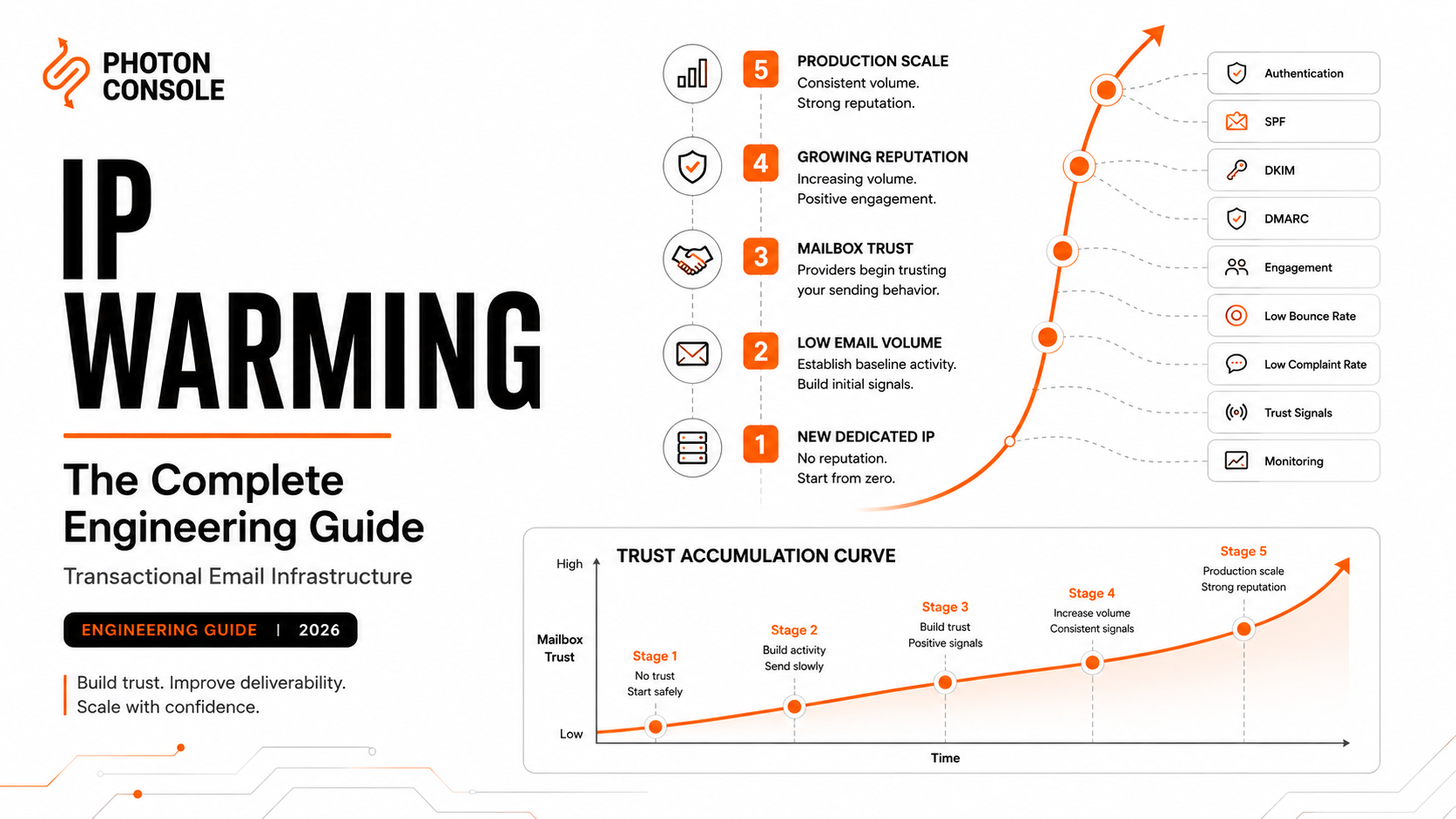
Gradually ramping send volume on a new IP so receiving ISPs build reputation history rather than treating a sudden spike as suspicious. It applies whenever you move to a new dedicated IP.
How long does a platform migration take?
For a straightforward stack, one to three weeks including a parallel testing period. Longer if templates are deeply coupled to the outgoing vendor’s engine.
Will migrating hurt my deliverability?
Temporarily, if a new domain or IP is involved and you don’t warm it. Migrating to a shared pool on an established sending domain usually has minimal impact.
What is a suppression list and why does it matter at migration?
A list of addresses that have hard bounced or complained. Failing to import it into the new platform means re-sending to known bad addresses on day one, which damages reputation immediately.
Should transactional and marketing email share a platform?
Sharing a vendor is fine; sharing a sending domain and IP reputation is risky, since marketing complaints degrade transactional deliverability. See transactional vs marketing email.
What compliance certifications should I look for?
Commonly SOC 2 Type II and ISO 27001; healthcare requires BAA availability, and EU operations may require documented data residency. Confirm current status directly with the vendor.
What does “observability” actually mean for email?
Being able to answer, for any individual message, what happened to it and when — and to detect aggregate degradation in bounce or complaint rates before customers report it.
How do I know if my platform’s deliverability is degrading?
Track bounce rate, complaint rate, and delivery latency as continuous metrics with alerting thresholds — see reducing bounce rate for SaaS applications.
What causes emails to be delayed on a platform?
Usually recipient-side throttling triggering platform retries. See emails delayed and transactional email latency.
Why do emails show as sent but never arrive?
Acceptance by the platform is not delivery to the inbox. See emails sent but not delivered.
Can free SMTP servers work as a platform?
No — they lack reputation management, retry engines, suppression handling, and support. See free SMTP servers for the tradeoffs.
How many platforms should I shortlist?
Two or three. Beyond that, evaluation cost exceeds the marginal benefit — use the Engineering Decision Matrix™ above to narrow quickly.
What questions should I ask a vendor during evaluation?
How soft bounces are classified and retried; published rate limits; webhook retry policy; suppression list export format; current certifications; and what changes at 10x your volume.
Can I run two platforms simultaneously as a failover?
Yes, and it’s common at scale — but it doubles your observability surface and requires both domains to maintain warm reputation. Only worth it if email downtime is genuinely revenue-critical.
Final Recommendation
There is no universally best transactional email platform, and any guide that names one is selling something. The defensible recommendation is a matching exercise:
- Regulated industries — start from compliance capability and evaluate only platforms that clear it. SendGrid, Mailgun, Postmark, SparkPost, and Amazon SES have the deepest procurement track records here.
- AWS-native teams at high volume — Amazon SES, provided you have the engineering capacity to assemble the surrounding platform layers.
- Transactional deliverability as the top priority — Postmark, where the transactional-only policy is the product.
- Marketing and transactional consolidation — SendGrid or Brevo, accepting shallower engineering tooling in exchange.
- React/Next.js product teams — Resend, if enterprise procurement isn’t a near-term requirement.
- Deliverability analytics depth at enterprise scale — SparkPost, if you’ll staff someone to act on the data.
- Inbound processing and complex routing — Mailgun.
- Variable, unpredictable volume with low tolerance for lock-in — pay-per-use platforms like PhotonConsole, where cost scales linearly and exit cost stays low.
Whatever you choose, the discipline that separates a good outcome from a bad one is the same: evaluate compliance before features, demand observability demos before signing, and ask what exit looks like before you need to know.
Related reading: Transactional email service · Email API integration · Email queue architecture · SMTP relay for transactional emails · Improve email deliverability · Email infrastructure checklist before launch · Why emails go to spam in Gmail
External references: RFC 5321 — SMTP · RFC 7208 — SPF · RFC 6376 — DKIM · DMARC.org · Gmail sender guidelines · Google Postmaster Tools · Microsoft SNDS · HHS HIPAA for professionals