


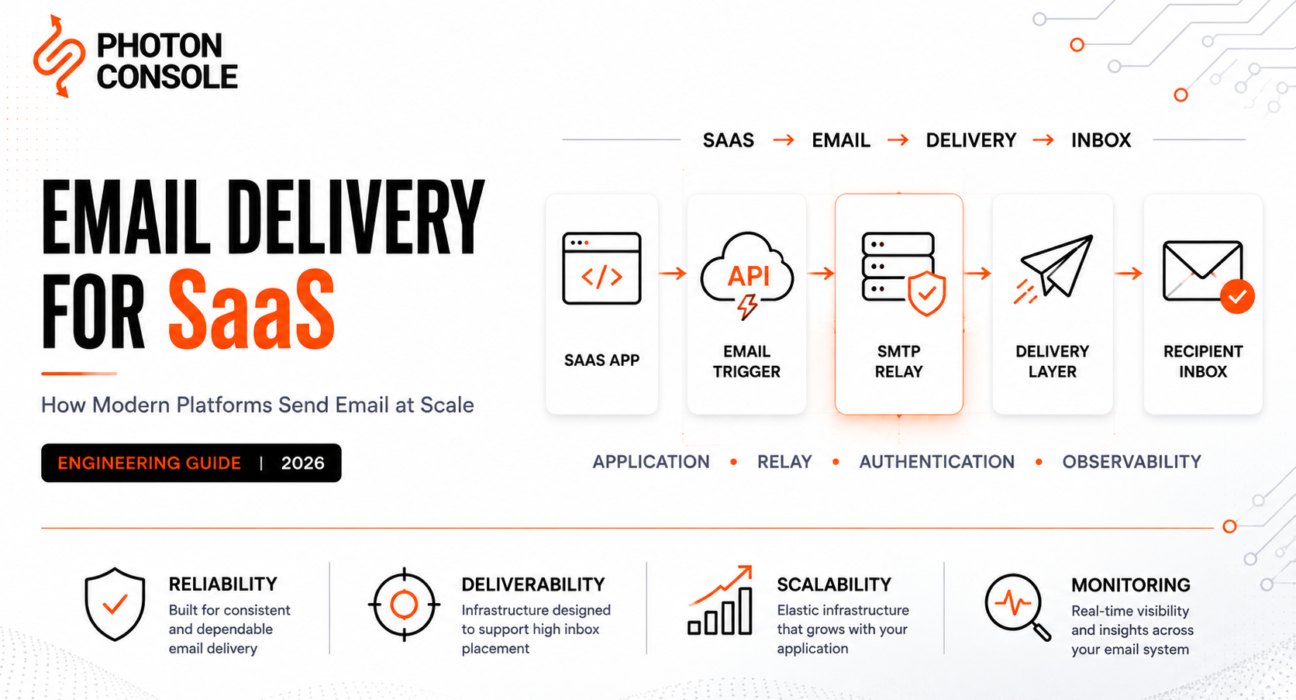
When a user clicks “Send” inside a SaaS product, they see one action. Underneath, the message has to be constructed, queued, handed to a relay, authenticated against a sending domain, attempted against a receiving mail server, and then judged by that server on the basis of who sent it and how that sender has behaved recently.
That gap between the button and the inbox is where two very different responsibilities live. The first is the customer-facing product: interface, contact records, segmentation, automation, dashboards. The second is the email delivery infrastructure: the relay, sender identity, delivery attempts, and the signals coming back. Both are engineering work. They are not the same engineering work, and the teams best suited to each are rarely the same team.
This matters most for products that send email on behalf of their own customers — an email marketing platform, a Shopify app, a CRM, a helpdesk. These are not just sending their own password resets. They operate a sending surface used by many organisations at once, which makes the delivery layer a shared asset rather than a private one.
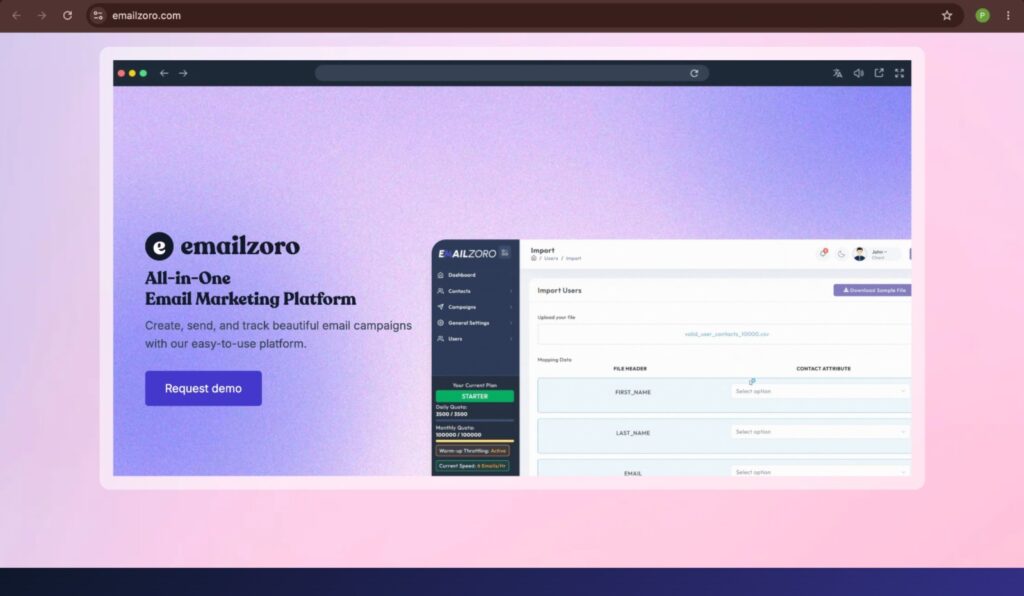
EmailZoro is a working example of how that split can be organised: the platform has selected PhotonConsole as its SMTP relay infrastructure partner, keeping its customer-facing software in-house while a specialised provider operates the relay beneath it. We return to that arrangement in detail below.

What Is Email Delivery Infrastructure for SaaS?
Email delivery infrastructure for SaaS is the layer of systems and operational practices that moves application-generated email from a software product toward recipient mail systems, and handles the responses that come back.
It sits below the product and above the public internet. The product decides what to send and to whom; the infrastructure layer gets it there and reports what happened. Depending on the architecture, a SaaS email stack may include some or all of the following:
- Application layer — where the message and its recipients are determined
- Trigger layer — the API call, event or queued task that initiates the send
- SMTP relay — accepts the message and owns delivery attempts
- Sender identity and authentication — the domain configuration proving the sender is legitimate
- Delivery processing — queueing, retry behaviour and connection handling
- Recipient mail systems — which accept, defer, reject or filter
- Bounce and complaint signals — feedback on whether sending practices are healthy
- Observability — logs and monitoring that make outcomes visible
No two products assemble these identically. A small application might use a single provider API and nothing else. A multi-tenant platform sending on behalf of many customers needs considerably more structure, because it manages sender identity and reputation for many parties rather than one. The useful question is not which components the canonical architecture has, but which of them your team owns and which someone else operates for you.
The Difference Between a SaaS Product and Its Email Delivery Infrastructure
A SaaS product and its email delivery infrastructure are two distinct layers with different failure modes, different skills and different day-to-day work.
The product layer is what customers evaluate, describe in reviews and pay for. The infrastructure layer is what they only notice when it breaks.
| SaaS product layer | Email delivery infrastructure layer |
|---|---|
| User accounts and permissions | SMTP relay operation |
| Campaign creation and editing | Message acceptance and queueing |
| Contact records and list management | Sender identity and domain configuration |
| Segmentation and targeting logic | Delivery attempts and retry handling |
| Automation and triggered workflows | Bounce and complaint signal processing |
| Dashboards and reporting | Infrastructure monitoring and delivery visibility |
| Ecommerce and third-party integrations | Traffic controls and sender-quality safeguards |
Two things follow. The skills barely overlap — building a good segmentation engine tells you nothing about how a receiving mail server interprets a sudden change in sending pattern. And the work has a different rhythm: product work ships on a roadmap, while infrastructure work is continuous and largely reactive. Reputation shifts, receiving systems change filtering behaviour, a customer imports a bad list. That work does not fit neatly into a sprint, which is why it tends to get deferred inside product-led teams until something breaks.
What Happens After a User Clicks “Send”?
The path from a user action to a delivery outcome runs through several stages. This is a conceptual model, not a description of any specific provider’s implementation.
- A user triggers an email. A campaign is sent, an automation fires, or a product event creates a message.
- The application prepares it. Content is rendered, personalisation applied, recipients resolved from contact records.
- It passes into the delivery layer. This handoff — SMTP submission or API call — is the boundary between product and infrastructure.
- The relay accepts and processes it. It queues the message and takes on delivery. Related: how an SMTP relay service works.
- Sender configuration is evaluated. Receiving systems check whether the domain authorised this infrastructure to send for it.
- Delivery attempts are made. The relay handles temporary failures, retries and permanent rejections per the responses received.
- Signals come back. Acceptances, bounces, deferrals and complaints report on the message and on the sender’s standing.
Stage three is where responsibility transfers, and therefore where the architectural decision gets made. Stage seven is the one most often neglected: a relay reporting successful handoff does not mean a message reached an inbox, since it can be accepted and then filtered.
The Main Components of a SaaS Email Infrastructure Stack
The Application Layer
This is the product itself — where messages originate. For a platform sending on behalf of customers, the application layer also holds the tenant model: which customer owns which contacts, which sending domain belongs to whom, and what each tenant may send. That structure matters downstream, because delivery problems in a multi-tenant platform are rarely global. They are usually specific to one customer’s sending behaviour, and the infrastructure needs enough context to tell the difference.
Email Triggers and APIs
Messages enter the delivery path through a trigger: a user action, a scheduled campaign, a webhook from an ecommerce store, or an automation rule. The mechanism is usually an SMTP submission or an HTTP API call. The design decision that matters here is whether sending is synchronous or queued — a product that blocks a user-facing request on a delivery call inherits the delivery layer’s worst-case latency as its own.
SMTP Relay Infrastructure
The relay accepts messages and takes on responsibility for delivery. It manages connections to recipient servers, applies retry logic to temporary failures, and interprets response codes to decide whether a message should be reattempted or abandoned. For platforms handling both campaign and triggered traffic, the relay is also where traffic separation becomes possible — covered further in SMTP relay for transactional email.
Sender Authentication and Identity
Authentication establishes that a message genuinely comes from the domain it claims. SPF, DKIM and DMARC are the mechanisms receiving systems use to decide, and misconfiguration is one of the most common causes of legitimate mail being rejected or filtered.
For a multi-tenant platform this is far more involved than for a single application: each customer sending from their own domain needs their own correct records, and the platform must guide non-technical users through DNS changes it cannot make for them. Our explainer on SPF, DKIM and DMARC covers the mechanics.
Bounce and Complaint Signals
Bounces indicate that an address is invalid or temporarily unavailable. Complaints indicate that a recipient marked a message as unwanted. Both are operational inputs, not reporting artefacts. Continuing to send to hard-bounced addresses, or to recipients who have complained, degrades sender standing over time — and in a shared environment it degrades it for everyone on that infrastructure. This is why suppression handling is an infrastructure concern rather than a per-customer courtesy.
Monitoring and Observability
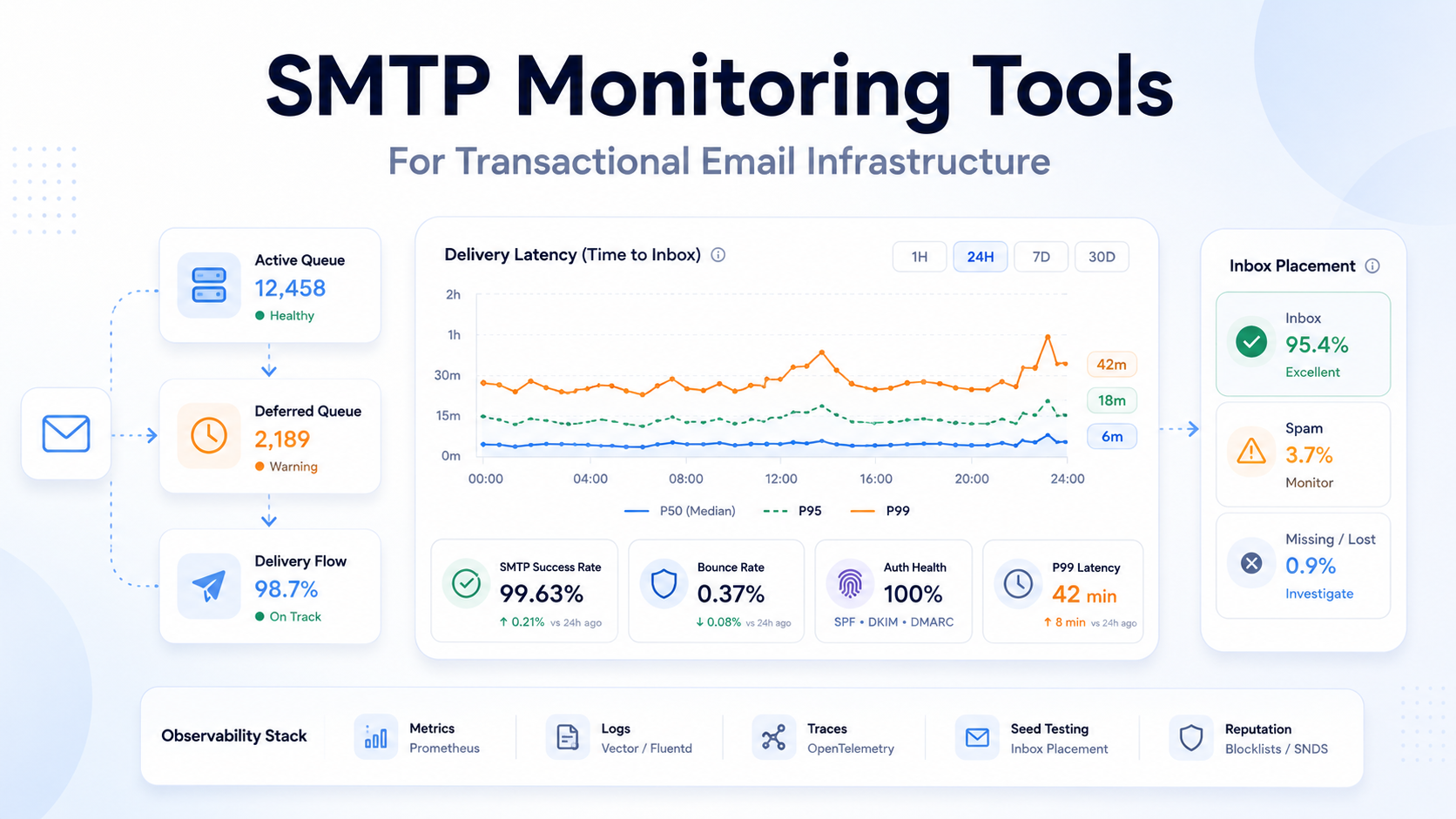
Observability is the ability to answer questions about delivery after the fact: what happened to a specific message, whether bounce rates have shifted, whether one tenant’s behaviour is affecting others. The distinction that matters is between absolute thresholds and rate of change — a complaint rate doubling is meaningful even within an otherwise acceptable band, and change-based alerting catches degradation earlier than fixed limits do.
Delivery Policies and Responsible Sending
Infrastructure that accepts any traffic offered to it eventually carries traffic that damages everyone on it. Policies governing what may be sent — consent requirements, prohibitions on purchased or scraped lists, unsubscribe handling — are part of the infrastructure layer, not decoration around it. For a platform, these also have to be enforceable at the tenant level, since the platform is accountable for traffic its customers generate.
Why SaaS Platforms Often Separate Product Development From Email Infrastructure
SaaS platforms separate these layers because product work and delivery operations compete for the same engineering hours while producing very different returns. Every hour on relay operations is an hour not spent on what customers chose the product for — and unlike product work, delivery operations produce nothing visible when they go well. Users notice a badly run relay layer, usually after something has already failed.
Separation is not automatically correct, though. The right approach depends on:
- Product requirements — whether email is a core feature or a supporting function
- Engineering resources — whether delivery operations can genuinely be staffed
- Scale and traffic profile — volume, burstiness, and how many senders share the infrastructure
- Architecture — how tightly delivery is coupled to product logic
- Compliance needs — data residency, audit or sector-specific obligations
- Operational requirements — incident response expectations and on-call capacity
Some organisations have genuine reasons to operate their own delivery infrastructure: unusual compliance constraints, volume economics at very large scale, or a requirement no provider serves. That is a legitimate position, provided the ongoing operational cost is acknowledged rather than discovered later. The failure mode is not choosing one approach over the other — it is choosing neither deliberately, running delivery operations informally with no one accountable until a reputation problem surfaces.
Build Your Own Email Infrastructure or Use a Specialised SMTP Provider?
Neither approach is universally correct. The comparison below sets out what each option actually entails.
| Consideration | Building internally | Using specialised infrastructure |
|---|---|---|
| Engineering ownership | Full control over the delivery path and its behaviour | Control over the product layer; delivery behaviour defined by the provider |
| Operational responsibility | Your team handles relay operations, incidents and remediation | Delivery operations sit with the provider |
| Infrastructure management | Servers, IP addresses, blocklist remediation and capacity are yours | Managed by the provider as its primary product |
| Product focus | Engineering attention divided between product and delivery | Engineering attention concentrated on the product |
| Customisation | Unconstrained, if you will maintain it | Bounded by what the provider supports |
| Sender reputation | Becomes a named internal responsibility | Maintained by the provider at the infrastructure level |
| Scaling | Growth introduces new infrastructure work at each step | Largely a commercial and configuration matter |
| Time to production | Longer — build before the feature ships | Shorter — integration rather than construction |
For products where email is a customer-facing feature rather than an internal utility, specialised infrastructure lets the product team concentrate on the application while a dedicated provider takes the delivery responsibilities. For teams with unusual requirements or the capacity to staff delivery operations properly, building internally is a reasonable choice. Our guide to choosing an email service for SaaS applications covers the vendor-selection criteria in more depth.
Real-World Example: How EmailZoro Uses Specialised SMTP Infrastructure
EmailZoro has selected PhotonConsole as its SMTP relay infrastructure partner. Under the arrangement, PhotonConsole provides the underlying SMTP relay infrastructure for applicable approved email traffic across both EmailZoro’s independent platform and the WDT Emailzoro app on the Shopify App Store.
The division of responsibility is clean:
| EmailZoro | PhotonConsole |
|---|---|
| Customer-facing platform and interface | Specialised SMTP relay infrastructure |
| Campaign creation and scheduling workflows | Underlying delivery layer for applicable approved traffic |
| Contact management and segmentation | Sender-quality signals and reputation-based practices |
| Automation, ecommerce functionality and Shopify integration | Responsible infrastructure practices and traffic controls |
What makes this a useful example is that EmailZoro did not give up product control in exchange for infrastructure support. Its roadmap, feature decisions, merchant experience and workflows remain entirely its own. What changed is where relay responsibility sits.
EmailZoro’s Shopify app shows why this is more than a procurement detail. The app synchronises store customers, builds segmented lists, runs campaigns and triggers automated abandoned-cart recovery communication. Every one of those features depends on messages actually being delivered — and none of them are improved by EmailZoro operating relay infrastructure itself.
The full announcement, including the scope of the arrangement and the responsibilities each company retains, is covered in our article on EmailZoro’s SMTP infrastructure partnership with PhotonConsole.
EmailZoro and PhotonConsole remain independent organisations. The collaboration concerns email delivery infrastructure specifically.
One Delivery Foundation Across Multiple Product Experiences
A single delivery foundation lets a SaaS company operate several customer-facing products without maintaining separate email infrastructure for each one.
Most growing SaaS companies end up with more than one surface: a standalone web platform, an ecommerce or marketplace app, sometimes a mobile product or a partner white-label. Each has its own interface, release cycle and feature priorities. What they usually do not need is separate delivery arrangements — one per surface means multiple sender configurations, multiple reputation profiles, and multiple places for a problem to originate, with no consolidated view across them.
Conceptually: customer-facing platform and ecommerce or marketplace application both route applicable email traffic into specialised email delivery infrastructure, which handles delivery attempts toward recipient mail systems.
EmailZoro’s arrangement follows that shape — the standalone platform and the Shopify app are separate products with separate audiences, both sending through one relay foundation. This is a simplified conceptual model, not a description of proprietary technical architecture.
The value is in the decoupling: product surfaces can be added, changed or retired without touching the delivery layer, and delivery-layer decisions do not ripple into product roadmaps.
Transactional and Permission-Based Marketing Email Have Different Requirements
Transactional and marketing email place different demands on delivery infrastructure, and treating them as one category is a common source of reputation problems.
Transactional communication is connected to a user action or requested service — confirmations, notifications, account messages. Recipients expect these, complaint rates are typically low, and timing matters.
Permission-based marketing goes to recipients who have given affirmative consent or where another lawful basis exists. Engagement varies more widely, complaint risk is materially higher, and timing tolerance is broader.
Because receiving systems evaluate reputation at the domain and IP level rather than per message, marketing traffic that generates complaints can affect transactional mail sharing the same sending identity. The separation mechanics are covered in our guide to transactional versus marketing email.
For platforms carrying both, infrastructure has to account for:
- Sender identity — accurate and consistent representation of who is sending
- Consent — a real basis for marketing, recorded and current
- List quality — ongoing hygiene rather than one-time cleanup
- Unsubscribe handling — functional, prompt, honoured across every sending surface
- Complaint and bounce signals — treated as operational triggers, with automated suppression
- Traffic controls — limits on what is permitted onto the infrastructure
Purchased, rented, harvested and scraped lists sit outside responsible sending entirely, as does continued marketing after an unsubscribe or complaint. These are the traffic patterns most likely to damage shared infrastructure for everyone on it.
Sender Reputation and Responsible Email Delivery
No email infrastructure provider can guarantee inbox placement. Delivery outcomes are decided by recipient mail systems, which weigh a range of factors no sending-side provider fully controls. This is worth stating plainly, because the opposite claim is common in the category and is not accurate.
Delivery outcomes can be influenced by:
- Sender practices — how lists are built, how often sending occurs, how volume changes
- Authentication — whether SPF, DKIM and DMARC are correctly configured and aligned
- Recipient engagement — opens, replies, deletions and moves to spam
- List quality — the proportion of valid, engaged, consenting recipients
- Complaint and bounce patterns — unwanted-mail reports and repeated sends to invalid addresses
- Message content — structure, links, and resemblance to patterns filters distrust
- Recipient mail system policy — each applies its own filtering logic, which changes over time
Several of these belong to the sender rather than the infrastructure. A platform can operate excellent delivery infrastructure and still see poor outcomes for a customer sending to a badly sourced list. What responsible infrastructure practice does is remove the failures within the infrastructure’s control and stop one sender degrading conditions for others — a different claim from guaranteed placement. Our guide to improving email deliverability covers the sender-side practices.
How SaaS Teams Should Evaluate Their Email Infrastructure
Work through these questions before committing to an architecture. They surface most of what matters earlier than an incident will.
- What types of email does the product send? Enumerate them. Most teams find more categories than expected.
- Is the traffic transactional, marketing, or both? If both, decide how they will be separated before either establishes reputation.
- Does the product send on its own behalf, or on behalf of customers? Multi-tenant sending changes almost every downstream answer.
- How will email be triggered? Synchronous calls inside user-facing requests are a latency liability.
- Which layer handles delivery? Name it — an unowned delivery layer is the most common structural gap.
- How is sender identity managed? Especially where customers send from their own domains and configure their own DNS.
- How are bounces and complaints handled? Automated suppression, or a manual process nobody runs?
- What monitoring is required? Can you trace one message, and would you notice a complaint rate doubling?
- Where is the boundary between product team and infrastructure provider? Write it down — ambiguity here surfaces during incidents.
- What happens if delivery stops for four hours? The answer determines how much of this deserves investment.
Key Takeaways
- A SaaS product and its email delivery infrastructure are distinct layers with different skills, failure modes and operational rhythms.
- SMTP relay is one component of a broader system that also includes authentication, delivery processing, feedback signals and observability.
- No infrastructure provider can guarantee inbox placement — sender practices, list quality and recipient engagement all influence outcomes.
- Multiple customer-facing products can share one delivery foundation, reducing sender configurations and reputation profiles to maintain.
- Whether to build or buy depends on product requirements, engineering capacity, scale, compliance needs and architecture — not a universal rule.
- Transactional and permission-based marketing email carry different complaint profiles and generally warrant separation at the sending-identity level.
- EmailZoro provides a real-world example: the platform uses PhotonConsole as its SMTP relay infrastructure partner across its independent platform and Shopify app, while retaining full ownership of its customer-facing product.
Frequently Asked Questions
What is email delivery infrastructure for SaaS?
Email delivery infrastructure for SaaS is the layer that moves application-generated email from a software product toward recipient mail systems and handles the responses that come back. Depending on the architecture it may include SMTP relay, sender authentication, delivery processing, retry handling, bounce and complaint signal processing, and delivery observability. It sits beneath the product layer that decides what to send.
What is the difference between a SaaS application and email delivery infrastructure?
The SaaS application is the customer-facing product — accounts, campaigns, contacts, segmentation, automation and dashboards. Email delivery infrastructure is the underlying layer that relays messages, manages sender identity, attempts delivery and processes feedback signals. The application decides what to send and to whom; the infrastructure is responsible for getting it there and reporting what happened.
What does an SMTP relay do for a SaaS platform?
An SMTP relay accepts messages from a SaaS platform and takes responsibility for delivering them to recipient mail servers. It manages connections, applies retry logic to temporary failures, interprets response codes, and returns delivery signals. For platforms sending on behalf of many customers, the relay is also where traffic controls and sender-quality practices are applied.
Should a SaaS company build its own email infrastructure?
It depends on the situation rather than on a general rule. Building internally makes sense where there are unusual compliance requirements, volume economics that justify it, or capacity to staff delivery operations as an ongoing responsibility. For many products — especially where email is a customer-facing feature — specialised infrastructure lets the team concentrate engineering effort on the application instead.
Can one email infrastructure support multiple SaaS products or applications?
Yes. A single delivery foundation can support several customer-facing products — a standalone platform, an ecommerce app, a mobile product — without separate infrastructure for each. This consolidates sender configuration and reputation management, and lets product surfaces evolve independently of the delivery layer beneath them.
How does EmailZoro use PhotonConsole?
EmailZoro uses PhotonConsole as its SMTP relay infrastructure partner for applicable email delivery across its independent platform and its Shopify app. PhotonConsole provides the underlying relay infrastructure for approved email traffic, while EmailZoro retains its customer-facing platform, campaign workflows, contact management, segmentation and automation. The two companies remain independent organisations.
What affects email deliverability for SaaS platforms?
Deliverability is influenced by sender practices, authentication configuration, recipient engagement, list quality, complaint signals, bounce patterns, message content and each recipient mail system’s own filtering policy. Some of these belong to the infrastructure layer and some to the sender. No provider can guarantee inbox placement, because the final decision rests with the receiving system.
What is the difference between transactional and marketing email infrastructure?
Transactional email is connected to a user action or requested service, typically carries low complaint rates and is time-sensitive. Permission-based marketing goes to recipients with affirmative consent, carries higher complaint risk and has broader timing tolerance. Because reputation is evaluated at the domain and IP level, mixing them means marketing complaints can affect transactional delivery.
Build the Right Email Infrastructure for Your SaaS Product
The decision worth making deliberately is not which provider to use. It is where the boundary sits between your product and your delivery layer, and who is accountable on each side of it.
If you are building a SaaS platform or an email-driven application and want that boundary to sit with a provider whose primary discipline is delivery, PhotonConsole operates SMTP relay infrastructure for software products that need a dedicated delivery layer rather than an infrastructure side project.


Why Email Marketing Platforms Use Specialized SMTP Relay Infrastructure | Photonconsole.com
August 25, 2026[…] Email Delivery Infrastructure for SaaS: How Modern Platforms… […]
SMTP Infrastructure For Shopify Apps: How Email Marketing Apps Handle Email Delivery | Photonconsole.com
August 25, 2026[…] Email Delivery Infrastructure for SaaS: How Modern Platforms… […]
How To Integrate SMTP Relay Into A SaaS Application: A Practical Guide | Photonconsole.com
August 25, 2026[…] Email Delivery Infrastructure for SaaS: How Modern Platforms… […]