

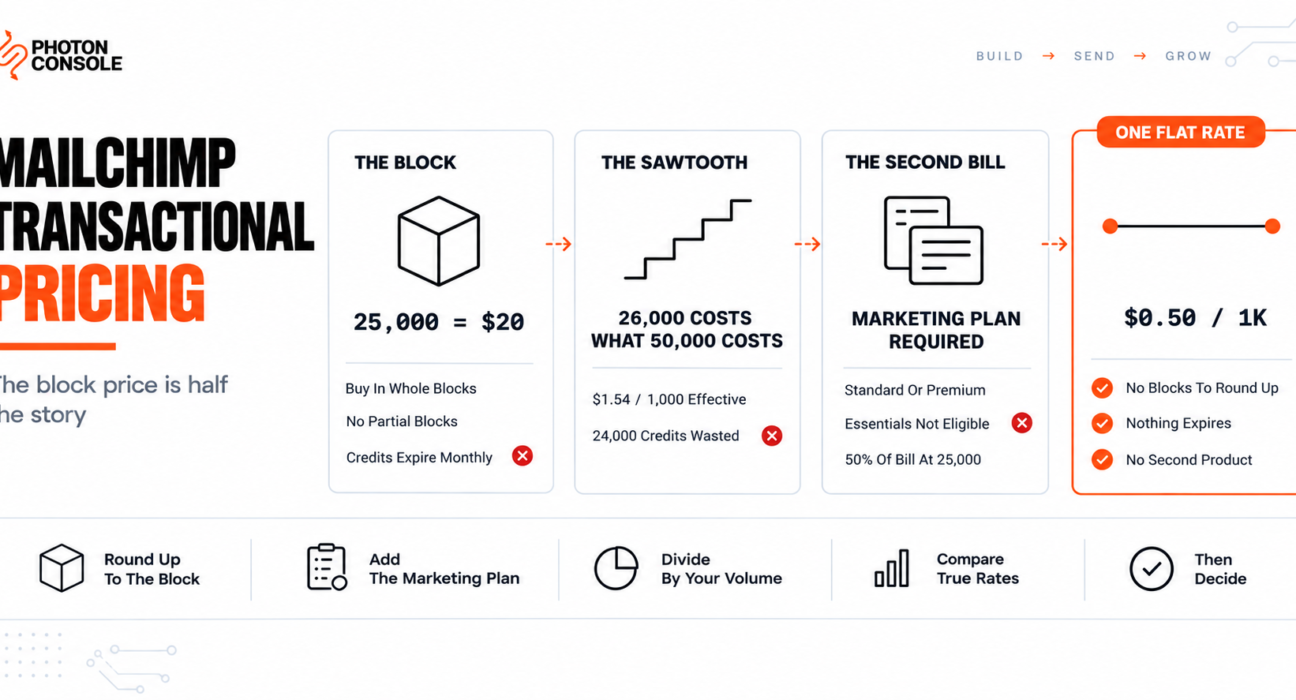
Mailchimp’s transactional costs $20 for a block of 25,000 emails. That is 80 cents per thousand, which looks competitive against most dedicated providers.
Your bill will not reflect that figure, because you cannot buy blocks on their own. Transactional Email is an add-on, and the thing it is an add-on to is a paid Mailchimp marketing plan you may have no use for.
At low volume that second product is not a detail. It is half of what you pay.
Quick Answer: What Is Mailchimp’s Transactional Cost?
From Mailchimp’s Transactional Email pricing page, each block is a credit for 25,000 emails, and the per-block rate falls as volume rises:

| Blocks | Emails per month | Price per block | Per 1,000 |
|---|---|---|---|
| 1–20 | Up to 500,000 | $20 | $0.80 |
| 21–40 | 500,000–1M | $18 | $0.72 |
| 41–80 | 1M–2M | $16 | $0.64 |
| 81–120 | 2M–3M | $14 | $0.56 |
| 121–160 | 3M–4M | $12 | $0.48 |
| 161+ | 4M+ | $10 | $0.40 |
Two conditions attach to all of it. Unused emails do not carry over from one month to the next. And per Mailchimp’s own documentation, Transactional Email “is a paid add-on to a Standard or Premium monthly Marketing plan” — the Essentials plan is explicitly not eligible.
A dedicated IP is available as an optional add-on at $29.95 a month. New users can try a free demo of up to 500 sends to a verified domain.
How Blocks Behave, and Why That Costs You
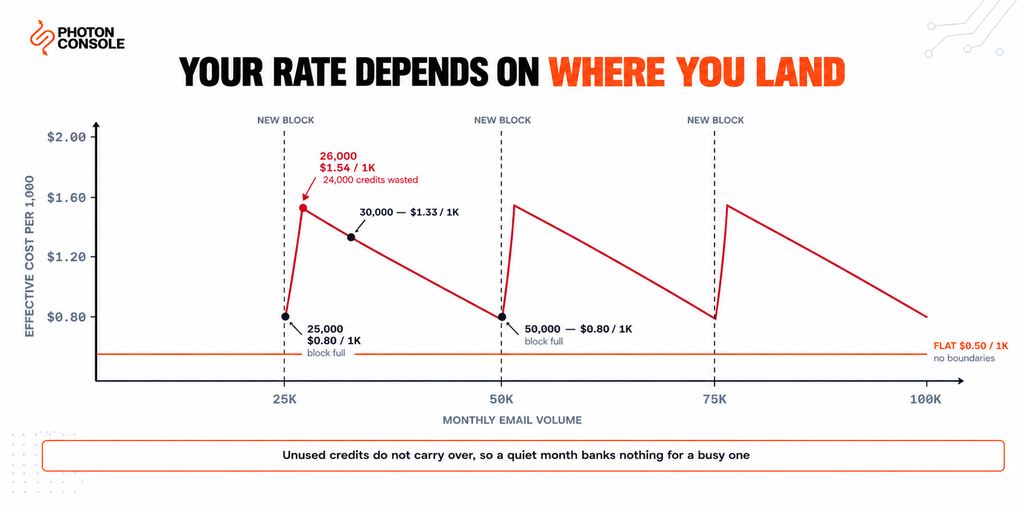
Block pricing is not the same as per-send pricing, and the difference shows up as a sawtooth in your effective rate.
Because you buy capacity in units of 25,000 and nothing carries over, a month that lands just above a boundary costs the same as a month that fills the block completely.
# Blocks are 25,000 emails. Unused credits expire monthly.

  25,000 emails  ->  1 block  = $20  ->  $0.80 / 1,000
  26,000 emails  ->  2 blocks = $40  ->  $1.54 / 1,000
  30,000 emails  ->  2 blocks = $40  ->  $1.33 / 1,000
  50,000 emails  ->  2 blocks = $40  ->  $0.80 / 1,000
  51,000 emails  ->  3 blocks = $60  ->  $1.18 / 1,000

# Sending 1,000 more than 25,000 costs an extra $20
# and discards 24,000 unused credits at month end.
So the advertised 80 cents per thousand is the best case — what you pay only when your volume happens to land exactly on a multiple of 25,000. Anywhere else, you are paying for capacity you will not use and cannot bank.
Common Mistake
Treating the per-thousand figure as your rate. It is the rate at a full block, and transactional volume rarely cooperates. A product sending around 27,000 emails a month pays for 50,000 every month, and the 23,000 unused credits expire rather than covering next month’s spike. If your volume sits a little above a boundary, the cheapest change available to you is often to send less — which is a strange position for an email provider to put you in.
The Second Product You Have to Buy
This is the part that changes the comparison, and it is easy to miss because it sits on a different pricing page.
Mailchimp Transactional is an add-on to a Standard or Premium Marketing plan. You cannot subscribe to it by itself, and you cannot attach it to Essentials — Mailchimp’s cheapest paid tier is not eligible. So the floor for any Transactional setup is a Standard Marketing plan plus at least one block.
Mailchimp’s Marketing pricing page lists Standard from $20 a month, though that figure is an introductory rate for the first twelve months and scales with your contact count — so treat it as an illustration and get your own number before comparing anything.
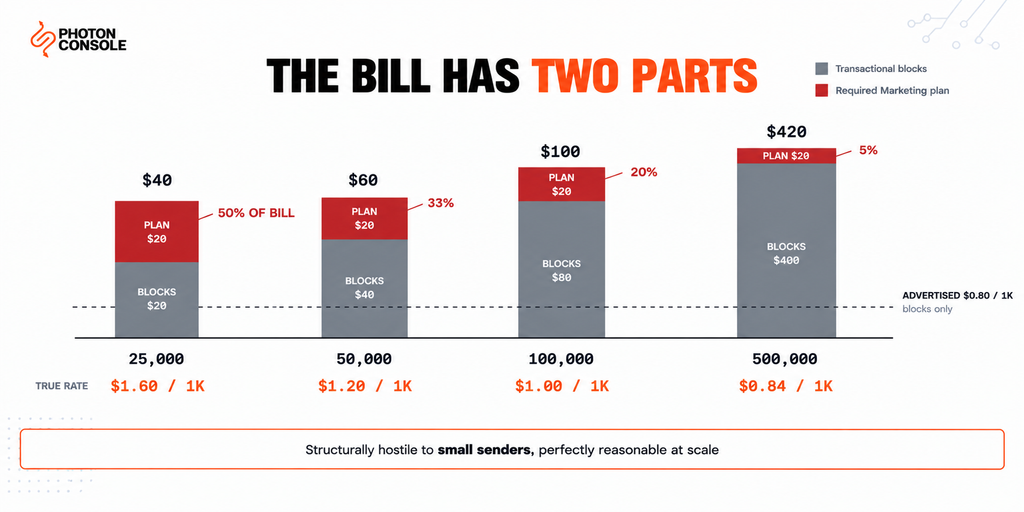
Using that $20 as the illustration, here is what the two products do to your effective rate:
| Monthly emails | Blocks | + Marketing plan | Blocks alone | True rate |
|---|---|---|---|---|
| 25,000 | $20 | $40 | $0.80/1,000 | $1.60/1,000 |
| 50,000 | $40 | $60 | $0.80/1,000 | $1.20/1,000 |
| 100,000 | $80 | $100 | $0.80/1,000 | $1.00/1,000 |
| 500,000 | $400 | $420 | $0.80/1,000 | $0.84/1,000 |
At 25,000 emails the Marketing plan is 50% of the bill, and your true rate is double the advertised one. At 100,000 it is 20%. By 500,000 it is under 5% and the advertised rate is close to honest.
That is the shape of this pricing model: structurally hostile to small senders, and perfectly reasonable at scale. Which is a legitimate commercial position — it just means the published per-thousand figure describes a customer you may not be.
Quick Fix
Working Out What You Would Actually Pay
- Take your heaviest month’s volume and divide by 25,000, rounding up — that is your block count
- Multiply by the block price for that tier
- Get your own Standard or Premium quote at your real contact count, not the promotional figure
- Add the two together, then divide by your volume in thousands for your true rate
- Compare that number — not the block price — against any other provider
Quick Fix
Your Volume Lands Just Over a Block Boundary
- Check how far above the multiple of 25,000 you actually are — often it is a few hundred emails
- Audit what is in that overflow: retries, duplicate notifications and internal alerts are common
- Trimming genuinely unnecessary sends below the boundary saves a whole block
- If the overflow is real user mail, you cannot trim it and the block is simply a cost
- At that point compare your true rate against a provider with no block granularity
When It Does Make Sense
Two situations, and in both it is a reasonable choice rather than a compromise.
You already pay for Mailchimp Standard or Premium. If the Marketing plan is a cost you carry anyway for campaigns, then the marginal cost of adding Transactional is just the blocks — and 80 cents per thousand, falling to 40 cents at high volume, is genuinely competitive. The two-product penalty only exists if the second product is one you would not otherwise buy.
You send at high volume. Above a few hundred thousand a month the fixed plan cost disappears into the noise and the block discounts start to matter. At 4 million emails a month the block rate is $10, or 40 cents per thousand, which is a strong number.
Where it does not make sense is the middle: a developer who needs transactional email, does not run Mailchimp campaigns, and sends tens of thousands rather than millions. That reader is buying a marketing platform to get an SMTP relay, and paying twice the advertised rate for it. For that profile a dedicated relay such as PhotonConsole costs a quarter as much at the same volume, with nothing bundled that they would not use.
A Note on the Name
Note
If you have been searching for Mandrill and finding nothing that matches, that is because Mailchimp has retired the name. Its current documentation calls the product “Mailchimp Transactional” or “Transactional Email” and the page explaining the distinction between the two products does not use the word Mandrill at all. The API and SMTP endpoints still carry the mandrillapp.com domain, which is why the old name persists in configuration files and in developers’ memory long after the marketing name changed. Searching for either term is fine; just expect the official pages to use the new one.
Alternatives and What Switching Involves
Because Transactional exposes SMTP, moving away is a credential change rather than a rewrite — unless you built against the Mandrill API, in which case the sending code needs replacing.
# Before
SMTP_HOST=smtp.mandrillapp.com
SMTP_PORT=587
SMTP_USER=your_mailchimp_username
SMTP_PASS=your_mandrill_api_key

# After
SMTP_HOST=smtp.photonrelay.com
SMTP_PORT=587
SMTP_USER=your_project_api_user
SMTP_PASS=your_secret_api_key
Three things to decide before you move, because they determine whether the move is worth making:
| Question | If yes | If no |
|---|---|---|
| Do you use Mailchimp for campaigns? | Keep it; Transactional’s marginal cost is just blocks | You are paying for a platform to get a relay |
| Is your volume above ~500,000/month? | Block discounts make it competitive | The fixed plan cost dominates your rate |
| Does your volume land near a block boundary? | Effective rate is close to advertised | You are buying unused capacity monthly |
If the answers point to moving, a flat per-thousand rate removes all three questions at once. PhotonConsole charges $0.50 per 1,000 with no blocks to round up to, no credits to expire and no second product required — so 25,000 emails costs $10 against Mandrill’s $40 true cost at the same volume, and the rate is identical whether you send 26,000 or 50,000.
Our guide to pay-per-use versus subscription pricing works through that comparison method properly, and transactional email pricing across nine providers covers the wider field.
Authentication records
# During migration — both authorised in ONE record
v=spf1 include:spf.mandrillapp.com include:relay.photonconsole.com ~all
CNAME photon._domainkey dkim.photonconsole.comTake Mailchimp’s exact include from your own account rather than from this article. Add the new one to the same record — a second TXT record beginning v=spf1 breaks authentication rather than combining — and mind the ten-lookup ceiling that RFC 7208 places on SPF evaluation.
Receivers including Gmail expect aligned SPF and DKIM on transactional mail. Our guide to SPF, DKIM and DMARC covers alignment, and the free email deliverability checker shows what your domain publishes today.
PhotonConsole issues credentials on signup, so the parallel path can be live the same day. Run both for a few days before decommissioning the old one. Pricing includes 5,000 free emails a month, which covers a parallel run without a second bill.
Pro Tips
- Round your volume up to the block, always. 26,000 emails is a 50,000-email purchase, every month.
- Never quote the block rate as your cost. Add the mandatory Marketing plan first, then divide.
- Get your Standard quote at your real contact count. The listed price is introductory and scales.
- Check Essentials eligibility before planning around it. It is not eligible, so Standard is the floor.
- Remember credits expire monthly. A quiet month does not bank capacity for a busy one.
- Keep the old name in your notes. Endpoints still use
mandrillapp.comeven though the docs no longer say Mandrill. - Verify before any cutover. MXToolbox checks the combined SPF record, and Mail Tester scores a real send.
Related Reading
- Postmark pricing — feature tiers that look like volume tiers
- Mailgun pricing explained — overage priced above your included rate
- Amazon SES sending limits — the cheapest per email, and what it asks of you
- Brevo free plan limits — a free plan whose first paid tier gives you less
- Sending 100,000 emails a month without overpaying
- Transactional versus marketing email
Frequently Asked Questions
How much does Mailchimp Transactional cost?
$20 per block of 25,000 emails at entry volume, falling to $10 per block above 4 million emails a month. A dedicated IP is an optional $29.95 add-on.
Can I buy Mandrill without a Mailchimp plan?
No. Mailchimp’s documentation describes it as a paid add-on to a Standard or Premium monthly Marketing plan, and the Essentials plan is not eligible.
What is the real cost per email?
Add the Marketing plan to your blocks. At 25,000 emails with Standard illustrated at $20, the true rate is about $1.60 per 1,000 — double the advertised $0.80.
Do unused emails roll over?
No. Unused block credits do not carry from one month to the next, so a quiet month does not build capacity for a busy one.
What happens if I send 26,000 emails?
You need two blocks, so you pay $40 rather than $20, and 24,000 credits expire unused at month end.
Is Mandrill the same as Mailchimp Transactional?
Yes. Mailchimp has retired the Mandrill name in its documentation, though the SMTP and API endpoints still use the mandrillapp.com domain.
When is Mailchimp Transactional good value?
When you already pay for Mailchimp Standard or Premium for campaigns, so blocks are the only marginal cost — or at high volume, where the fixed plan cost becomes negligible and block discounts apply.
Is switching away difficult?
If you send over SMTP it is a change of host, port, username and password. If you integrated through the Mandrill API, the sending code needs rewriting.
Conclusion
Mailchimp Transactional’s published rate of 80 cents per thousand is accurate and incomplete. It is the rate for a customer who fills every block exactly and already pays for a Mailchimp Marketing plan. Change either condition and the real number moves sharply.
Blocks of 25,000 that do not roll over mean your effective rate depends on how near a boundary your volume lands — 26,000 emails costs what 50,000 costs. And because Transactional is an add-on to Standard or Premium, with Essentials excluded, there is a fixed second cost underneath everything: half your bill at 25,000 emails, a fifth at 100,000, and negligible by half a million.
So the answer depends entirely on which customer you are. Already running Mailchimp campaigns at serious volume? The marginal cost is just blocks and the economics are good. Need transactional email and nothing else, at tens of thousands a month? You are buying a marketing platform to obtain an SMTP relay, at roughly double the rate on the page.
For that second reader, a flat per-thousand rate from a reliable SMTP provider removes the whole calculation — no blocks to round up to, no credits expiring, no second subscription, and one rate that holds whatever your volume does this month. Work out your true rate first, then compare. That single piece of arithmetic is what every article in this series has been for.