

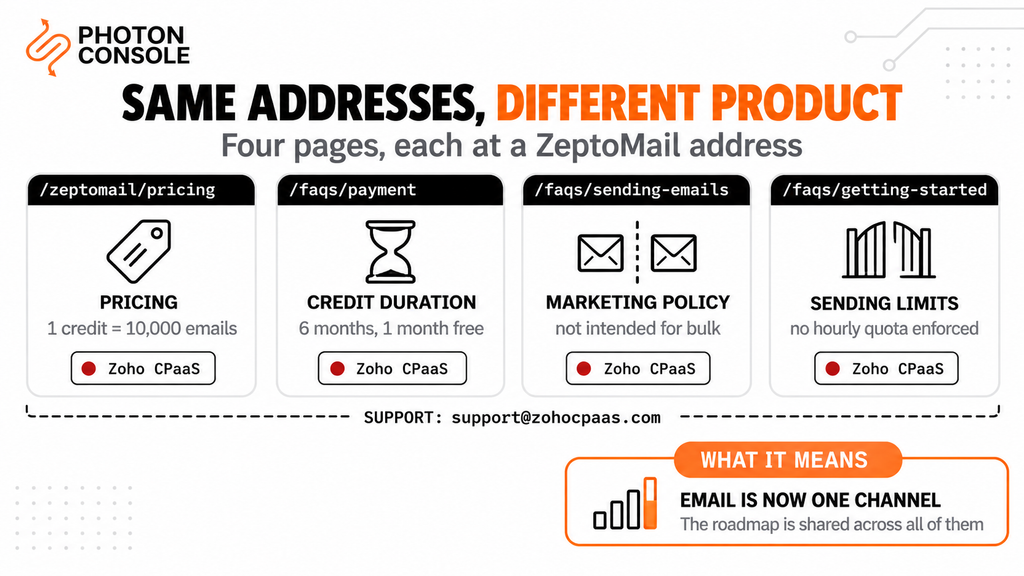
Open ZeptoMail’s pricing page today and read it carefully. It describes Zoho CPaaS. The credit validity FAQ in ZeptoMail’s own knowledge base describes Zoho CPaaS credits. The sending-limit FAQ describes Zoho CPaaS sending. The support address it gives you is support@zohocpaas.com.
ZeptoMail is being absorbed into a broader multi-channel communications platform. That is not a criticism — it may well mean more capability — but it changes what you are buying, and nothing on the page announces it.
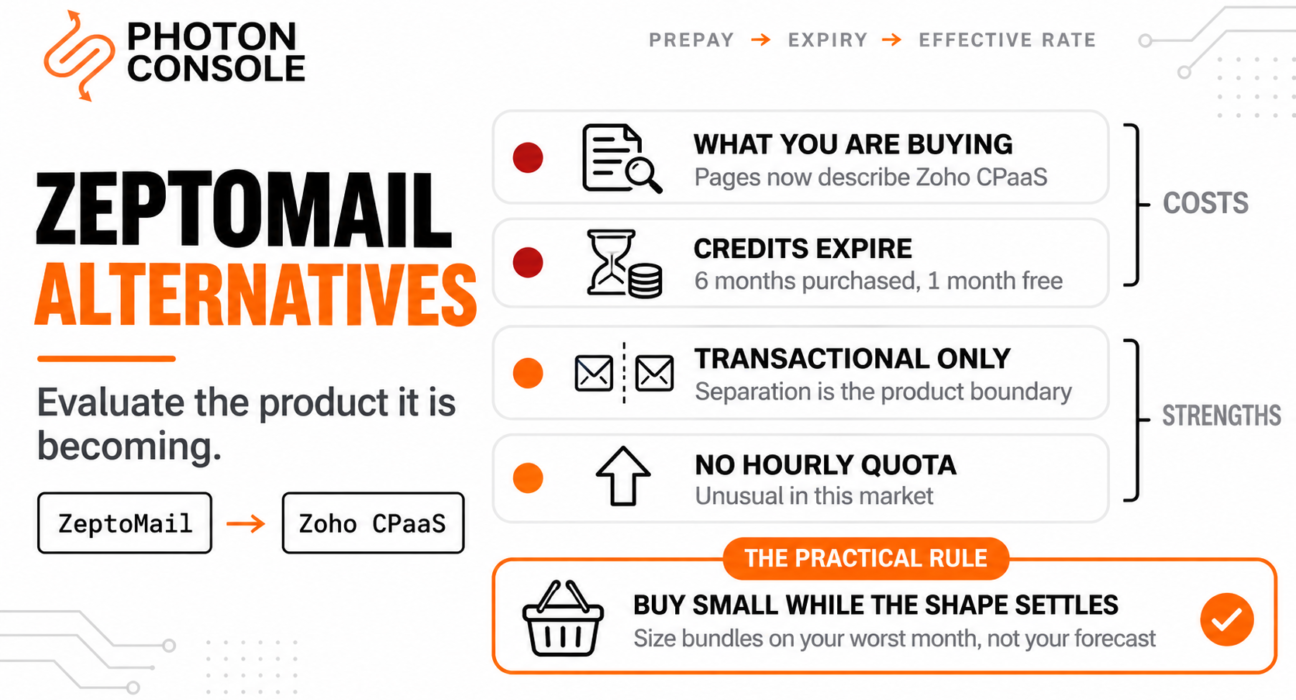
If you are choosing a transactional email provider, you should evaluate the thing it is becoming rather than the thing it was.
Quick Answer: Four Things to Check
| What to check | What the documentation says |
|---|---|
| What product you are buying | ZeptoMail pages now describe Zoho CPaaS; support is at zohocpaas.com |
| Credit expiry | Purchased email credits valid 6 months; free sign-up credits valid 1 month |
| What you may send | “Not intended for sending bulk marketing or promotional emails” |
| Sending limits | “Does not enforce an hourly quota or sending limit for email sending” |
Two of those are genuine strengths and two are costs. The order matters less than knowing all four before you prepay for anything.

The Product Is in Motion
This is the finding that should shape your evaluation, so it is worth being precise about the evidence.
The ZeptoMail pricing page presents Zoho CPaaS pricing, with email as one channel among several. Its email section states that each credit covers 10,000 emails, that the first credit is free, and that email credits are valid for six months. Dedicated IP addresses appear as an add-on billed annually, available in the US, EU and IN data centres.
The credit-duration article in ZeptoMail’s own help centre describes Zoho CPaaS credits rather than ZeptoMail credits. The sending-limit article in the same knowledge base says “Zoho CPaaS does not enforce an hourly quota or sending limit for email sending”, and directs questions to support@zohocpaas.com.
What this means in practice is not that the service is going away. It means email is becoming one channel in a platform that also handles other messaging types, and that the pricing, credits and support structure now belong to that platform.
Note
A repositioning like this is neither good nor bad on its own, but it does change which questions matter. A single-purpose transactional email product competes on delivery, logs and latency. A multi-channel communications platform competes on breadth, and its roadmap is shared across every channel it carries — which means email feature requests queue behind SMS, voice and whatever else the platform adds. If email is incidental to the platform’s strategy, your needs are incidental too. Ask where email sits in the roadmap before you commit to a long prepayment, and treat an answer you cannot get as information in itself.
Credits Expire, Which Changes the Price
The headline rate on a credit-based model looks excellent. The effective rate depends on whether you use what you bought.
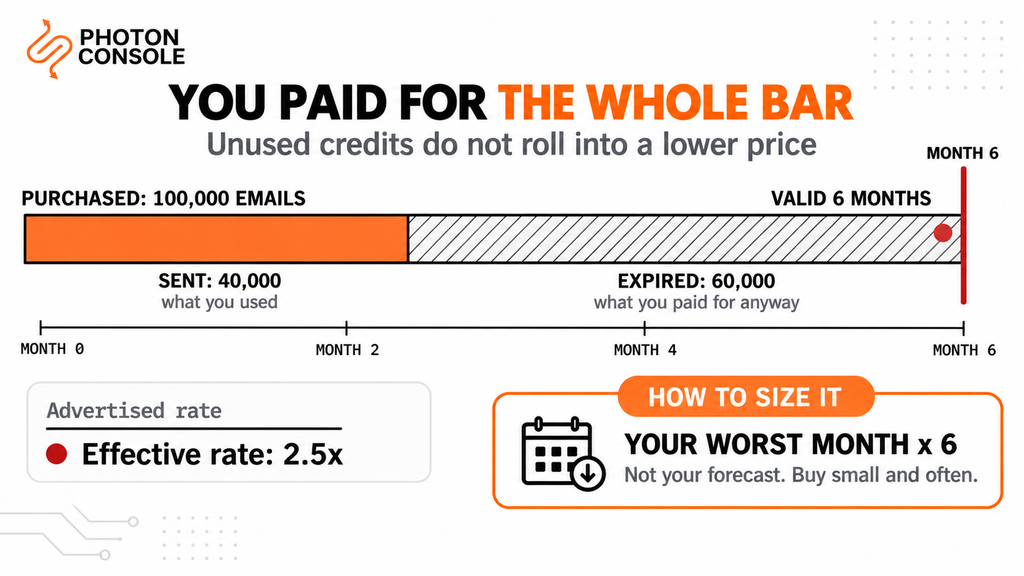
Per the documentation: purchased email credits are valid for six months from purchase, and the free credits allocated at sign-up are valid for one month. Each credit covers 10,000 emails.
That turns a cheap per-email rate into a consumption bet.
# The arithmetic nobody does before buying a bundle

  You buy       10 credits  = 100,000 emails
  Validity      6 months
  You actually send in 6 months:   40,000 emails
  ----------------------------------------------
  Consumed      4 credits
  Expired       6 credits  = 60,000 emails

  Effective cost per email:  2.5x the advertised rate
  You paid for 100,000 and sent 40,000.

# Now the hard part: transactional volume is driven by
# your users, not your plan. You cannot size the bundle
# confidently in advance, which is the whole problem.
This is a structural issue with prepaid credits rather than a trick. The cheaper the headline rate, the larger the bundle you are tempted to buy, and the larger the bundle the more likely some of it expires unused.
It also inverts the usual direction of risk. On a monthly plan, under-sending wastes a month. On expiring credits, under-sending wastes up to six months of prepayment — and the sender most attracted by a low rate is usually the one least able to forecast volume.
Quick Fix
Sizing a Prepaid Credit Purchase
- Take your lowest month of the last six and multiply by six — buy that, not your optimistic forecast
- Buy small and often rather than large and discounted, until you have a year of volume history
- Diarise the expiry date; nothing will remind you that credits are about to lapse
- Check whether unused credits roll over on repurchase before assuming they do
- Recalculate your effective rate on actual consumption, not on purchased volume — that is the number to compare against other providers
Transactional Only, and That Is a Feature
ZeptoMail’s help centre answers the marketing question directly: the service “is not intended for sending bulk marketing or promotional emails”, and the recommended product for those is Zoho Campaigns. The stated reason is the right one — using the same sending channel for both can affect inbox placement, which matters most for time-sensitive transactional messages.
This deserves credit rather than criticism, and it is the exact inverse of the problem we documented in Brevo alternatives.
On a marketing-first platform, transactional and marketing mail share a reputation by default, and separating them requires deliberate work — in Brevo’s case, two dedicated IPs each needing over 100,000 emails a month to stay warm, which puts separation out of reach for most senders. Here the separation is the product boundary. You cannot accidentally send a newsletter down your password-reset channel because the service will not carry it.
So an architecture that A37’s readers have to build by hand arrives as the default. The cost is that “all-in-one Zoho” means two products with two bills and two integrations — which is precisely the split-the-stack arrangement we recommend to Brevo and Mailjet users anyway.
Common Mistake
Reading “transactional only” as a limitation and looking for a provider that will carry both. That instinct is understandable and it is backwards. A provider that happily sends your newsletter and your password resets through one identity has not given you a feature — it has handed you a deliverability problem to manage yourself, usually without telling you. The providers that enforce separation, whether by policy like this one or by infrastructure like Postmark, are doing work on your behalf. If you need marketing email, the answer is a second sending identity on a second subdomain, not a single provider willing to mix the two.
No Hourly Quota, Which Is Genuinely Unusual
The sending-limit documentation states that there is no enforced hourly quota or sending limit for email, with the caveat that sending may be temporarily restricted if account activity does not comply with the terms of service.
That is a real differentiator, and it is worth seeing against what else is in this market:
| Provider | Documented rate constraint |
|---|---|
| Resend | 10 API requests per second per team, with no burst allowance |
| Microsoft 365 | 30 messages per minute |
| Zoho Mail (the mailbox product) | A dynamic hourly range, not a fixed ceiling |
| This service | No enforced hourly quota or sending limit |
For bursty transactional traffic — a flash sale, a forced password reset after a security event, a nightly digest — the absence of a rate ceiling removes a whole category of engineering work. We covered why that work is usually necessary in Resend alternatives and Microsoft 365 SMTP relay limits.
Treat it as headroom rather than permission, though. No enforced quota is not the same as no consequences: the terms-of-service caveat is the real limit, and a sudden volume spike on a new account is exactly the pattern that triggers a review anywhere. Our guide to reducing bounce rate covers warming a new sending identity properly, and Google’s bulk sender requirements give the receiver-side thresholds that apply regardless of your provider’s policy.
Where This Service Is Genuinely the Better Choice
Four things, and two of them are things we do not offer.
No rate ceiling is the strongest technical argument here. If your sending is spiky and you would rather not build a queue and a batching layer, that is real engineering time saved.
Enforced transactional-only separation is the right default. Most providers leave this to you. This one makes it structural, and that protects your reset deliverability whether or not you ever think about it.
The first credit is free — 10,000 emails. That is a usable trial rather than a token, and more than several competitors’ free allowances.
Dedicated IPs are available in the IN data centre alongside US and EU. For senders whose audience is primarily in India, a dedicated IP in-region is not something every provider offers, and it matters for both latency and compliance conversations.
And if you are already running Zoho CRM, Desk or Books, the integration story is real. Transactional mail triggered from systems you already operate, billed through an account you already have, with one vendor relationship to manage. That has genuine operational value that a standalone relay cannot match.
The Alternatives, by the Problem You Have
| Your binding constraint | Where to look | What you trade |
|---|---|---|
| You cannot forecast volume six months ahead | Pay-per-use or monthly billing — no expiry risk | No bulk prepay discount |
| Cost per email above all | Amazon SES — cheaper than every managed provider, us included | You assemble notifications, suppression and logging yourself |
| You want one vendor for email and marketing | Zoho Campaigns alongside it, or a marketing platform plus a relay | Two products either way; the separation is the point |
| Enforced separation without a policy boundary | Postmark — separate IP pools as a platform property | Feature-based tiers, and no provider-side spend cap |
| You want a single-purpose email product | A transactional specialist — email is the roadmap, not a channel | No multi-channel breadth |
| Predictable flat-rate sending, no expiry | PhotonConsole — flat per-thousand pricing, credits that do not lapse | No CRM or helpdesk integration, no SMS or voice |
The first row is the one that decides this for most readers. If you can forecast six months of transactional volume accurately, prepaid credits at a discount are a good deal and the expiry never bites. If you cannot — and most growing products cannot — then monthly billing or pay-per-use is worth more than the discount.
PhotonConsole bills flat per thousand with no expiry on what you have paid for, which removes the forecasting problem rather than pricing it. But SES is cheaper per email than we are and will stay that way, and the Zoho integration story is one we cannot match if you already run that stack. Our comparison page sets the options side by side.
Evaluating a Provider That Is Repositioning
Quick Fix
Six Questions When a Product Is Changing Shape
- Does the documentation still use the product name you signed up for? Mixed naming means a transition in progress
- Where does the support address point? It usually changes before the marketing pages do
- Is email the product or a channel? That determines whose feature requests get built
- Has the pricing model changed — per-email to credits, or credits to bundles — and when?
- Do prepaid balances survive a plan change, a repricing, or a platform migration?
- What is the longest commitment you would make if the product were renamed again next quarter?
Question six is the practical test. A repositioning is not a reason to avoid a provider — plenty of good products get folded into bigger ones and improve. It is a reason to avoid a long prepayment while the shape is still settling, which is exactly what a six-month credit bundle is.
If You Move
Authentication failures are one of the most common causes of delivery problems during a provider change, so the DNS work deserves more care than the code.
- Use your remaining credits first. Unlike a monthly plan, a prepaid balance is money already spent — plan the cutover around the expiry date rather than against it.
- Export suppressions and import them before the first production send, never after.
- Publish a new SPF include and DKIM selector. Count your lookups first, because exceeding the ten-term limit in RFC 7208 returns
permerrorand fails authentication for both providers at once. - Check which data centre you are in. If you chose the IN or EU region deliberately, confirm your destination offers an equivalent before committing.
- Keep the transactional-only discipline. Moving to a provider that would carry marketing mail does not mean you should send it down the same path.
- Verify both paths with MXToolbox and Mail Tester before real traffic moves.
Follow the sequence in our guide to migrating email providers without downtime, measure the switch with the method in running two email providers during a migration, and work through the migration checklist before cutting over. The SMTP relay API reference and the quickstart cover getting a parallel path live.
Pro Tips
- Read the pricing page for the product name. Mixed naming tells you more than any feature list.
- Size prepaid bundles on your worst month, not your best. Expiry only punishes optimism.
- Diarise credit expiry dates. Nothing will remind you.
- Calculate your effective rate on what you sent, not on what you bought.
- Treat “no rate limit” as headroom, not permission. The terms of service are the real ceiling.
- Keep marketing mail on a separate identity even when a provider would allow it on the same one.
- Check the data centre if region matters to you — IN, EU and US are not interchangeable for compliance.
- Avoid long prepayments while a product is changing shape. Buy small until the naming settles.
Related Reading
- Brevo alternatives — the inverse problem, where separation must be built by hand
- Zoho SMTP limits — the mailbox product’s dynamic hourly ceiling, which this service does not share
- Resend alternatives — where a 10-per-second rate limit shapes your architecture
- Amazon SES sending limits — cheaper still, and what it asks in return
- Elastic Email alternatives — the three currencies a low price is paid in
- Email provider migration checklist — the 40 checks before you switch
Frequently Asked Questions
Do ZeptoMail credits expire?
Yes. Purchased email credits are documented as valid for six months from purchase, and the free credits allocated at sign-up are valid for one month.
How many emails does one credit cover?
The pricing documentation states each credit covers 10,000 emails, and that the first credit is free.
Can I send marketing emails with ZeptoMail?
No. The help centre states it “is not intended for sending bulk marketing or promotional emails” and recommends Zoho Campaigns for those, because mixing both through one channel can affect inbox placement.
Is there an hourly sending limit?
The documentation states there is no enforced hourly quota or sending limit for email, though sending may be temporarily restricted if account activity does not comply with the terms of service.
Why do ZeptoMail pages mention Zoho CPaaS?
The product appears to be consolidating into Zoho’s broader multi-channel platform. The pricing page, the credit FAQ and the sending-limit FAQ all describe Zoho CPaaS, and support is directed to zohocpaas.com.
Is transactional-only a limitation?
It is closer to a feature. Keeping marketing mail off your transactional channel is what protects reset and receipt deliverability, and most providers leave that work to you.
How should I size a prepaid credit purchase?
On your lowest recent month multiplied by the validity period, not on your forecast. Buy small and often until you have a year of volume history.
What is my real cost per email on a credit model?
Divide what you paid by what you actually sent before expiry, not by what you bought. Unused credits raise the effective rate.
Does a dedicated IP work for Indian senders?
Dedicated IPs are listed as available in the US, EU and IN data centres, which is useful if your audience is primarily in India.
Conclusion
There is a good product here, and two of its properties are genuinely better than most of the market: no enforced hourly sending quota, and a transactional-only boundary that gives you by default the separation that Brevo and Mailjet users have to engineer themselves.
Two things deserve care. The documentation across the pricing page, the credit FAQ and the sending-limit FAQ now describes Zoho CPaaS rather than ZeptoMail, with support directed to a zohocpaas.com address — so email is becoming one channel in a larger platform, and its roadmap will be shared accordingly. And credits expire at six months for purchases and one month for the free allocation, which converts a cheap advertised rate into a bet on your own volume forecast.
Those two interact in a way worth noticing. A six-month prepayment is a long commitment to make to a product that is currently changing its name, and the sender most tempted by a discounted bundle is usually the one least able to predict six months of transactional volume.
So the practical advice is narrow: buy small while the shape settles, size bundles on your worst recent month, and calculate your effective rate on what you actually sent. If forecasting that far ahead is the part you cannot do, a reliable SMTP relay billed flat per thousand with no expiry removes the question rather than pricing it — and keep the transactional-only discipline wherever you land, because that part they got right.