


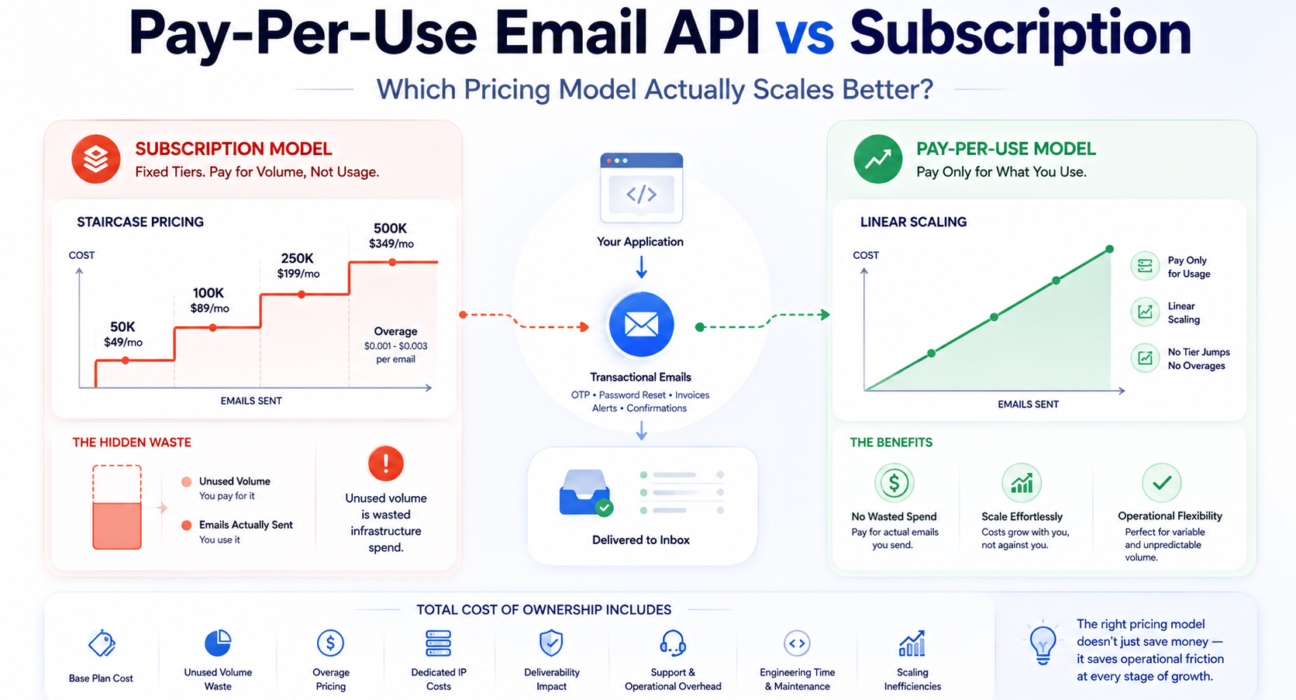
A startup signs up for an email plan at $89 per month for 100,000 emails. They send 12,000. Two months later, a product launch pushes volume to 130,000 — triggering an overage bill, or a forced upgrade to the $199 tier, for a spike they will not repeat for another six months.
This is not an edge case. It is the standard economic experience of SaaS teams that chose an email pricing model based on the cheapest monthly plan rather than their actual usage pattern.
Most teams do not realize they are overpaying for email infrastructure until volume spikes or drops unpredictably — and by then, the billing model is already built into their operational expectations.
This analysis covers every cost category in both pricing models, with realistic scenarios for each stage of growth, so you can make an infrastructure pricing decision based on total cost — not the number on a plan page.

The cheapest email platform is not the one with the lowest monthly plan. It is the one that wastes the least infrastructure spend.
Quick Answer: Pay-Per-Use vs Subscription Email — What Is the Structural Difference?
The structural difference is simple. Everything else — cost efficiency, flexibility, scaling behavior, overpayment risk — follows from it.
- Pay-per-use email APIs charge per email sent. Zero sends in a month means zero infrastructure cost. A volume spike costs more for that month — and returns to baseline when volume normalizes. No tiers, no caps, no overages.
- Subscription email services charge a fixed monthly fee for a defined volume ceiling. Below that ceiling, you have paid for capacity you may not use. Above it, you pay overage rates — typically 3 to 5 times higher per email than the base plan rate — or you are forced to upgrade to the next tier.
| Factor | Pay-Per-Use Email API | Subscription Email Service |
|---|---|---|
| Cost Flexibility | High — scales directly with usage | Low — fixed tiers create a cost floor regardless of volume |
| Overpayment Risk | None — pay for actual sends only | High — unused volume is wasted spend every billing cycle |
| Scaling Efficiency | Linear — cost increases proportionally with volume | Stepped — cost jumps at tier boundaries |
| Predictability | Moderate — variable if volume fluctuates | High at stable volume — predictable monthly expense |
| Startup Fit | High — no minimum cost floor during early stages | Low to moderate — minimum monthly spend regardless of usage |
| Spike Handling | Automatic — no tier changes required | Manual — requires tier upgrade or incurs overage billing |
| Enterprise Fit | Good at high volume — no ceiling risk | Good at predictable, stable high volume |
The core insight: Subscription pricing optimizes for the provider’s revenue predictability. Pay-per-use pricing optimizes for the customer’s cost efficiency. These are structurally different objectives — and the model that best serves the provider is not always the model that best serves you.
What Is a Pay-Per-Use Email API?
A pay-per-use email API bills you based on the number of emails you actually send in a billing period. No monthly minimum, no volume ceiling, no tier structure. Your bill reflects exactly what you used — no more, no less.
This model was designed for the way transactional email actually works in SaaS systems: it is demand-driven, not scheduled. You send 10,000 OTPs per month because 10,000 users triggered an authentication event — not because you planned to. That number is not predictable in advance, especially during growth stages, product launches, or seasonal traffic spikes.
Where pay-per-use works best:
- Startups and early-stage products with unpredictable or growing volume
- Transactional email systems where volume tracks user activity directly
- Developer tools and APIs with variable downstream email generation
- Applications with seasonal traffic peaks — e-commerce, event platforms, education
- Agencies managing multiple client applications with separate billing per project
For a technical overview of what separates purpose-built transactional relay infrastructure from general-purpose email platforms, the transactional email service architecture guide covers the operational differences in detail.
What Is a Subscription Email Service?
A subscription email service charges a fixed monthly fee for a defined volume ceiling — typically structured in tiers (10,000 emails per month, 50,000, 100,000, 500,000). Send 3,000 or 98,000 on a 100,000-email plan — the bill is identical.
Three structural dynamics in subscription pricing are consistently underweighted during initial evaluation:
1. The Volume Floor Problem
Every subscription plan carries a minimum monthly cost that exists independent of usage. For pre-launch products, slow months, or products with genuinely low email volume, this floor is pure infrastructure waste — paying for sending capacity that delivers no user value and no business outcome.
2. Tier Jump Economics
When volume crosses a plan ceiling, the decision is always the same: pay overage rates (typically 3 to 5x the base per-email rate), or upgrade to the next tier and immediately overpay for unused capacity until growth catches up. Neither option is efficient.
Visual model — what a tier jump looks like in practice:
| Month | Emails Sent | Subscription Plan Tier | Emails Paid For | Waste |
|---|---|---|---|---|
| Month 1 | 45,000 | 50,000-email plan | 50,000 | 5,000 unused |
| Month 2 | 51,000 | Forced 100,000-email plan | 100,000 | 49,000 unused |
| Month 3–7 | 55,000–70,000 | 100,000-email plan | 100,000/month | 30,000–45,000 unused per month |
One volume spike forces months of overpayment. This is not an anomaly — it is how tier pricing is designed to work.
3. Bundled Features That Inflate Cost
Higher subscription tiers frequently bundle marketing automation tools, template editors, and dedicated account management — features that are irrelevant to teams whose sole requirement is reliable transactional email delivery. These features inflate plan cost without contributing to the operational outcome you actually need.
Unused email volume is not capacity in reserve. It is recurring overhead that compounds monthly with zero operational return.
Total Cost of Ownership: Every Cost Category Compared
Monthly plan price is one line in the total cost of ownership calculation. Here is the complete picture — and where most teams discover their actual infrastructure spend.
1. Effective Per-Email Rate vs Advertised Rate
A subscription plan advertising $0.001 per email at full utilization is actually costing $0.003 to $0.006 per email when utilization sits at 20 to 40% — which describes most early and mid-stage SaaS products throughout most months.
Example: A startup sending 8,000 emails per month on a 25,000-email plan at $49/month is paying an effective rate of $0.006 per email — 2.4x the advertised rate. On a pay-per-use model at a comparable base rate, those same 8,000 emails cost approximately $16 to $20.
The advertised per-email rate only becomes accurate at full utilization. Most teams are never at full utilization for the majority of their subscription period.
2. Overage Pricing — The Most Expensive Emails You Will Send
Overage rates at major email platforms typically run $0.005 to $0.015 per additional email — frequently 3 to 5x the plan’s effective base rate. The operational problem: volume spikes — product launches, viral growth, seasonal peaks, large onboarding batches — are precisely the moments when you most need reliable delivery at full capacity.
Hitting a volume ceiling during a high-traffic event means overage bills, rate limiting, or forced plan upgrades at the worst possible time. Overage pricing turns growth into a billing penalty.
For context on what infrastructure failures at peak moments actually cost, the email infrastructure failure cost guide covers downstream revenue impact in terms that product and finance teams can evaluate.
3. Dedicated IP Costs
Most subscription base tiers include shared IP infrastructure only. Dedicated IPs — which give you full control over sender reputation and eliminate shared pool contamination — are typically priced as add-ons at $20 to $30 per IP per month, or gated behind premium enterprise tiers.
For SaaS products above 50,000 emails per month, dedicated IPs are an operational requirement. The relationship between IP reputation and email bounce rates is direct — degraded shared IPs raise effective bounce rates across your entire sending volume, creating downstream costs in lost activations and support overhead that never appear on an email invoice.
4. Engineering Maintenance Overhead
Complex email platforms with elaborate dashboard configurations, webhook management, and multi-feature account structures require ongoing engineering time to maintain. At an internal billing rate of $120 per hour, two hours per month of relay configuration, bounce log investigation, and plan management represents $240 in engineering overhead — often exceeding the entire cost of the email plan itself.
A purpose-built SMTP relay service that requires no ongoing platform management reduces this overhead to near zero. The correct cost comparison is plan cost plus engineering overhead — not plan cost alone.
5. Deliverability Impact — The Invisible Invoice
This is the cost category most teams ignore entirely — and often the largest one.
When transactional emails fail to deliver, the cost is not measured in dollars per email. It is measured in:
- Lost user activations from bounced confirmation emails
- Failed logins from OTPs that never arrived
- Support tickets from users who did not receive password resets or invoices
- Churn from users who experienced a broken product flow
The difference between a 0.4% and a 2% bounce rate in a SaaS onboarding flow is the difference between losing 4 users per thousand and losing 20 per thousand at identical traffic levels. A subscription plan that saves $30 per month but runs on poor shared IP infrastructure can cost thousands per month in lost activation revenue from broken onboarding flows.
A cheaper plan with poor deliverability can become the most expensive option operationally.
The email deliverability improvement guide helps quantify what deliverability quality is actually worth in product economics terms.
Total Cost of Ownership Checklist — Before Choosing a Pricing Model:
- Average monthly email volume — and how variable it is month to month
- Effective per-email rate: actual plan cost divided by emails sent, not plan capacity
- Unused capacity waste: (plan ceiling – emails sent) x effective per-email rate
- Overage exposure: maximum monthly spike volume x overage per-email rate
- Dedicated IP add-on fee, if not included in base plan
- Engineering maintenance time: estimated hours per month x internal billing rate
- Deliverability impact: bounce rate above 0.5% x estimated activation value per lost user
The sum of these categories is your true monthly infrastructure cost — not the plan price.
Real-World Scenarios: Which Model Fits Each Growth Stage
Scenario A: Early-Stage Startup — 0 to 15,000 Emails Per Month
Volume is low and inconsistent — 200 emails in week one, 3,000 in week three during a marketing push, 800 in week four. Monthly totals bounce between 2,000 and 12,000 with no predictable pattern.
- Subscription model: Lowest reasonable tier is $25 to $35 per month. In low-volume months, effective utilization is 10 to 30% — the majority of the monthly fee is unused capacity. Over 12 months at average 50% utilization, the team pays for approximately twice the infrastructure they actually needed.
- Pay-per-use model: 5,000 emails per month costs $10 to $15. A slow month costs proportionally less. A 12,000-email month scales proportionally. Total annual cost tracks actual usage rather than plan capacity.
Best fit: Pay-per-use. Eliminates the cost floor and unused capacity waste that subscription plans impose during unpredictable early growth stages.
Scenario B: Growing SaaS Product — 20,000 to 200,000 Emails Per Month
Monthly volume has grown from 20,000 to 80,000 over eight months. Occasional product launches cause spikes to 150,000 to 180,000.
- Subscription model: Starts on a 50,000-email tier at $89/month. By month four, requires the 100,000-email tier at $149/month. Spikes then trigger either overage billing or a jump to a 250,000-email tier at $249/month — covering months of 40% utilization until growth catches up.
- Pay-per-use model: Cost scales linearly with volume. No tier decisions, no overage calculations, no months of paying for unused ceiling capacity. The operational overhead of managing plan transitions does not exist.
Best fit: Pay-per-use during the growth phase. Eliminates tier jump inefficiency and overage penalties during the period when volume is most variable.
Some pay-per-use relay providers — including PhotonConsole — avoid tier ceilings entirely by structuring billing directly around usage, with no plan management required at any volume level.
Scenario C: High-Volume System — 500,000+ Emails Per Month
A mature SaaS product with stable traffic patterns sends 800,000 to 1,000,000 transactional emails per month. Volume variance is below 10% month to month.
- Subscription model case: At high volume with high predictability, negotiated subscription plans can offer competitive per-email rates with fixed monthly billing that simplifies financial planning. Enterprise tiers also typically include dedicated IPs and SLA-backed support.
- Pay-per-use model case: No ceiling risk, no overage exposure, no renegotiation when quarterly growth pushes volume above committed levels. Per-email rates at this volume are typically competitive with subscription enterprise pricing.
Best fit: Depends on volume stability. Extremely predictable high-volume systems may find subscription pricing advantageous for financial planning. Any system with meaningful volume variance — including seasonal patterns, promotional spikes, or continuing growth — favors pay-per-use even at scale.
Cost Scaling — Visual Model:
- Pay-per-use: Linear scaling — cost increases proportionally with every email sent, at every volume level. No ceiling, no penalty, no plan change.
- Subscription: Step-based cost spikes — cost stays flat within a tier, then jumps sharply at tier boundaries, then stays flat again until the next boundary. Growth within a tier is effectively free. Crossing a boundary is immediately expensive.
The practical implication: subscription pricing rewards staying small within a tier and penalizes natural growth. Pay-per-use rewards only actual usage.
Hidden Costs Most Teams Do Not Calculate
Delayed OTP Delivery — A Product Tax on Users
An email platform with overcrowded send queues or inadequate transactional prioritization may deliver OTPs in 15 to 45 seconds instead of under 5. For users on mobile networks, in authentication flows with short session timeouts, or in regions with ISP processing delays, this latency produces failed authentication experiences that appear to users as product unreliability.
If you are seeing email delivery delays in transactional flows, the root cause is almost always queue management and infrastructure prioritization at the relay level — not your application code.
Support Overhead from Delivery Failures
Every bounced signup confirmation, every undelivered password reset, every lost invoice email creates a potential support interaction. At $15 to $25 per support ticket fully loaded, a 1% bounce rate on 50,000 monthly emails generates 500 potential support touchpoints annually — a cost that dwarfs the monthly email plan fee.
If transactional emails are not reaching inboxes at all, the emails sent but not delivered diagnosis guide covers the most common infrastructure-level causes.
The Free Plan Illusion
Free tiers with limits of 100 to 300 emails per day seem cost-efficient until you calculate what they actually impose: sending rate limits that prevent burst sends, no delivery event logging that enables bounce diagnosis, and the most congested shared IP pools in the provider’s network.
Running a production transactional email system on a free plan is not saving money — it is trading invisible deliverability failures for a zero-dollar monthly bill. The SMTP failure diagnosis guide covers the breakdowns most commonly associated with underprovisioned email infrastructure.
Most SaaS teams discover infrastructure waste only after scaling. By then, the cost has already accumulated for months.
When Pay-Per-Use Email APIs Are the Right Choice
Pay-per-use pricing is structurally advantageous for these scenarios:
- Early-stage and pre-revenue startups — no minimum monthly cost floor means infrastructure spend scales from zero with the product
- Products with fluctuating or seasonal email volume — cost automatically adjusts to actual traffic rather than requiring manual plan management at every growth inflection
- Transactional-only email systems — the overhead of a bundled marketing platform is irrelevant and adds cost without adding value
- Developer-built applications and APIs — per-email billing matches the programmatic nature of email generation
- Products experiencing rapid or unpredictable growth — volume trajectory cannot be reliably projected 12 months ahead
The common thread: pay-per-use is optimal whenever the cost of overcommitting to a volume ceiling is greater than the cost of paying per email at the base rate. For most growth-stage SaaS products, this condition applies throughout the first three to five years.
When Subscription Models Still Make Sense
Subscription pricing has genuine advantages in specific conditions. The goal is to choose correctly — not to argue for a predetermined conclusion.
- Extremely stable, high-volume email programs — when you send 800,000+ emails per month with variance below 5%, negotiated subscription pricing can match pay-per-use rates while simplifying financial planning
- Bundled marketing and transactional email needs — if both a marketing automation platform and a transactional relay are genuinely required from one provider, a bundled plan may be more cost-effective than two separate services
- Finance team requirements for fixed monthly billing — in enterprises with strict budget variance requirements, predictable monthly invoicing is sometimes an operational requirement independent of cost efficiency
Outside these conditions — which describe a fairly narrow segment of SaaS businesses — subscription pricing works against the buyer’s interests. Volume floor waste, tier jump economics, and overage penalties are structural features of subscription pricing, not edge cases. They apply to the majority of SaaS products throughout the majority of their growth timeline.
Subscription tiers are designed to be upgraded into. Pay-per-use billing is designed to scale with you.
How PhotonConsole Is Built Around This Problem
PhotonConsole was designed around a specific structural principle: email infrastructure pricing should scale with usage, not against it.
Its SMTP relay operates on a pay-as-you-use model with no monthly minimum, no volume tier commitments, and no overage billing. A slow month costs proportionally less. A product launch volume spike does not trigger an overage invoice or require an emergency plan upgrade.
For SaaS teams where transactional email reliability directly affects activation rates and user experience — OTPs, confirmations, account notifications, billing emails — the pricing model is not the only relevant variable. But a pricing structure that penalizes growth spikes, creates incentives to stay on underprovisioned plans, or bundles features that add cost without operational value introduces infrastructure overhead that compounds over the product lifecycle.
Review the current pricing structure to calculate what your actual sending volume would cost versus your current plan.
A quick calculation worth running: Take your average monthly email volume. Divide your current plan cost by the emails you actually sent (not plan capacity). That is your effective per-email rate. Compare it to a pay-per-use rate at the same volume. The gap between those two numbers is your current monthly infrastructure waste.
Full Cost Comparison Tables
Cost Structure — Pay-Per-Use vs Subscription
| Cost Category | Pay-Per-Use Email API | Subscription Email Service |
|---|---|---|
| Monthly Minimum | None — zero send means zero cost | Fixed — you pay regardless of volume used |
| Unused Volume | No wasted capacity — pay per send only | Wasted spend on unused ceiling capacity every month |
| Volume Spikes | Cost scales linearly — no ceiling, no penalty | Overage rates or forced tier upgrade |
| Growth Transition | Seamless — no plan change required | Tier jumps create temporary overpayment periods |
| Slow Months | Cost drops with volume automatically | Fixed cost continues regardless of reduced usage |
| Dedicated IPs | Typically available on usage-based pricing | Often gated behind premium tier or add-on billing |
| Feature Overhead | Pay for delivery infrastructure only | Higher tiers bundle features that may not add operational value |
| Total Cost Predictability | Variable — tracks actual usage | Fixed within tier — predictable but often not optimal |
Use Case Fit Summary
| Scenario | Pay-Per-Use Fit | Subscription Fit |
|---|---|---|
| Pre-revenue startup | Strong — no cost floor | Poor — minimum spend regardless of revenue |
| Early-stage with variable volume | Strong — cost tracks actual usage | Poor — overpays in low months, penalizes in spike months |
| Growing SaaS (10k to 200k/month) | Strong — no tier management overhead | Moderate — tier jumps create planning friction |
| Seasonal or event-driven volume | Strong — automatic cost scaling | Poor — overcommits on capacity for off-peak periods |
| Stable high-volume (500k+/month) | Good — competitive at scale | Good — negotiated rates become advantageous |
| Marketing + transactional bundled need | Moderate — may require separate tools | Good — bundles both in one billing relationship |
| Fixed-budget enterprise billing | Moderate — variable billing requires forecasting | Good — predictable invoicing simplifies budgeting |
Common Evaluation Mistakes Teams Make
Comparing Advertised Rates Instead of Effective Rates
A plan advertising $0.001 per email at full utilization is costing $0.003 to $0.006 per email when utilization is 20 to 40%. This comparison only becomes accurate when you divide actual plan cost by actual emails sent — not plan capacity.
Not Accounting for Volume Growth in Year One
An email plan that is appropriately priced at launch will likely require a tier upgrade within 6 to 12 months for any product with normal growth. The tier upgrade cost and the overpayment period immediately following it are predictable and calculable — but rarely included in initial infrastructure budgeting.
Evaluating Plans Without Deliverability Quality
A cheaper plan that produces worse inbox placement may generate more lost activations than a more expensive plan with better deliverability. The correct comparison is total cost — infrastructure fee plus deliverability impact — not plan fee alone. The SMTP relay evaluation guide explains how to include deliverability quality in infrastructure selection decisions.
Ignoring the Cost of Choosing the Wrong Provider
Migrating email infrastructure — DNS records, SMTP credentials, domain warmup on the new provider, transition period deliverability risk — has a real cost that depends heavily on integration depth and sending domain count. Teams that choose an initial provider without full evaluation often discover the mismatch during a growth period when migration is most disruptive.
The comparison content on SendGrid vs Mailgun and Mailgun alternatives covers the specific trade-offs teams most frequently encounter during migration decisions. The SMTP configuration guide covers the migration process systematically — but the lowest-cost migration is the one you never have to do.
Frequently Asked Questions
What does pay-per-use email API mean?
A pay-per-use email API charges you based on the number of emails you actually send, with no monthly minimum or volume commitment. You integrate the API into your application, send email, and pay only for the messages delivered. There are no subscription tiers, no unused volume waste, and no overage penalties. Cost scales directly with usage in both directions.
What are the hidden costs of subscription email services?
The main hidden costs are: unused volume waste, overage rates when volume exceeds plan ceilings (typically 3 to 5x the base per-email rate), dedicated IP add-on fees, bundled features in higher tiers that you pay for but do not use, and engineering time spent managing plan transitions. Additionally, deliverability quality differences between plans create downstream costs in lost user activations and support overhead that never appear on an email platform invoice.
What is the best email pricing model for startups?
Pay-per-use pricing is almost always the better fit for startups and early-stage SaaS products. Early volume is low, variable, and unpredictable — exactly the usage pattern that subscription pricing handles worst. A pay-per-use model eliminates the monthly cost floor, scales automatically with product growth, and does not penalize volume spikes with overage billing.
How is SMTP relay pricing typically structured?
SMTP relay pricing comes in three main structures: pay-per-use (per email sent, no minimum), tiered subscription (fixed monthly fee for a volume ceiling), and hybrid models (monthly base fee covering a volume floor, with per-email pricing above it). Total cost of ownership requires evaluating all components — not just the advertised plan price. Review the PhotonConsole pricing for a pay-per-use model without hidden fee layers.
Is pay-as-you-go email more expensive than subscription at scale?
At very high, stable volumes — typically above 500,000 emails per month with less than 10% variance — negotiated subscription pricing can match or slightly undercut pay-per-use rates. Below that threshold, or at any volume with meaningful variance, pay-per-use is typically more cost-efficient when total cost of ownership is fully calculated. The break-even point depends on your specific volume stability and the per-email rates available on each model.
Can I switch from a subscription plan to pay-per-use without disrupting delivery?
Yes, but the migration requires planning. You will need to update SMTP credentials in your application, reconfigure DNS records for the new sending domain if you are changing providers, and allow a warmup period if you are moving to new sending IPs. Run the migration in parallel — keeping the existing provider active while validating delivery on the new infrastructure — before cutting over completely. The SMTP relay selection guide covers the evaluation and transition process in detail.
Conclusion: Infrastructure Pricing Should Scale with Usage
The email platform pricing decision is not a minor operational detail. For SaaS products where transactional email is part of the core user journey — authentication, onboarding, billing, account management — the pricing model determines not just how much you pay, but how your infrastructure behaves during the moments that matter most.
Subscription tiers create cost floors that do not serve products with variable or growing volume. They create overage penalties that hit hardest during product launches and growth spikes. They create tier jump economics that penalize growth at the boundary and reward staying underprovisioned.
Pay-per-use pricing eliminates all of these dynamics. Cost tracks usage. Spikes do not trigger penalties. Slow months cost proportionally less. The infrastructure billing model is aligned with how transactional email actually works in a real product — demand-driven, variable, and tied to user actions rather than planned sending schedules.
Calculate your effective per-email rate on your current plan — actual cost divided by actual emails sent, not plan capacity. Compare it to what that same volume would cost on a pay-per-use model. For most growth-stage SaaS products, the gap in that calculation is the cost of having chosen the wrong pricing model.
Five things to remember from this analysis:
- Subscription tiers optimize for provider revenue predictability, not customer cost efficiency.
- Unused email capacity is not a safety margin. It is recurring overhead.
- Overage pricing punishes growth at the exact moment infrastructure reliability matters most.
- A cheaper plan with poor deliverability is often the most expensive option operationally.
- The cheapest email platform is the one that wastes the least infrastructure spend.
If you are evaluating a pay-as-you-use SMTP relay service purpose-built for transactional email delivery, PhotonConsole is designed around exactly the pricing structure and operational simplicity this analysis describes.
Read More
- Best SMTP relay service evaluation guide
- How to choose the right SMTP relay for transactional email
- How to reduce email bounce rate for SaaS applications
- How to improve email deliverability
- Transactional email service architecture guide
- SPF, DKIM, and DMARC explained simply
- SendGrid vs Mailgun — detailed comparison

Choosing An SMTP Relay: 8 Critical Criteria Developers Must Evaluate | Photonconsole.com
May 9, 2026[…] total cost of ownership analysis for SaaS teams shows exactly where subscription and pay-per-use models diverge as volume […]