

Brevo is a capable marketing platform. Campaigns, automation, a CRM, SMS, landing pages — and transactional email included, which is why a lot of teams end up sending their password resets through it.
That last part is where the trouble starts, and it is not a quality problem. It is a routing problem. On a marketing-first platform your transactional mail shares a sending reputation with your campaigns by default, which means your newsletter gets a vote on whether password resets reach the inbox.
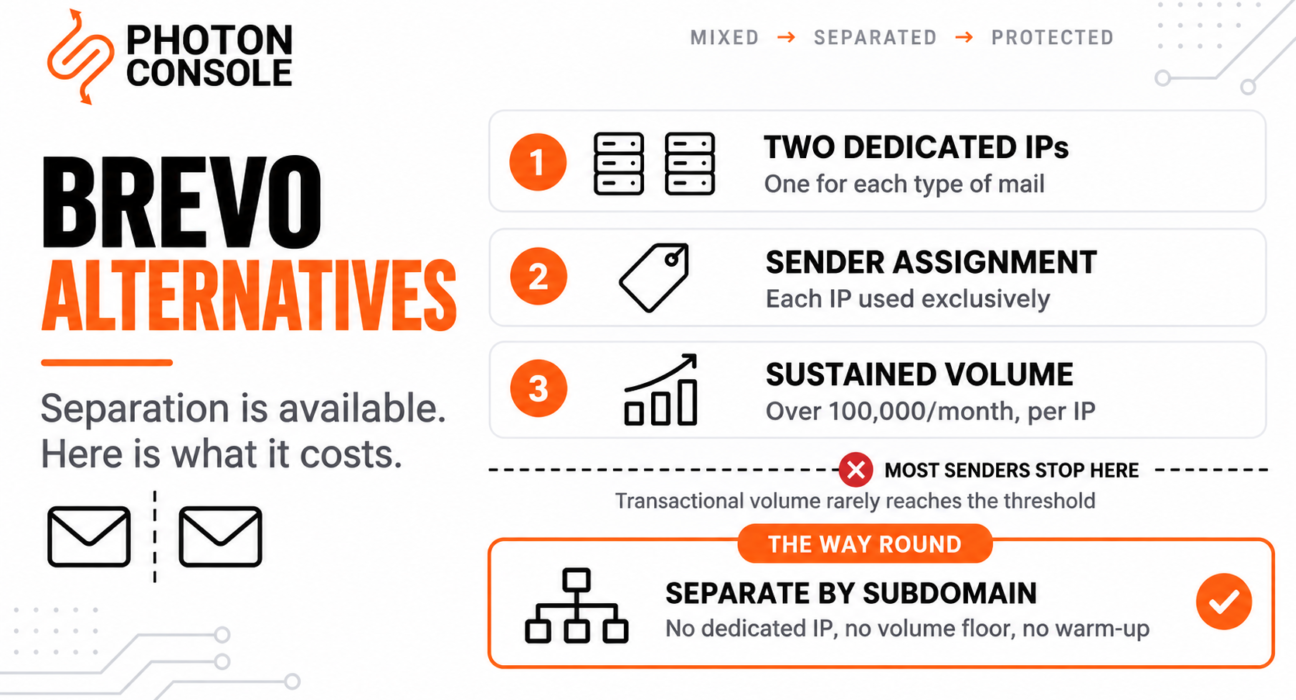
Brevo documents how to separate the two. The interesting part is what that separation actually requires.
Quick Answer: Who Should Stay and Who Should Look
| Your situation | Verdict |
|---|---|
| Marketing is your main use; transactional is occasional | Stay. You are getting a lot of platform for the money |
| You want one tool for campaigns, CRM, SMS and automation | Stay. Few competitors cover that spread |
| Transactional mail is business-critical — resets, OTPs, receipts | Look. Separation is achievable but expensive to reach |
| You send under ~100,000 marketing emails a month | Look — you likely cannot qualify for separated routing at all |
| You are on the Free plan and sending transactional mail | Look now. Every email carries a third-party badge |
| You need delivery logs for disputes or audits | Check retention against your actual dispute window |
The honest split: if you came for marketing and transactional is a bonus, Brevo is fine. If transactional email is load-bearing for your product, the arithmetic below is worth ten minutes.

Marketing-First Means Mixed by Default
Authentication and reputation are shared across everything you send from one identity, which is why mail type matters. A newsletter and a password reset are judged by receivers as the same sender unless you deliberately make them different.
The two kinds of mail behave nothing alike:
- Marketing mail goes to many recipients on your schedule. Some will never open it, some will mark it as spam, and a complaint rate of a tenth of a percent is normal and acceptable.
- Transactional mail goes to one recipient who just asked for it. It is opened almost immediately, almost never reported, and it must arrive within seconds.
Mix them and the marketing signals dominate, because that is where the volume is. Receivers learn that the sending identity is bulk mail, and the transactional messages inherit that classification. Our guide to migrating from Postmark covers the same problem from the other direction, because Postmark is the one major provider that enforces the separation for you as a platform property.
What Brevo Says Separation Requires
Brevo publishes a help article on exactly this, and it is worth reading before you assume the platform handles it. Separate the routing of your transactional and marketing emails describes the method as separating routing “by using different IPs and senders.”
The stated prerequisites are three:
| Requirement | What Brevo documents |
|---|---|
| Dedicated IPs | “An IP pool with at least two dedicated IPs, one for each type of emails” |
| Sender assignment | Each IP assigned to senders “used exclusively for either transactional or marketing emails” |
| Warm-up volume | “A high and consistent volume from each IP to properly warm them up” |
Note what the article does not say. It does not describe separation as automatic, and it does not describe it as a setting. The language throughout is instructional — things you need to have and steps you take. The default state is mixed.
Separate subdomains appear in Brevo’s own example, something like transac.yourdomain.com and marketing.yourdomain.com, though the page stops short of requiring them. That is sound practice regardless of provider.
The Arithmetic That Makes It Unreachable
Here is the part that matters, and it comes entirely from Brevo’s own documentation.
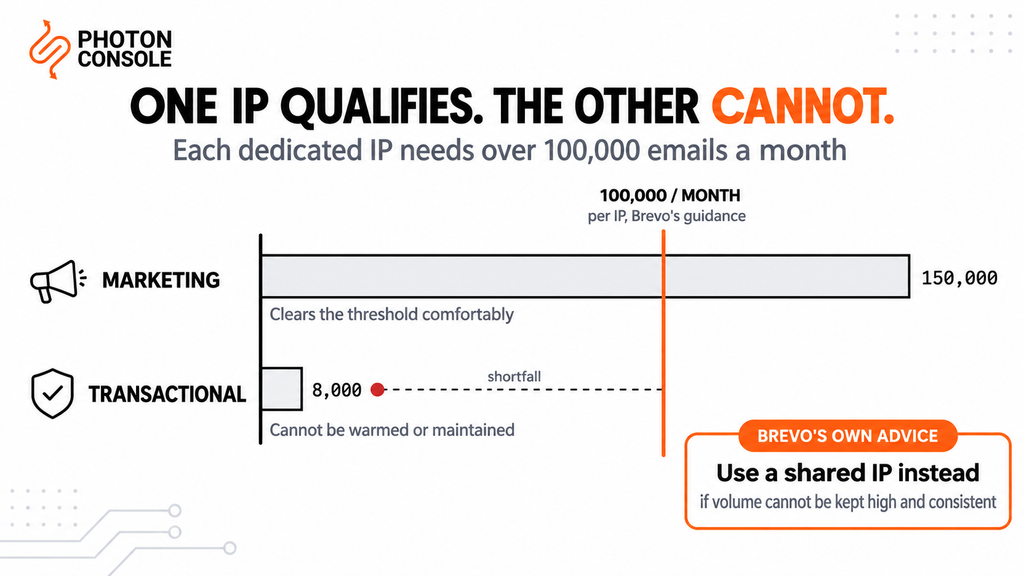
Separation needs two dedicated IPs. Brevo’s best practices for managing a dedicated IP state the volume each one needs: “Send at least three email campaigns per week to 3,000 or more contacts, or over 100,000 emails per month.” It also advises never going more than a week between sends, and says that after 30 days without sending you must rewarm the IP from scratch.
Put those two documents together and the requirement becomes concrete.
# What separated routing on Brevo actually requires

  Transactional dedicated IP   needs  >100,000 emails/month
  Marketing dedicated IP       needs  >100,000 emails/month
                                      ------------------------
  Combined                            >200,000 emails/month
                                      AND split roughly evenly

# Now a realistic SaaS sending profile:

  Marketing   150,000/month   qualifies comfortably
  Transactional 8,000/month   nowhere near the threshold

# The transactional IP cannot be warmed or maintained.
# Brevo's own advice in that case: use a shared IP instead.
That is the trap, and it is a structural one rather than a criticism of the product.
Almost every business sends far more marketing than transactional mail. A company doing 150,000 campaign emails and 8,000 password resets a month has plenty of volume for a marketing IP and nothing like enough for a transactional one. Brevo’s guidance for that situation is explicit: if you cannot keep volume high and consistent, consider a shared IP instead.
So the senders who most need transactional separation are the ones who cannot achieve it. Separation is reserved for high-volume transactional senders, which is a small minority of the accounts that would benefit from it.
Common Mistake
Buying a dedicated IP for transactional mail without checking whether you can feed it. A dedicated IP with low or sporadic volume performs worse than a well-managed shared pool, because a shared IP carries established reputation from aggregate traffic while a cold dedicated IP carries none and builds it slowly. Sending 8,000 emails a month from your own IP means receivers have very little history to judge you by, and every bad week weighs heavily because there is nothing to average it against. Brevo also states that it will not replace an IP whose reputation has been damaged, so a dedicated IP that goes wrong is a problem you own permanently. Check the volume threshold before you buy, not after.
Quick Fix
Do You Actually Have a Separation Problem?
- Check whether transactional and marketing mail leave from the same From domain — if yes, they share reputation
- Compare delivery rates for your resets against your campaigns, segmented by receiving domain
- Look for transactional mail landing in Gmail’s Promotions tab — a direct signal of bulk classification
- Check Google Postmaster Tools for your domain’s spam rate; a campaign spike that moves it affects everything
- Send a reset to a seed inbox immediately after a campaign goes out, and see where it lands
The Free Plan Is Not Viable for Transactional Mail
Worth stating separately, because a lot of small teams start here and do not realise what they have agreed to.
Brevo’s Free plan limits are documented clearly:
| Free plan | Documented value |
|---|---|
| Daily sends | 300 per day; unused sends do not carry over |
| Contacts stored | Up to 100,000 |
| Contacts in active automations | 2,000 unique |
| Branding | Every email carries a “Sent with Brevo” sticker that cannot be removed on this plan |
| Users | One — the account owner only |
| Statistics | Basic only |
| Once the daily cap is hit | Campaigns cannot be scheduled for the next day |
The 300 per day is generous for a free tier — more monthly volume than several competitors offer, including our own free allowance. Credit where it is due.
The branding is the problem. A password reset email carrying another company’s badge is a security-relevant trust signal going the wrong way, and it is exactly the kind of detail that makes a careful user hesitate before clicking. Marketing mail can carry a provider badge without much cost. An account recovery email cannot.
The daily cap compounds it. Transactional volume is driven by your users, not your schedule, so a bad day of signups and resets can exhaust 300 sends before the evening — and unlike a campaign, transactional mail cannot wait until tomorrow. Our breakdown of Brevo’s free plan limits covers what the first paid tier changes.
Where Brevo Is Genuinely the Better Choice
Three things, and they are real.
The free tier is one of the most generous in the category. 300 sends a day is roughly 9,000 a month, which is more than most providers give away and more than PhotonConsole’s free allowance. If free volume is what you are optimising for, Brevo wins and we do not.
Storing 100,000 contacts on a free plan is unusual. Most platforms charge by contact count well before that. For a team building a list before monetising it, that is a material advantage.
The breadth is the actual product. Campaigns, automation, CRM, SMS, landing pages and transactional sending in one place, on one bill, with one login. Assembling that from specialists costs more and takes integration work. If you want one tool rather than four, very few competitors cover the same spread — and none of the transactional specialists come close.
That breadth is also the reason the routing problem exists. A platform built around campaigns treats transactional mail as a feature of a marketing product, which is the correct priority for most of its customers and the wrong one for yours if transactional is what you depend on.
The Alternatives, by the Problem You Have
| Your binding constraint | Where to look | What you trade |
|---|---|---|
| Separation without buying two IPs | Postmark — enforces it as a platform property, no dedicated IP needed | Feature-based tiers, and no provider-side spend cap |
| Cost per email above all | Amazon SES — cheaper than every managed provider, us included | You assemble notifications, suppression and logging yourself |
| Developer experience | Resend — the best API in the category | Thirty-day log retention on every tier below Enterprise |
| Inbound mail routed into your app | Mailgun — a real regex routing engine | Overage charged above the headline rate |
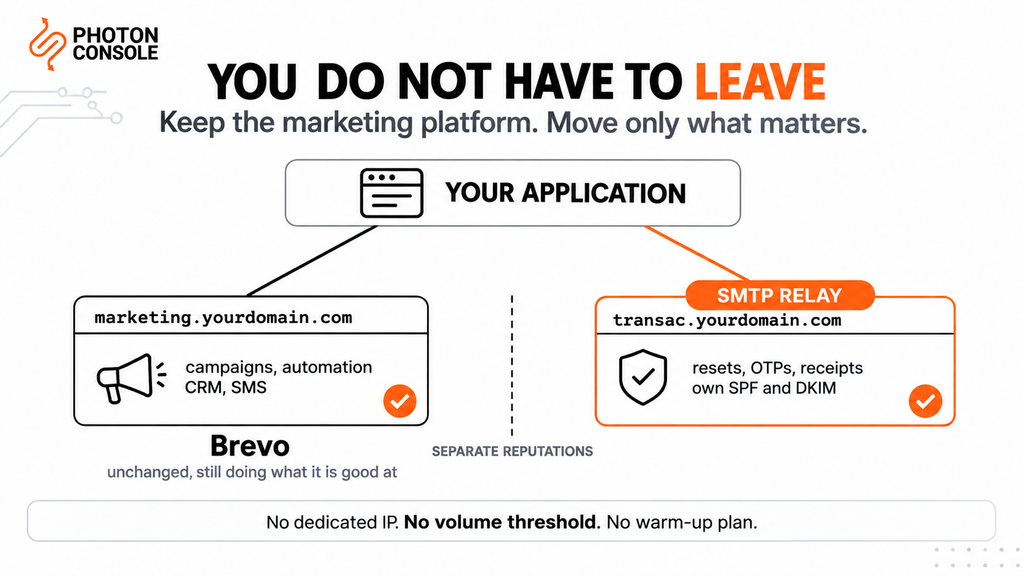
| Keeping your marketing platform | Split the stack — Brevo for campaigns, a relay for transactional | Two bills, two integrations; separation by subdomain, free |
| Predictable flat-rate transactional sending | PhotonConsole — flat per-thousand pricing, no overage premium | Not a marketing platform; no CRM, campaigns or SMS |
That fifth row is the one most readers should consider, and it is worth spelling out because it does not require abandoning anything.
You can keep Brevo for campaigns and route transactional mail through a dedicated relay on a separate subdomain. Separation then comes from the subdomain and the separate sending identity, not from buying two dedicated IPs and finding 200,000 emails a month to feed them. PhotonConsole authenticates a subdomain like transac.yourdomain.com independently, so the split is a DNS exercise rather than a platform upgrade — and the marketing tool you already know keeps doing the thing it is good at.
Two rows work against us and both are accurate. SES is genuinely cheaper per email and will stay that way. Brevo’s own free tier gives more monthly volume than ours. If either is your binding constraint, we are not your answer. The comparison page sets the options side by side.
Checking Separation on Any Provider
Quick Fix
Six Questions Before You Commit
- Is separation the default, a configuration option, or unavailable?
- Does it require a dedicated IP? If yes, at what plan, cost and minimum volume?
- What volume does a dedicated IP need to stay warm, and can your transactional traffic alone supply it?
- Can you authenticate a subdomain independently, so separation costs DNS records rather than IPs?
- Is provider branding added to your emails, and can it be removed at your plan?
- Is the sending cap daily or monthly? Transactional volume follows your users, not your calendar
Note
Question six catches people out more than it should. A monthly quota absorbs a bad day; a daily cap does not. Transactional volume is set by your users rather than your calendar, so a product launch, a press mention or a forced password reset after a security incident can triple a day’s sends with no warning. Marketing mail can wait until tomorrow when a cap is hit, which is why daily limits are a reasonable design for a campaign tool. A password reset that waits until tomorrow is a support ticket, and a receipt that never arrives is a dispute. Check whether the cap you are agreeing to is daily or monthly before you depend on it.
Question four is the one that reframes the whole decision. Separation by subdomain achieves most of what separation by dedicated IP achieves, costs nothing, and has no volume floor. Any provider that supports independent subdomain authentication gives you the architecture without the upgrade.
If You Split the Stack
Moving transactional mail off Brevo while keeping it for campaigns is the lowest-risk version of this change, because nothing about your marketing setup moves.
- Pick a transactional subdomain and publish its own SPF and DKIM records. Count your SPF lookups first — exceeding the ten-term limit in RFC 7208 returns
permerrorand fails authentication for everything you send. - Export suppressions and import them before the first production send, never after.
- Keep marketing and transactional suppression lists separate. A campaign unsubscribe is not a reason to stop sending receipts.
- Move transactional traffic gradually, not in one switch. The method is in our guide to running two email providers during a migration.
- Verify both paths with MXToolbox and Mail Tester before real traffic moves.
Follow the sequence in our guide to migrating email providers without downtime, and work through the migration checklist before cutting over. Because your marketing stays put, this is a smaller job than a full provider migration — the authentication work is the bulk of it.
Pro Tips
- Check the dedicated IP volume threshold before buying one. Over 100,000 a month per IP, by Brevo’s own guidance.
- Separate by subdomain before separating by IP. It is free, it has no volume floor, and it does most of the work.
- Never send transactional mail on a plan that adds provider branding. A badged password reset undermines the trust the email exists to carry.
- Watch for your resets landing in Promotions. That is bulk classification, visible and diagnosable.
- Treat a daily cap as a transactional risk. Your users decide your volume, and they do not know about your quota.
- Keep the two suppression lists apart. Flattening them lets an unsubscribe block a receipt.
- If you keep Brevo for marketing, say so in the architecture. Splitting the stack is a legitimate design, not a failed migration.
Related Reading
- Brevo free plan limits — what the free tier gives and what the first paid tier changes
- Migrating from Postmark — the provider that enforces separation, and what happens when you lose it
- Resend alternatives — if developer experience is your priority
- Amazon SES sending limits — the cheapest option, and what it asks in return
- SPF, DKIM and DMARC explained simply — authenticating a transactional subdomain
- Email provider migration checklist — the 40 checks before you switch
Frequently Asked Questions
Does Brevo separate transactional and marketing email automatically?
No. Brevo’s documentation describes separation as something you configure, requiring an IP pool with at least two dedicated IPs, one assigned to transactional senders and one to marketing senders.
What volume do I need for a dedicated IP on Brevo?
Brevo recommends at least three campaigns a week to 3,000 or more contacts, or over 100,000 emails a month, per IP. Separated routing needs two IPs, so roughly 200,000 a month in total.
Why can’t most businesses separate transactional mail on Brevo?
Because transactional volume is usually a fraction of marketing volume. A company sending 150,000 campaign emails and 8,000 transactional ones cannot keep a transactional dedicated IP warm, and Brevo’s own advice in that case is to use a shared IP.
Can I use Brevo’s free plan for transactional email?
It is not advisable. Every email on the Free plan carries a “Sent with Brevo” sticker that cannot be removed, which is a poor trust signal on a password reset, and the 300-per-day cap does not flex with user-driven volume.
Is a dedicated IP always better than a shared one?
No. A dedicated IP with low or sporadic volume performs worse than a well-managed shared pool, because it carries no established reputation and builds it slowly. Brevo also states it will not replace an IP whose reputation has been damaged.
How do I separate transactional mail without buying dedicated IPs?
Send it from its own subdomain with its own SPF and DKIM records, through a provider that authenticates subdomains independently. That gives separate sending identities at no cost and with no volume floor.
Can I keep Brevo for marketing and move only transactional email?
Yes, and for most teams this is the lowest-risk option. Your campaigns and automation stay where they are; only transactional sending moves, onto its own subdomain.
What is the cheapest alternative to Brevo for transactional email?
Amazon SES is cheaper per email than every managed provider. The trade is that you assemble the surrounding infrastructure — notifications, suppression and logging — yourself.
Does Brevo’s free plan really store 100,000 contacts?
Yes, with up to 2,000 unique contacts allowed into active automations. It is one of the more generous free allowances in the category.
Conclusion
Brevo is a good marketing platform with transactional email attached, and the distinction matters more than it sounds.
Separation of transactional from marketing mail is available, documented and real — but reaching it requires two dedicated IPs, each needing over 100,000 emails a month to stay warm by Brevo’s own guidance. Most businesses have the marketing volume for one and nowhere near the transactional volume for the other, which puts separated routing out of reach for exactly the senders who would benefit most. That is a structural consequence of the arithmetic, not a flaw anyone chose.
So the decision is simpler than a full provider comparison. If transactional email is incidental to your business, stay — the free tier is generous, the contact allowance is unusual, and the breadth is genuinely hard to replace. If password resets, OTPs and receipts are load-bearing, separate them, and do it by subdomain rather than by buying IPs you cannot feed.
The version most teams should consider is not a migration at all. Keep Brevo for campaigns, route transactional mail through a reliable SMTP relay on its own subdomain, and let each tool do the thing it was built for. That costs two integrations and buys you a separation that needs no volume threshold, no dedicated IP, and no warm-up plan.